Showing posts with label Apple II. Show all posts

Tuesday, June 4, 2024

Sword of Kadash (1985)


Sword of Kadash is an early action RPG, created by Chris Cole and one of the very first releases from Dynamix. Dynamix was behind many classic games such as Project: Firestart, MechWarrior, Stellar 7, the Aces war simulation series, Red Baron, and Rise of the Dragon, among numerous others. Almost none of their games are fantasy-themed, however, so Dynamix likely won't be coming up again here.

Like many PC games of the time, it has an arcade sensibility, similar to something like Berzerk, but with just a bit extra to hopefully interest players beyond recognizing algorithms and honing reflexes. The player controls the hero from a top-down view, attempting to navigate a huge maze one screen at a time. The player can pick up different weapons but despite whatever the weapons are identified as, the combat always takes the form of firing arrows across the screen at enemies. Among the threats you face are various types of wildlife, the undead, orcs, and a liche, among others.
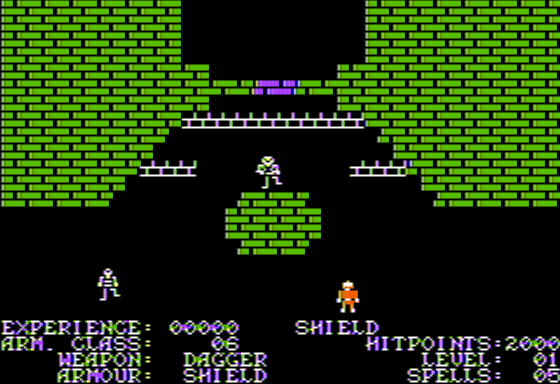


The maze is always the same, but it's full of devious traps beyond the creatures inhabiting it, so progress is best made by mapping or memorizing the layout and noting how the traps work and which items are safe to pick up, so the player can gradually work out the most efficient path through. It's a tough but engrossing game.

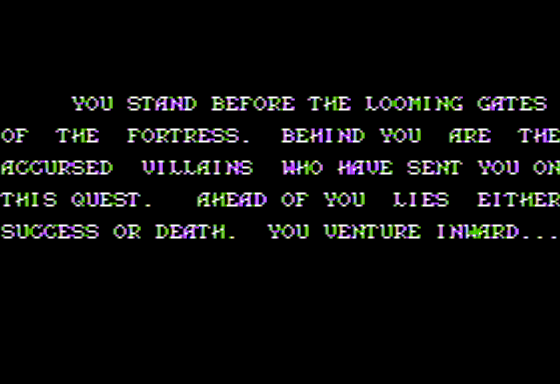
The story explained in the manual is that your character is a merchant traveling to Persia to do business, but your guide sneaks off with all your merchandise and provisions, leaving you to die in the desert. Fortunately (?) a band of brigands appears and takes you captive. The leader forces you to enter the Fortress of the Dragon to recover the fabled Sword of Kadash or die trying. You're sent in with "a dagger, a shield, and your natural charm." Assuming you actually succeed, your now hardened hero emerges with the sword with the intent on turning it against the brigands instead of peacefully handing it over.


Cole told the CRPG Addict that he envisioned the game as having more a high fantasy theme, but that the publishers forced the Middle Eastern/historical fantasy theme on him late in development. It's possible a high fantasy theme may have improved sales - this was the mid-80s, when things were shifting toward epics - but for the purposes of this blog, the game's final theme is actually much more in line with classic sword-and-sorcery. A lone adventurer exploring a haunted fortress in the middle of the Persian desert and dealing with brigands sounds like the kind of premise Robert E. Howard could have used for a yarn featuring Conan, El Borak, or maybe Cormac Fitzgeoffrey. 


[Apologies for very slow upload pace in recent months. Real life concerns have been incessant, but there's no lack of things to talk about.]

Friday, June 3, 2022

COVER ART: The Demon's Forge (1981)


Someone at Saber Software must have been a fan of Vicente Segrelles's El Mercenario because aside from a general fantasy theme this art doesn't have much to do with the story of Demon's Forge, Brian Fargo's first game. But if there's one thing bands like Molly Hatchet and Cirith Ungol taught us, it's that it never hurts to just use classic fantasy art instead of commissioning something new.

Thursday, February 3, 2022

Conan: Hall of Volta (1984)


Obviously for a blog of this nature, the various officially licensed Conan games are going to be of particular interest. As near as I can tell, this release from Datasoft was the first Conan game to be released, although it really isn't much of a Conan game after all. It was originally designed by Eric Robinson and Eric Parker for the Apple II and then ported to other 8-bit systems such as the Atari 400/800 and the Commodore 64.

One of Datasoft's early distinguishing features was that they were enthusiastic about licensed games. Starting in 1984, the company released games based on Bruce Lee, The Goonies, Zorro, the Dallas TV series, and The Neverending Story, and with the exceptions of Dallas Quest and Neverending Story these games were all platforming action games with a certain amount of puzzle-solving. 

In Conan, you control the alleged barbarian as he must traverse a castle divided into seven levels to defeat an evil wizard. Killing a wizard is a classic go-to move for sword-and-sorcery stories, so in that sense the game is more or less on-brand. Where it starts getting hazy is that Conan is occasionally aided by a friendly bird, which was never a feature in any of Robert E. Howard's stories, and instead of using a standard weapon, Conan throws swords that loop back to him like boomerangs.

Conan runs at a pretty fast clip, he can safely fall any distance, and he takes long somersaulting leaps, and passing levels generally requires that the player master Conan's jumping ability to avoid falling into lethal hazards like lava pits or beds of spikes. Swords can be thrown to fend off enemies such as bats or giant bugs, and keys and gems need to be collected to unlock doors or operate certain mechanisms. 

The game is actually not bad at all. The controls can be unpredictable in that Conan sometimes gets caught on ledges in odd ways or they won't respond as quickly as modern players are accustomed to, but each level has a distinguishing feature. In level 3, for instance, you have to make use of portals that teleport you to a different floor to get a gem, which you place on an altar to create giant air bubbles from a lava pit, which you ride on to rise high enough to jump into a hole that takes you to the next level. It's a challenge to get through all seven levels but not an insurmountable one.

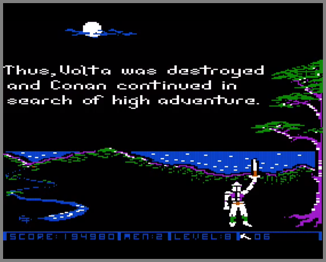
The reward for defeating Volta is a congratulatory screen that says Conan "continued in search of high adventure," but the character depicted on the screen, wearing full armor and helmet, doesn't resemble any popular depiction of Conan, even if Conan did occasionally dress that way in Howard's stories. Later revisions of the game replaced this figure with something closer to the classic Conan image. The reason for this, along with other departures from Conan's, uh, canon is because the game allegedly began as an unrelated game called Visigoth that was retitled and slightly modified to be a Conan game after Datasoft secured the license as a tie-in with Conan the Destroyer. Not uncommon for the gaming industry but this unserious approach has persistently dogged Conan as a property. 

Source: Digital Press


SKALD: Against the Black Priory (2024)

  SKALD: Against the Black Priory is a Kickstarted RPG by Anders Laurindsen that hearkens back to classic PC RPGs, particularly those for t...