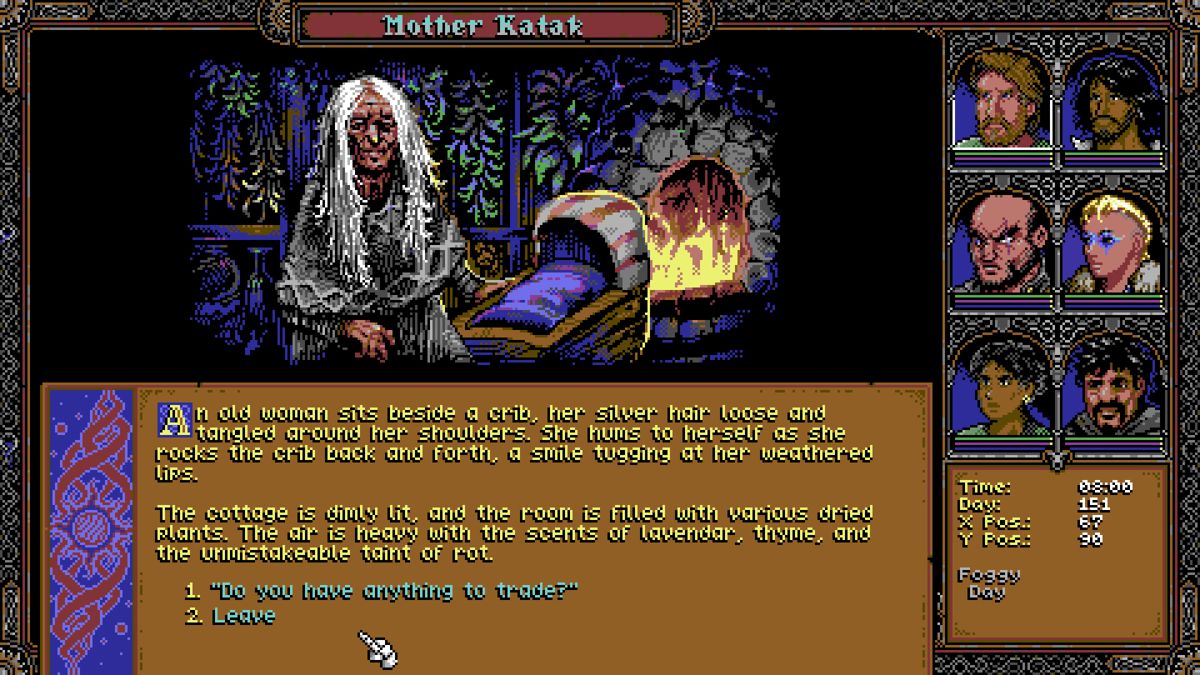
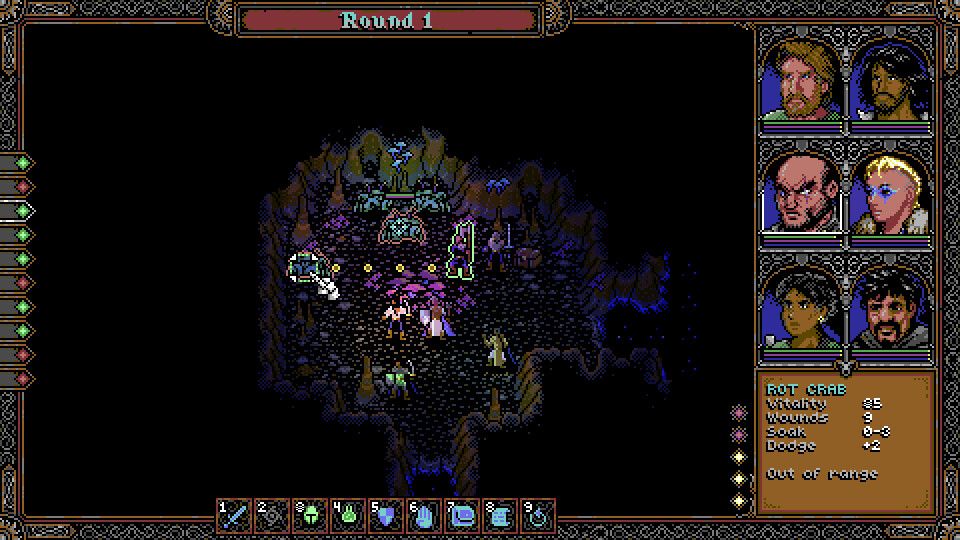
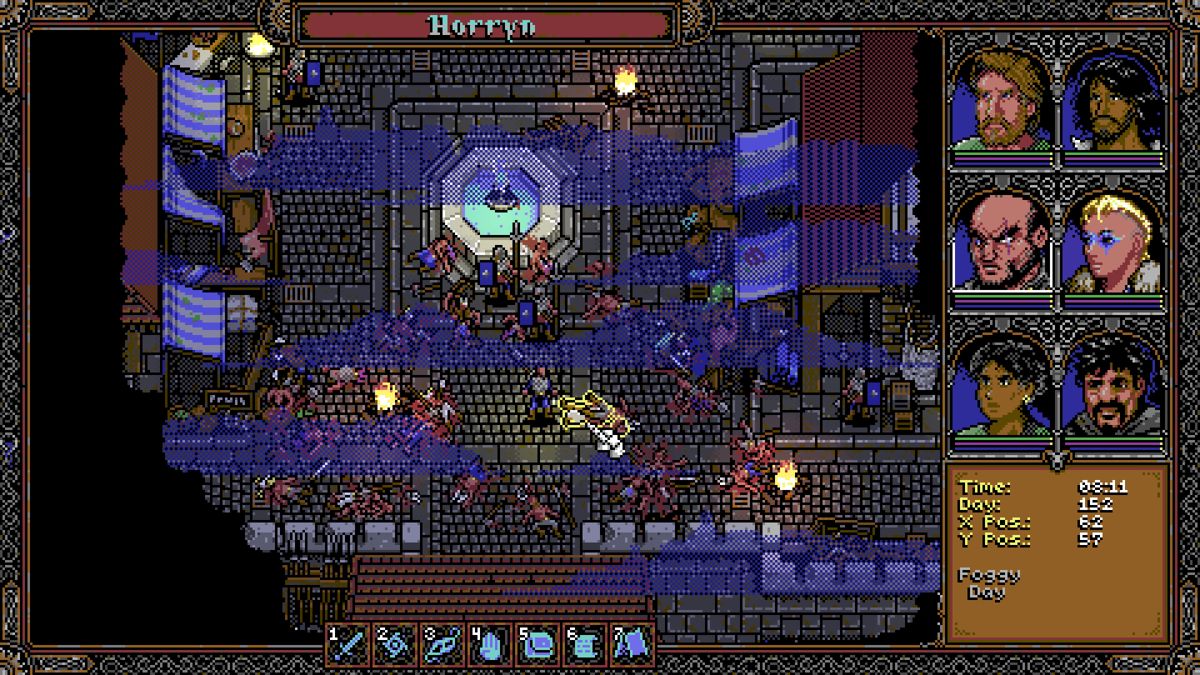
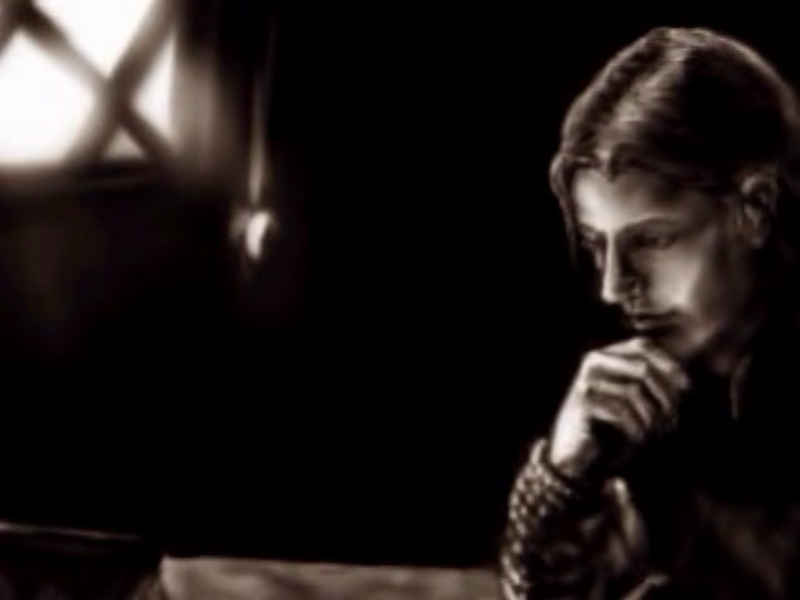
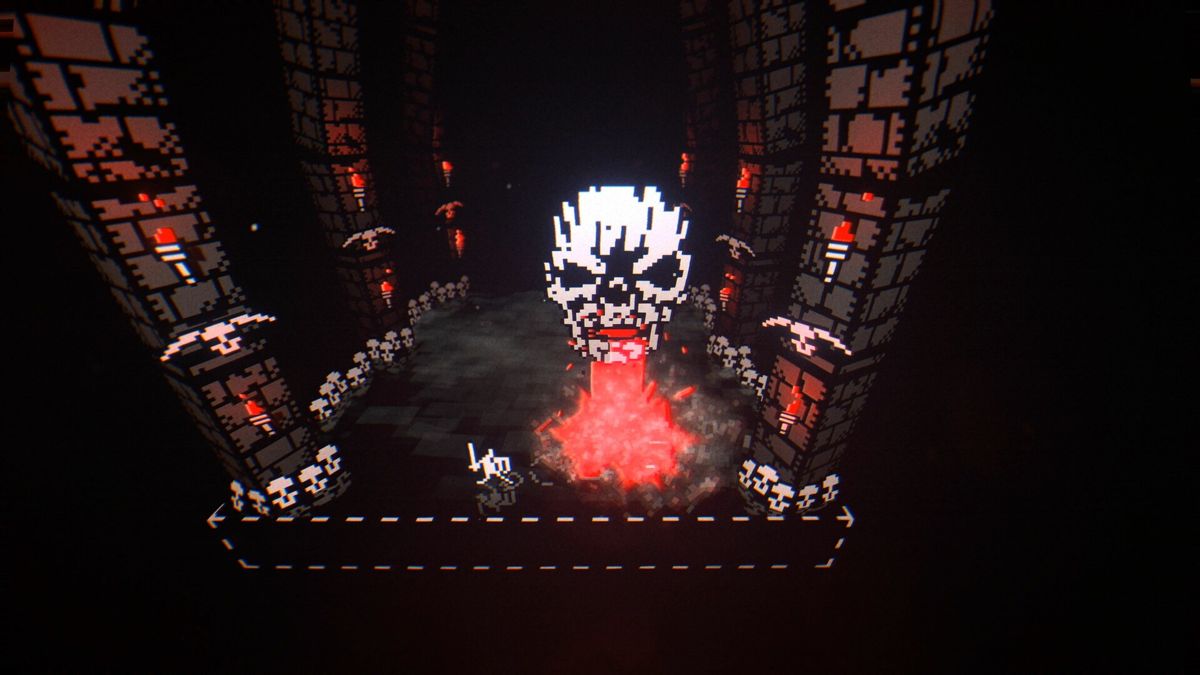
SKALD: Against the Black Priory is a Kickstarted RPG by Anders Laurindsen that hearkens back to classic PC RPGs, particularly those for the Commodore 64, but adds in a much darker mood that leans heavily on Lovecraftian horror.
The game has a strong story focus. You create your own hero, but once you set out the game will generally progress in the same way, with only minor differences depending on how you resolve subplots and which skill checks you pass or fail. The opening sees you on a ship sailing to "the Outer Isles" when suddenly the boat is attacked by a leviathan of the deep. The game then flashes back to a calm scene of you being summoned to a lord's court, where you're given a mission to find the lord's daughter, a magically-touched woman, who happens to have been a childhood friend of yours, who has vanished on the trip to the Outer Isles. The game then flashes forward to the present of you waking up on a beach. You set about your mission, finding equipment and companions to help you along the way.
The party members are pre-generated characters such as Kat the thief, but you can also hire mercenaries and these you can customize to your liking. The party members will occasionally contribute to the story, offering exposition or simply their opinions on what's happening, but thankfully this is no blockbuster RPG in which people engage you in lengthy conversations for the purpose of starting a romance or requiring you to be a psychiatrist and helping them with their particular hang-ups. The writing is bent on furthering the game's dark atmosphere but still relatively restrained, without huge reams of text dumped on the player. The only place it really falls down is in providing worldbuilding details (e.g., magic system stuff) that feel awkwardly inserted and are arguably extraneous. Laurindsen is also clearly a fan of the movie Aliens and doesn't mind throwing a reference in the dialogue here and there.
Beyond the tentacle monster ripping your ship in half at the opening, shortly after washing up on the beach you'll be exploring caves full of giant man-eating crabs - you can tell they eat men because the gory remains are all over the place. You learn that the major town on the island literally went crazy one night as good citizens began slaughtering their neighbors and formed a cult of human sacrifice. Refugees who managed to escape are dying from a grotesque disease that causes writhing things to grow in their bellies. Even a mid-game episode involving a trip to an idyllic town, where you run fetch quests to help happy residents prepare for their yearly festival, devolves into a Robert W. Chambers-influenced nightmare. With the leviathan still patrolling the deep waters around the islands, the characters have no option to simply leave. The game feels like a tight corridor you're being herded down and the sense of doom gets thicker the closer you get to the end. The ending isn't very happy.
It's a fun game to play, though. The restrained completion time is always welcome compared to the bloat of so many modern RPGs, and the nasty tone is unlike most modern RPGs, which often can't resist self-aware humor or nonsensical worldbuilding. Such a local-level story, based on simply finding a missing person, is particularly rare in video games, as even most sword-and-sorcery-influenced games still incorporate dark lords or battles for the fate of the world, trying to make the low and high sides of the fantasy genre play nice with each other. The game feels like playing a very horror-heavy Dungeons & Dragons module, and Laurindsen's experience as a DM for his own table-top games comes through.
The combat system is a bit rigid at first (no diagonal melee attacks), but it's easy to get to grips with it, and the C64-like graphics lend a sense of grit and darkness to the game, the only major downside being that they're so detailed that it's easy to miss important things unless you hold the shift key to highlight interactive objects.
No sorcery in this one, just sword, but a lot of classic S&S does have a strong historical element. And even as history-minded as this game is, it does brush up against a sense of weirdness in a couple of spots.
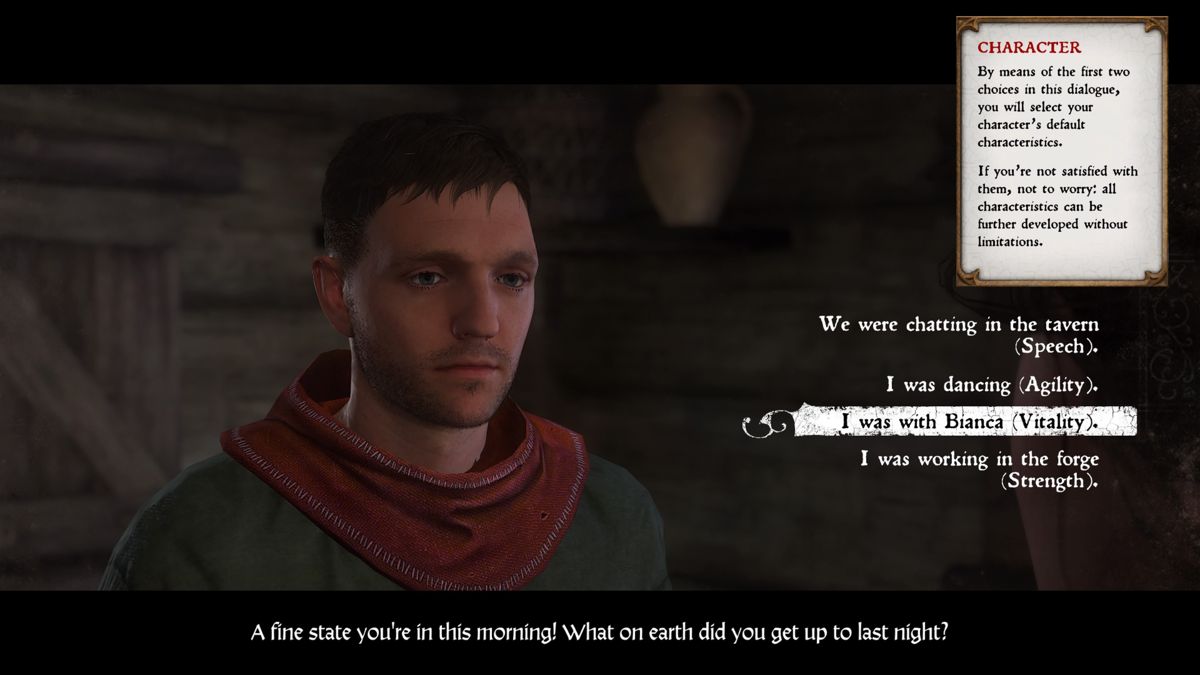
Kingdom Come: Deliverance was Kickstarted in 2014, released in 2018. The player takes control of Henry of Skalitz, the son of a blacksmith living in a Bohemian village in 1403. The king, Wenceslaus IV, is a bit of a disappointment compared to his father, Charles IV, who presided over a golden age for the country. In response to Wenceslaus's frivolous ways, his half-brother Sigismund leads an invasion of the country to presumably sort things out. What this means for humble citizens like Henry is that his village, a valuable silver-mining center, is sacked by Cuman mercenaries who take liberties with the locals in the process, including killing Henry's parents. Just before the invasion, Henry's father had forged an exceptional sword for the local lord, Sir Divish, and in the early portion of the game the sword is stolen by the villains, so Henry's quest becomes to recover the sword while taking revenge for his parents and village. Henry will become a knight in Sir Divish's service and will travel across a region that includes the towns of Sasau and Rattay.
The game is a first-person RPG, built on the CryEngine, with very good graphics that emphasize realism over art direction and mood. Henry has basic needs for sleep and sustenance that have to be monitored, although they aren't too difficult to maintain. Injuries have to be looked after. Not bathing or taking care of your clothes and armor will draw insults from other characters. The fighting system involves having to practice to level up strength and skills so Henry will have more endurance and ability to parry, strike, and counter attacks. The combat system is interesting but disappointingly falls down in major battles where Henry is part of larger forces clashing. It simply becomes a mess of men flailing at each other and the most effective technique is probably to just run behind the enemy shield wall and start backstabbing people while your fellows keep them occupied in front. Not exactly the blood and thunder one would hope for in such situations.
KCD had to be crowdfunded because historical games, especially ones in as obscure a setting as medieval Bohemia that require a hefty budget, terrify game publishers that would greatly prefer to stick to tried-and-true settings like Tolkienesque/D&D-flavored fantasy or space marine-centric sci-fi. As much as possible, KCD is based on real places and events, peppers its story with several actual historical figures, and generally tries to present its setting with as much accuracy as a video game could reasonably allow. A writer like Harold Lamb might have found it interesting. Accessing the game menus will allow the player to read brief encyclopedia entries on medieval society, enough that playing the game will give players an elementary-level foundation of Bohemian history. The game also is generally even-handed in how it depicts its setting, eschewing Monty Python-like images of cruel nobles mercilessly beating idiotic peasants covered in mud and excrement. Instead there's a range of personalities shown, with nuanced examples of people all along the social strata. Some lords are entitled brats but others are serious-minded and dedicated to their duties on behalf of subjects, while peasants might be hardworking, lazy, or opportunistic depending on their minds and circumstances.
The story is linear but the player is free to define Henry however they like. He can be a selfless do-gooder or a complete psychopath or likely somewhere in between. He can specialize in fighting (and particular weapons) or have a silver tongue or be a stealthy type. The game is open enough to different playstyles that there are usually multiple valid ways to overcome situations. Come across a bandit camp and don't think you're strong enough to simply walk in and massacre everyone? Perhaps try waiting until midnight and then sneak into the camp so you can take out watchmen silently in the dark and then murder the others in their beds. Or slip poison into their food and let it do its work.
Even at his strongest, Henry isn't a cartoon hero. Travel on the roads can be very tense, especially in the earlygoing, as Henry can run into highwaymen, stray bands of Cuman raiders, or be baited into traps by people claiming to be in distress. Henry's odds of winning a fight drop significantly with each extra man added on the other side - one-on-one isn't too bad; one-on-two is doable; against three, four, or especially five, though, and he might be in real peril and simply trying to escape or even surrendering might be the best play.
As mentioned above, the game does touch briefly on more fantastic aspects in two notable sections. First, there's a sidequest that can only be completed if Henry is able to access a cabinet of forbidden books in the Sasau monastery's library. The particular book he needs is Lovecraft's Necronomicon, although somewhat disappointingly, the presentation of the book is a bit drier than might be anticipated. Nothing about its authorship by Abdul Alhazred, and even looking over its pages makes it seem like nothing more than just another book, albeit slightly more esoteric than some. But at least it's something, and the lighter touch in how it's presented is probably more in the spirit of classic S&S than the overkill most games go for.
The other episode is a somewhat more standard one in which Henry is tasked with uncovering witchcraft in one of the villages. His investigations will take him to a secluded woodland spot where some of the women are trying to commune with Satan by using psychedelic drugs, and, after confronting them, when they smear the drug on Henry's face he starts hallucinating, seeing men with the heads of beasts.
KCD ends on a bit of a cliffhanger, but the sequel has yet to appear despite the game turning out to be an unexpectedly big hit. Considering how actual history went and the allegiances of the main characters in this game, it doesn't look good for Henry and his friends having a triumphant ending, but perhaps he will slip through the cracks and land on his feet somehow.
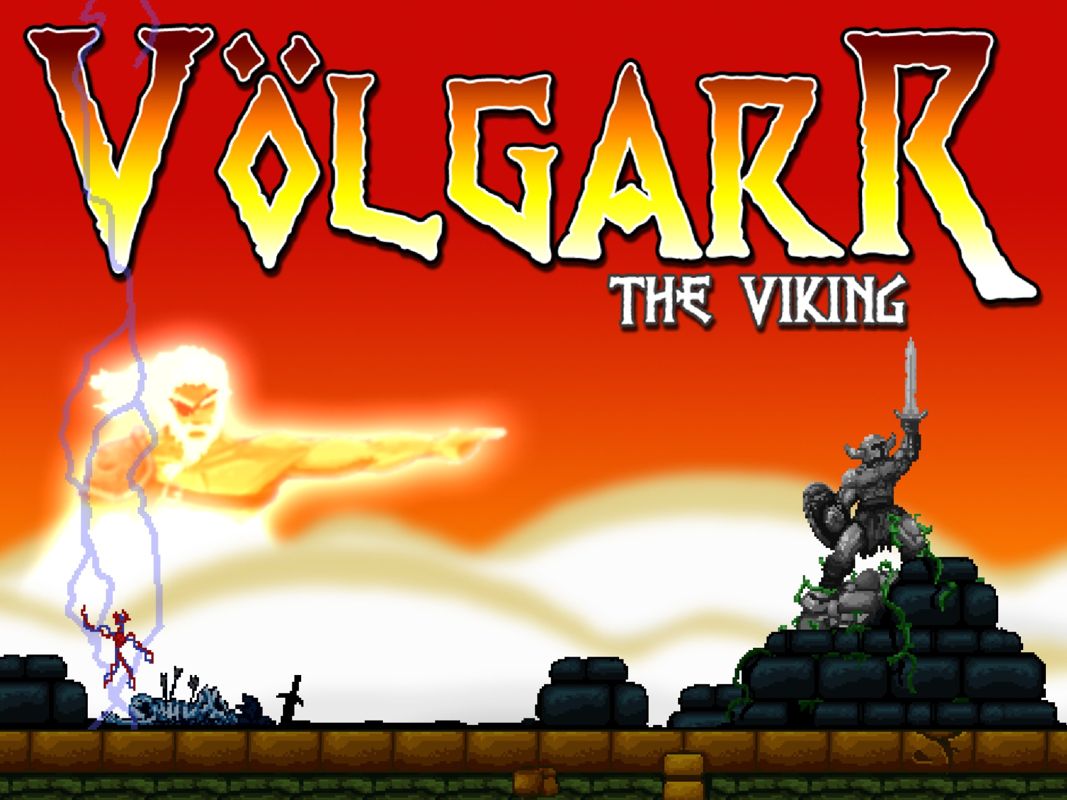
Volgarr the Viking was one of the old Kickstarter success stories, a throwback to Rastan intended to be particularly challenging and gameplay-heavy. "A game with no real challenge is like a cheeseburger with no meat...We're here to put the meat back in the cheeseburger!" the creators, Crazy Viking Studios, said, and they meant it. Volgarr the Viking is a tough game that demands practice and memorization of the best ways to overcome difficult parts.
Being a viking, Volgarr is resurrected by Odin and sent out to fight whatever happens to be in front of him. That's about the extent of the story, although there are multiple endings based on how you play and the endings reveal certain things, such as how Fafnir the Dwarf was transformed into a dragon. The creators weren't kidding when they talked about a "time when games were about the game, not about the cutscenes or cinematic presentation."
The pixel art isn't a lush knockout on the level of Henk Nieborg's work or the Metal Slug games, but it's solid enough and the graphics are very clear, with characters easy to distinguish from backgrounds at all times, which matters in a challenging gameplay-first game. Despite the Norse theme of the game, Volgarr will cut his way through a variety of Lovecraftian fishmen and lizardmen and other giant bugs and sea creatures.
The music is deliberately non-retro and features stirring compositions by Kochun Hu that stand up well to anything short of Basil Pouledoris's Conan the Barbarian score. There are many sword-and-sorcery B-movies that wish they had music as good as this game does.
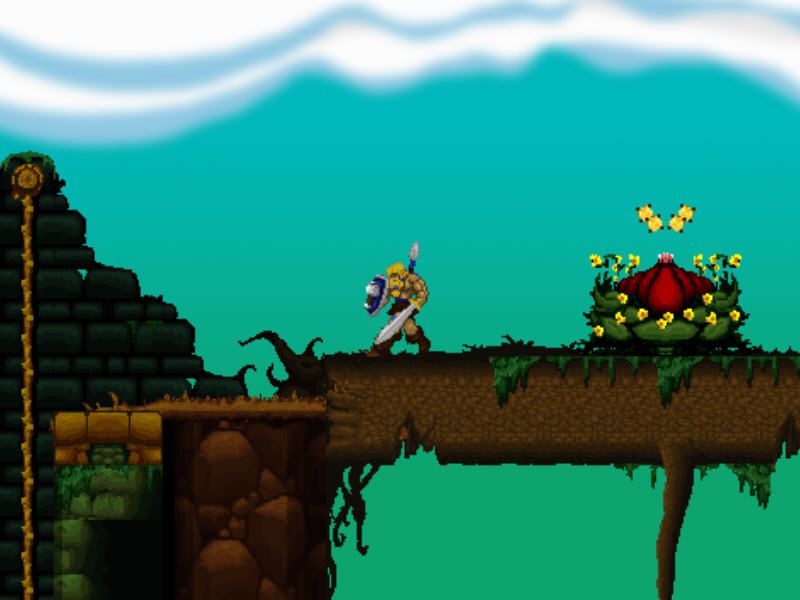
To get into the details of how it plays, Volgarr can swing his sword and also throw spears that when thrown into walls also serve as platforms for him to jump on to reach high places. He can move while attacking with the sword but must stop in place to throw a spear. He can also double-jump in midair and stab downward while falling. Similar to Rastan but with a few extra wrinkles thrown in and making progress mostly means knowing which sequence of moves to make in particular situations. Volgarr also has various layers of protection. Get hit once and he'll lose his helmet, get hit again and he'll die. His shield can block attacks but it will break unless a reinforced version of the shield is picked up.
Unlike a lot of modern games, Volgarr doesn't feature liberal use of checkpoints or saving, so if someone plans to get good at the game, they'll do best to carve out some decent time for the game and be willing to die and retry many times until they master just a single level, never mind the whole game. And then even more so if someone wants to get the best possible ending.
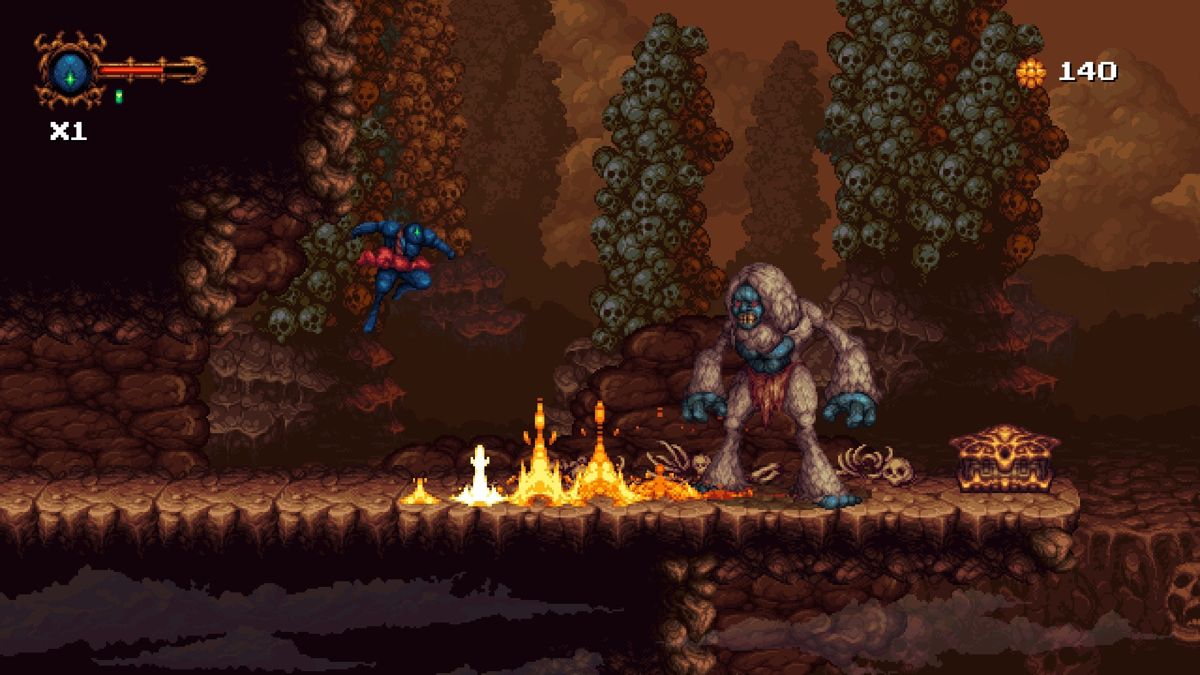
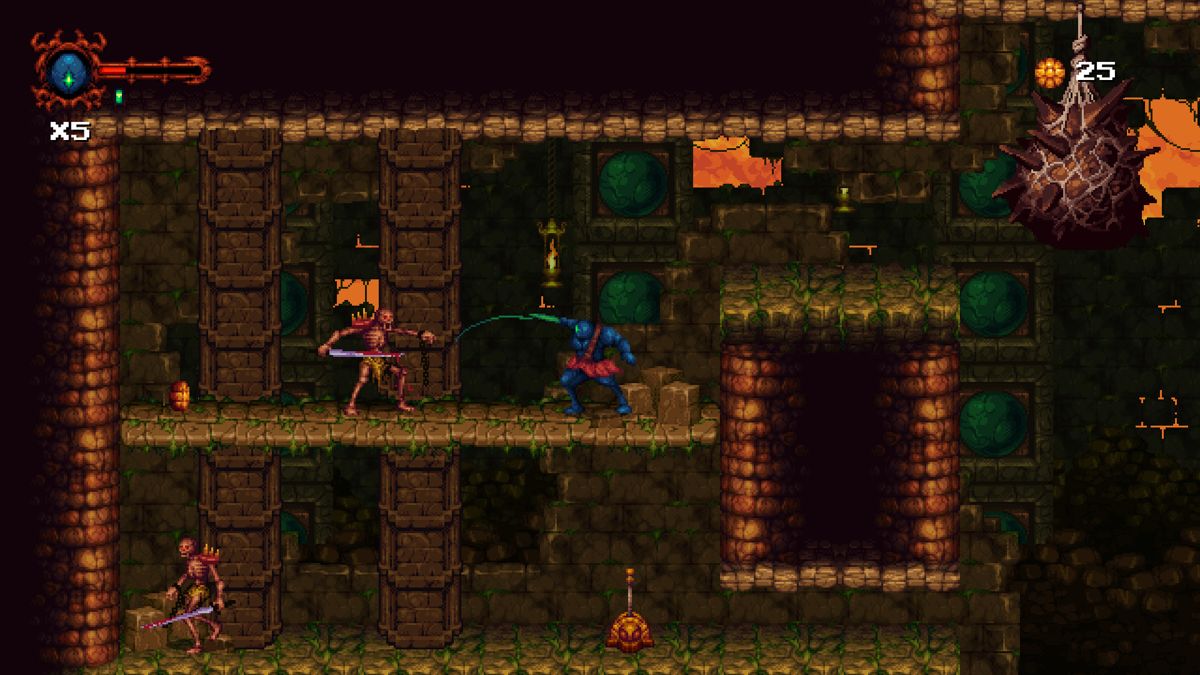
In Primal Light, you control "Krog, a mysterious blue creature in a red loincloth, as he traverses a labyrinth of ladders, levers, traps, and monsters." The game was created by Fat Gem, a studio that appears to be comprised of two people, Jeff Nixon and Shane Sicienski. Krog specifically is a humanoid who seems to have a carapace-like skin and glowing green cross where a person's face would be. The use of a non-human protagonist is a bit reminiscent of some of the protagonists seen in the stories of Schuyler Hernstrom and other writers that like to go for a more exotic, off-Earth feel in their characters and settings.
There's barely any story in Primal Light. Krog, like many before him, comes home to find his village devastated and the few survivors implore him to go forth and destroy the "dark god" responsible. So Krog heads out, runs and jumps through 10 levels with difficult boss enemies at the end of each, and then comes home to a simple congratulatory image if he succeeds. It's not a game to be played by people who look to video games for their stories.
It is a game that can be enjoyed by people who like to be challenged, because even on easy mode Primal Light is quite difficult. Like the "Nintendo hard" games of the past, much of the challenge comes from enemies being placed in such a way as to knock Krog off course during jumps, sending him falling to an instant death. The level bosses can also be tough, with fast-moving and complicated patterns that have very tight margins for evading harm. The game does allow Krog to replenish some health a limited number of times per life, and currency picked up throughout levels can be used to buy extra lives. The game is also generous with the number of lives you start with and in allowing continues. The game will occasionally have a fork in the path through a level, with the alternate route featuring a challenge section ending with a power-up that can give Krog an extra edge in the game, but at minimum Krog will learn several techniques like double-jumping and mid-air dashing that will make him more mobile but also will be needed to overcome platforming sequences. That said, Krog's only attack throughout the game is to slash with his sword.
The game has some really pretty high-resolution pixel art and nice music, and it controls well enough that you usually will blame yourself for failing more than the game. It would have been nice if Krog had the ability to look up or especially down to cut down on the number of blind jumps that occasionally crop up. Although you can usually make a good guess as to where the floor is going to be, the ability to confirm it would be even better. Overall, it's a good game, worth checking if you're into this type of rush'n'attack and platforming challenge, and its grim, alien setting sets it apart from many games.
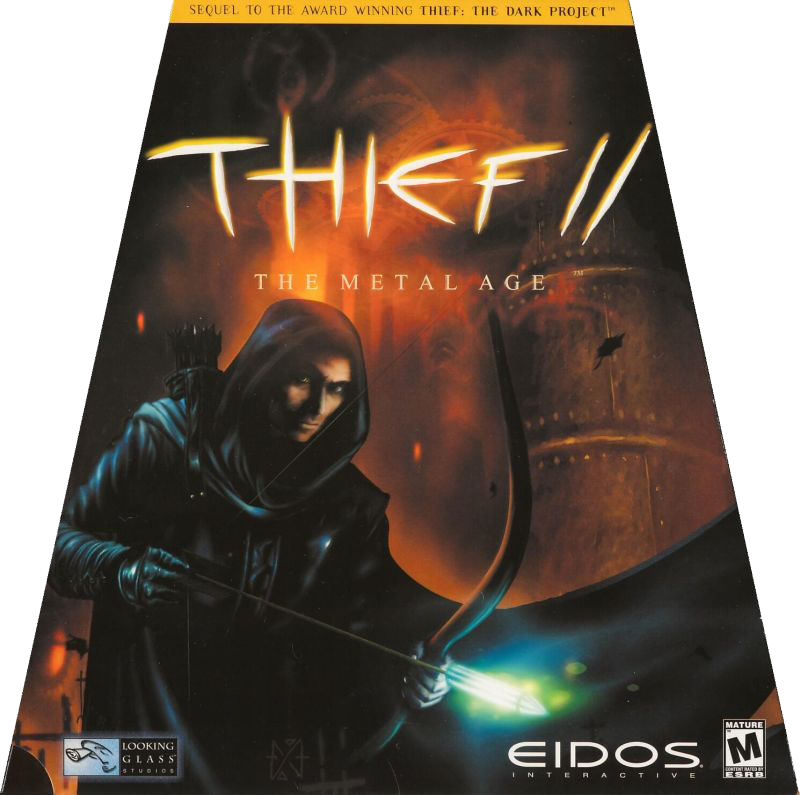
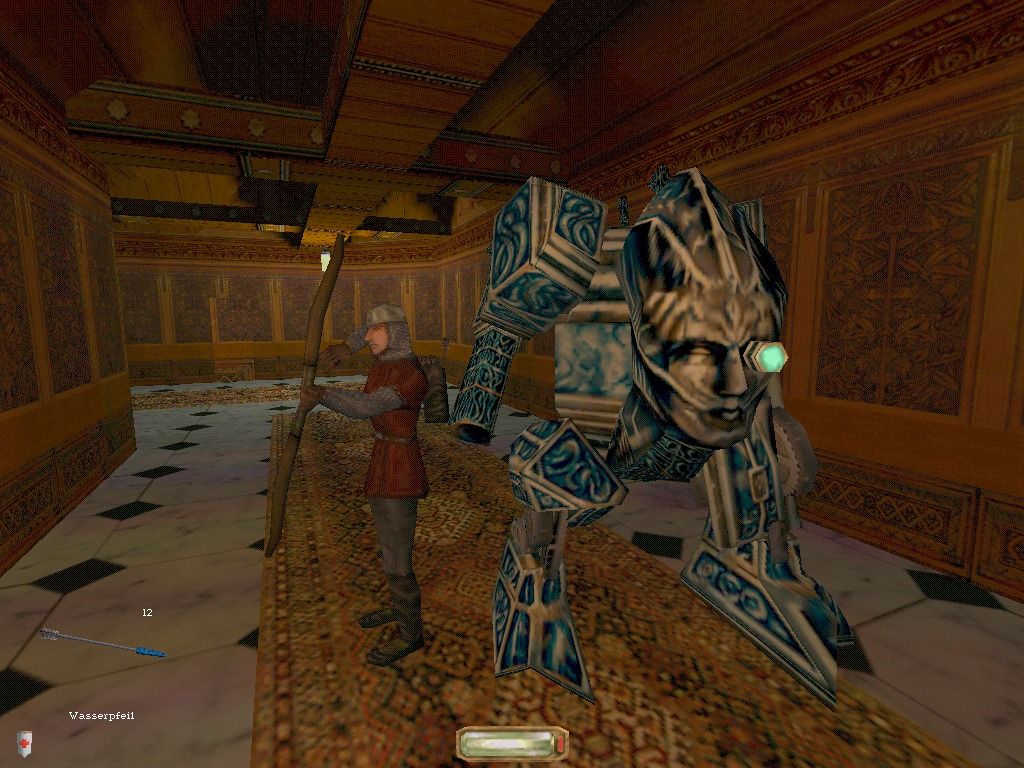
With Thief: The Dark Project turning out to be an unexpected success, Looking Glass Studio didn't take too long to produce a sequel. The first game featured Garrett battling Chaos-worshipping pagans who wanted nature to run amok over the world, so the sequel, The Metal Age, goes for a contrast. At some point a Hammerite splinter faction called the Machinists, lead by the mysterious Karras, ascended and began upgrading the technology level of the City. It's now full of steampunk surveillance cameras and even security robots that look like ED-209 from Robocop given a baroque chassis.
It's not much of a spoiler to reveal that Karras, with his Droopy Dog accent, is a madman who's been working with the city police to abduct criminals and undesirables and transform them into automatons that the city's nobility can use to as cheap labor to replace their human servants, but Karras has an additional plot to unleash a weapon that will annihilate organic life entirely. Much like the first game, Garrett starts out simply doing his usual work of burglarizing mansions, but he will gradually be pulled unwillingly into conflict with the Machinists and have to infiltrate their cathedrals, factories, and bases to uncover and stop Karras's schemes.
The game largely plays the same as the original, with keeping to the shadows as much as possible and making as little noise as possible the keys to success. Garrett has some extra tricks, such as using the steampunk eye he got as a replacement for the one plucked out in the prior game as a link with scout spheres he can toss to scope out areas without exposing himself. The designers listened to player feedback from the original game and emphasized stealth gameplay above all else, largely avoiding the first game's occasional pushes toward faster action that were included because they were uncertain players would tolerate a game with so little combat. Thief II's levels are sprawling and complex and mission objectives sometimes evolve as new areas are explored. Garrett will often have to criss-cross large buildings to find important objects or operate switches that will unlock areas he needs to enter, such as a level in which he has to rob the vault of a huge, highly secure bank by getting into its basement to deactivate the vault door's massive bolt lock. In keeping with Looking Glass's design philosophy, players are allowed to approach levels however they like, with most areas having multiple points of entry, and playing on expert difficulty is encouraged because doing so exposes the player to more of the game, requiring that they simply accomplish more objectives instead of superficially making enemies tougher.
A downside of the game's greater focus on stealth and the creation of steampunk antagonists is that the game does lose a bit of the sword and sorcery flavor of the original game. Although the undead aren't entirely absent, their appearances are sparse and quickly pass, and monsters like the burricks and elementals are entirely absent. The unceasing use of Machinist enemies gives the game a slightly drier atmosphere. In the celebrated Life of the Party level, Garrett can briefly invade a necromancer's tower in the middle of the city. If the player is foolish enough to read the Book of Ash (the Thief universe equivalent of the Necronomicon) on the wizard's altar, the player will find himself beset by a pair of ghouls. A later level finds Garrett stuck in pagan territory, where he has to tangle with humanoid enemies and possibly even living trees. These moments of horror are very welcome in giving a break from the robots and Machinist patrols.
Thief II maintains the moody style of cutscenes and the game is still exceptionally well-written compared to most video games.
Garrett is as cynical as ever, although he does get a bit unusually emotional at the climax, perhaps the only note that's questionable. Garrett is a very refreshing game character in how he feels vulnerable and how no matter how big the story gets, his adventures always come down to how well he can sneak in and out of a particular structure. Although the games tell a broader story, any level has the feeling of a single short story featuring this protagonist who merely wants to perform his trade to make enough money to keep his rent paid. As well-loved as these original two games are, they've given rise to a rich scene of fan-created missions that can be freely downloaded, many of them well-designed variations of raiding ancient tombs or opulent mansions.
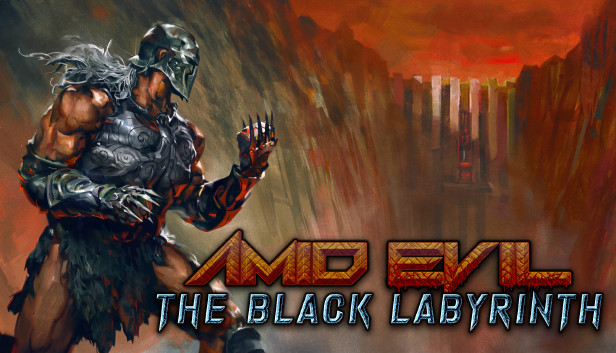
When Amid Evil begins, it establishes that you're the champion of the gods because you conquered the Black Labyrinth and seized the mystical axe at its end for yourself. So when Indefatigable wanted to do an expansion of the game, it only made sense to do a prequel in which you get to see what the Black Labyrinth is like for yourself.
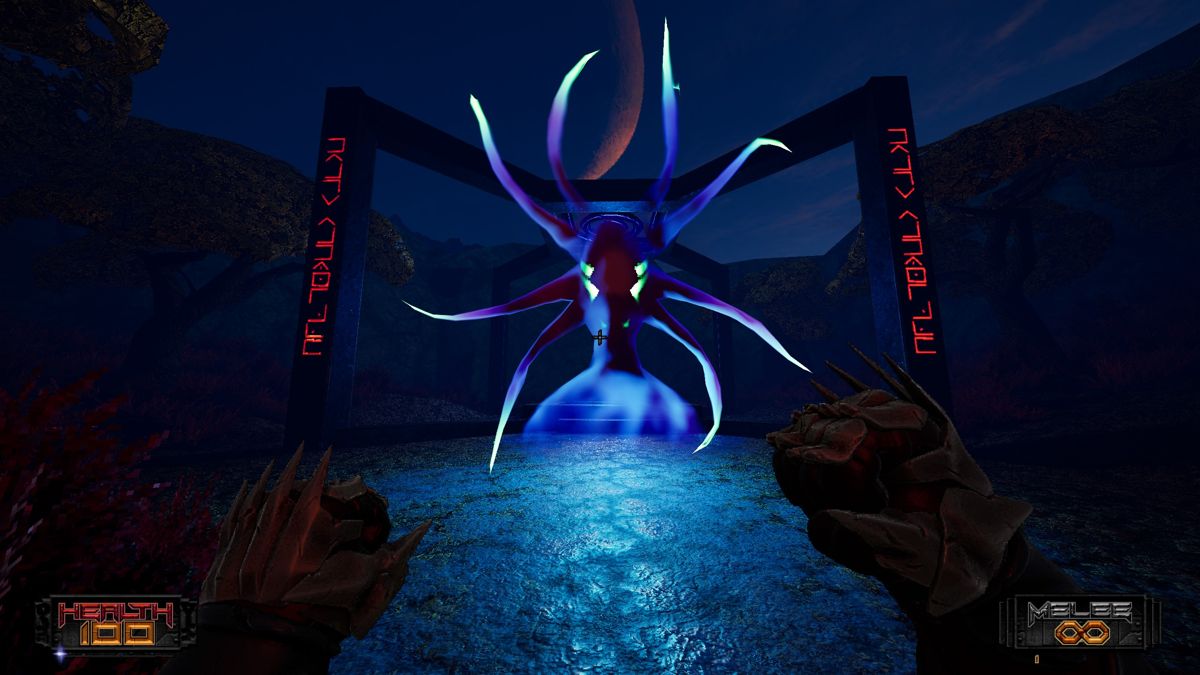
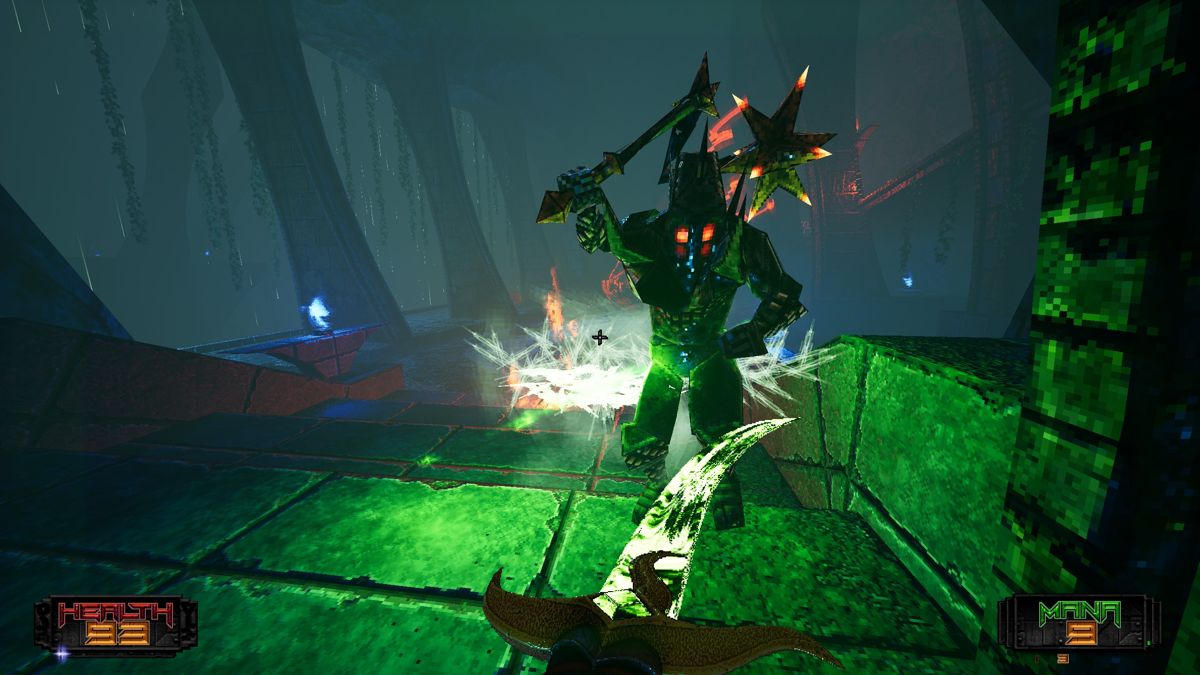
Since you obviously don't have the axe yet, the game replaces the no-ammo melee option with a pair of spiked gauntlets that are actually pretty fun to use. Punching enemies into mush just doesn't get old, especially when you activate the alt-fire mode and the punches turn from mere flurries into such a hyperactive torrent that it becomes hard to see what you're attacking. The other new weapon addition is the Voidsplitter, a scythe that fills in for the Aeturnum of the base game. If you complete the expansion, the game gives the option of going forward with the main campaign with the new weapons, in addition to the main campaign's array.
Beyond the weapons, the expansion is more of the same, which is good because the game is good. In keeping with how the original game was designed, the expansion has its own set of new enemies, such as archers, flail-wielding armored men, and elemental spirits.
The final boss is quite a challenge, perhaps more than any from the base game. Otherwise, the Black Labyrinth maintains the same sense of rich color. Despite the concept of being caught in a labyrinth, which might suggest tight corridors, the expansion instead goes for massively spacious rooms, some of which can shift similar to old Build engine games, and even some outdoor spaces in which you could get punished for trying to escape by making a break for the horizon. It's not a very long set of levels and is definitely worth a play for those who enjoyed the original.
In 2008 the Turkish developer TaleWorlds released Mount & Blade, a medieval combat sandbox game. The game is set in an alternate version of Europe and Asia Minor called Calradia. You create a character whose background and starting abilities you can set, but whatever you settle on the game will start you in the same place: as a lone adventurer who needs to learn how to fight better, take jobs to earn money, and use that money to gradually upgrade your equipment and hire mercenaries who can help you take even bigger jobs. You can pledge yourself as a vassal to one of the Calradian lords who are always fighting each other, be totally independent as a mercenary captain, or even just run around entirely on your own. You can even just be a dull trader of goods, stocking up cheaply from one town and hauling somewhere else where prices are high, if you don't feel like fighting. There is no ultimate object and you just make whatever fun and story you feel like making. It's similar to the classic Pirates! game by Sid Meier, except you're controlling a landbound horseman instead of a ship captain. One thing you can't do is, unlike Conan, you can't become so big that you seize a crown for yourself.
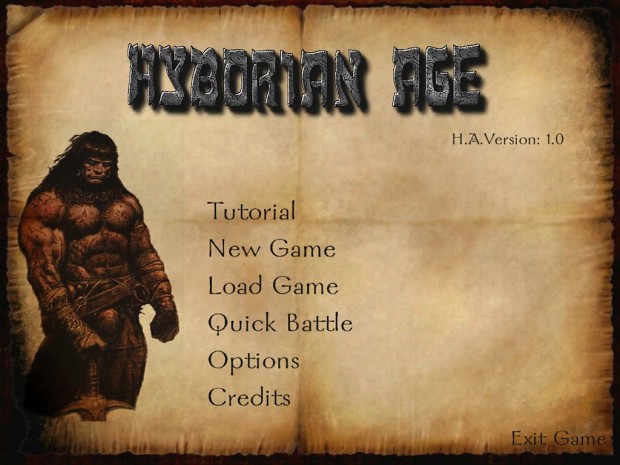
Like Pirates, it's a very compulsively playable game, one of those "Oh man, it's 3 a.m.!" games where you lose track of things because it's so easy to run just one more mission, visit one more town, fight one more battle, over and over. Although it's quite Howardian, it's not a sword and sorcery game because there isn't any sorcery in it...but it is a very moddable game and some fans have introduced fantasy elements on their own. There's a mod that allows you to fight the War of the Ring from Lord of the Rings, there are mods like Prophecy of Pendor that are set in original fantasy universes, and there's a mod called the Hyborian Age that attempts to rework the game's map and factions to resemble those found in Howard's Conan stories.
As it is, the Hyborian Age mod doesn't really change the game very much. It's still fundamentally the same game, but there's an option to make your new character a sorcerer/sorceress who begins with a spellbook and the ability to throw some fireballs. Otherwise, character progression is mostly similar.
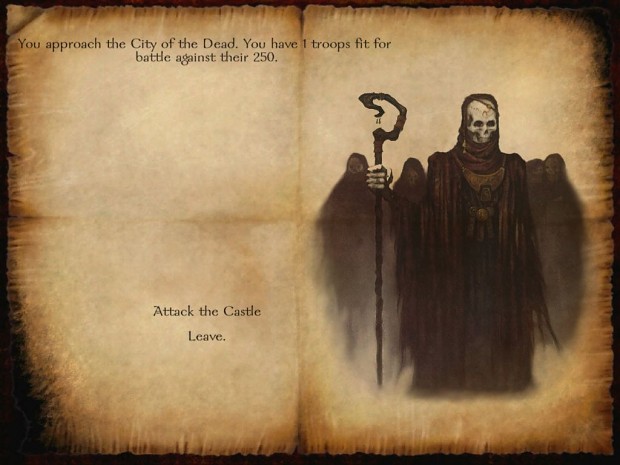
The map as said renames the areas to better match Howard's stories, with places like Cimmeria, Nemedia, and Shem represented, although one could quibble a bit with the arrangement; e.g., the game's version of Cimmeria is probably a bit too far north and snowy compared to how Howard described it. The most dramatic change might be that the southern regions are peppered with undead armies instead of regular bandits.
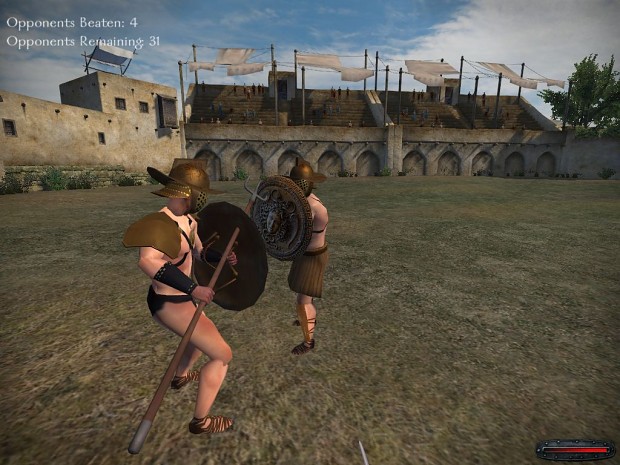
The arena/tournaments also use more of a classical gladiator vibe than the base game and there are some changes to how equipment looks.
It's a nice bit of work and could serve players who really want some Conan flavor in an already relatively Howardian game, although not necessarily a must-play considering the age of the mod and the base game itself at this point, and there seem to be later attempts to do Hyborian Age-inspired mods for the Warband expansion and also Mount & Blade II: Bannerlord. Mount & Blade is a good game regardless of how it's modded and it got better as it was expanded on.
Bleak Sword was originally released on Apple Arcade in 2019, but got an expanded DX edition this year. It was intended by designer Luis Jiminez to do something like Dark Souls on a touchscreen, so it's all about brutal combat with a simple interface. You attack or dodge, with some basic variations, and defeating enemies requires you to study their patterns, make sure you're not in the way when they go for a big attack, and then let them have it while they're open. It's actually a pretty easy game, at least on the PC.
It has a striking presentation. The music is by Jim Guthrie, who was a big factor on Sword & Sworcery, which Jiminez cited as a major influence. The non-boss enemies are small and rendered in minimal pixel art graphics, but what leaps out about the graphics are the diorama-like arenas where the battles take place, some of which add environmental hazards like out of control mine carts.
The game definitely falls more in line with the modern grimdark style, especially the type popularized by Dark Souls. It's a grungy, seemingly hopeless world overrun with demons and slimy predators. Lots of undead and necromancy, with a hero who dutifully trudges through everything because it's really the only thing he can do. Just kill as much as he can until he hopefully ends whatever curse the king has foolishly unleashed. There's a sense of delirium that hangs over everything.
Northern Journey opens with you controlling a guy in a rowboat, apparently having gotten lost among the Norwegian fjords. You turn and notice an operating lighthouse on a nearby island and a moment later some strange energy comes from near the lighthouse and pokes holes in your boat, forcing you to hurriedly row to the shore, arriving just before the boat sinks. You take a path up a hill and meet a strange man wearing a wolf's head, playing a flute, who tells you some things were stolen from him and he needs you to find them. A short way further in, you find a tiny village, but everything is strange. The constable is keeping some kind of demon or elf woman in his cell, there are tiny humanoid creatures scampering about who burrow into the earth when they see you coming closer, a little boy is torturing a thief locked in some stocks, something big is locked in a cellar under the church, and a there's a pair of witches keeping two black goats and boiling some strange green stuff in a cauldron. The whole place has a sense of wrongness similar to the atmosphere in Lovecraft's Innsmouth. With nothing else to do, you push forward on your mission to help the flute player get his stuff back.
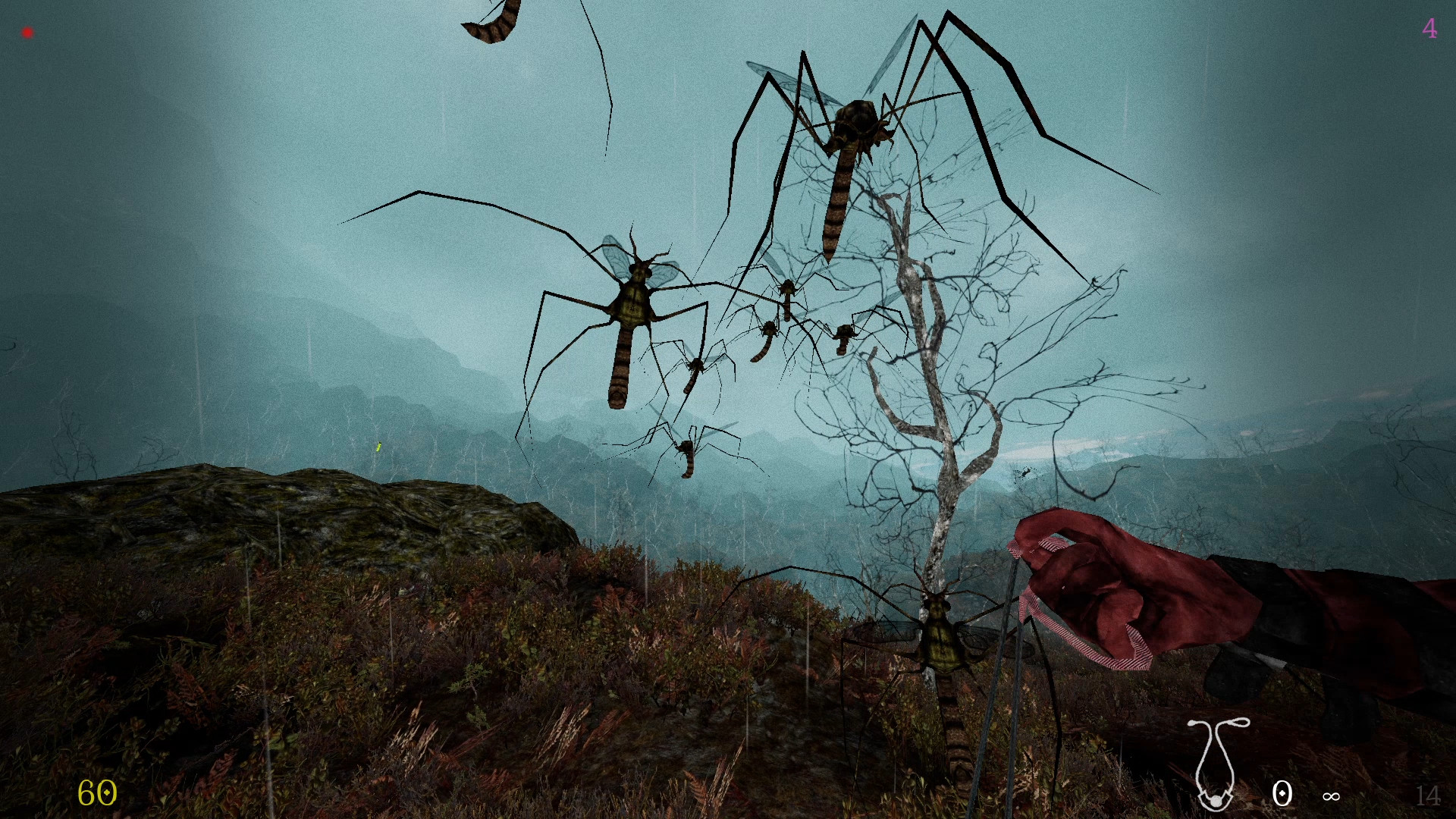
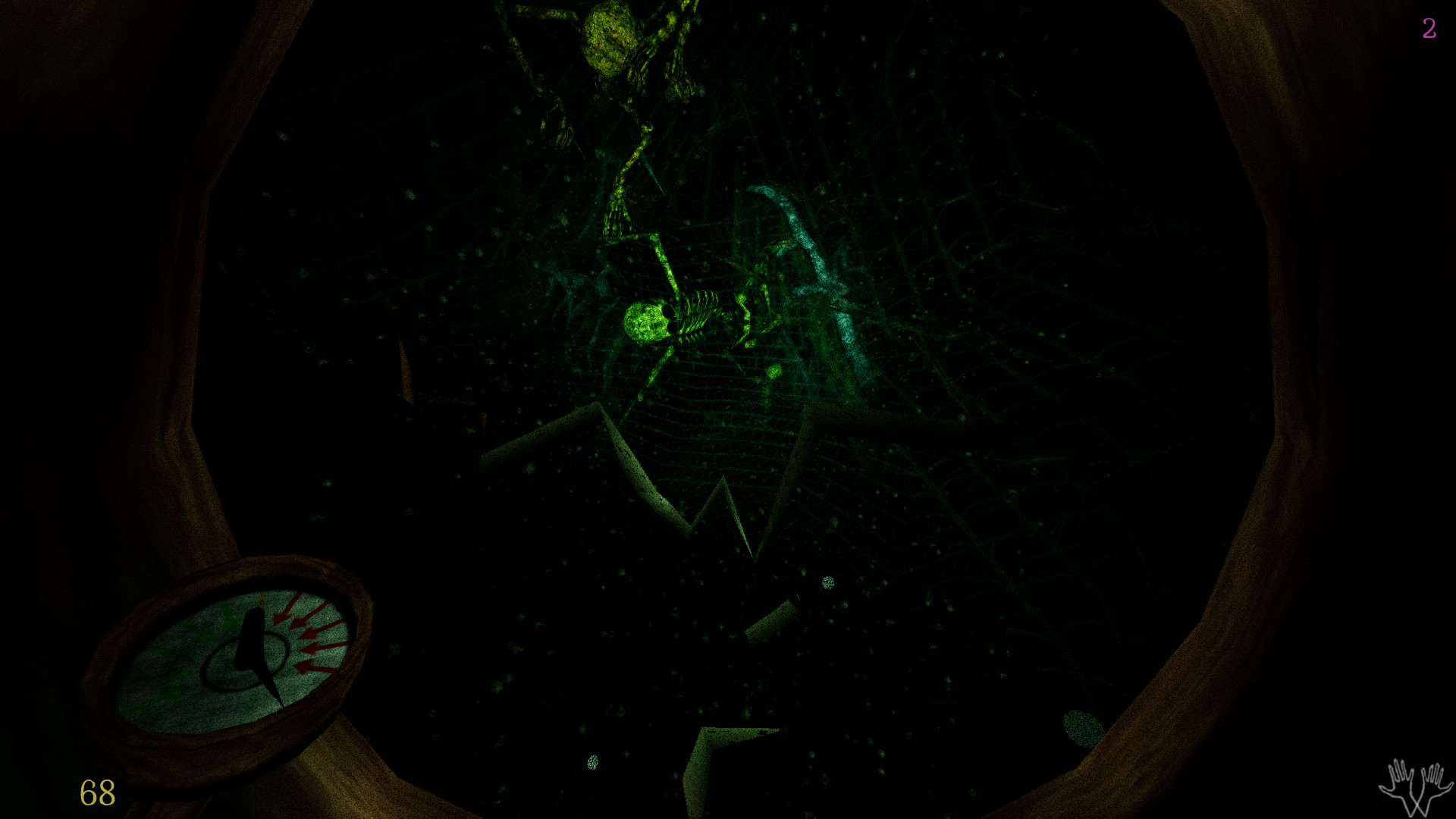
In short order, you start accumulating weapons, starting with a sling, and you find yourself using them against the island's hostile wildlife, which is mostly represented by giant bugs. There's a variety of spiders who attack you, giant mosquitos, and trilobytes, among others. Northern Journey isn't a game that should be played by people with bug phobias. One particularly harrowing sequence has you creeping through a crevasse with a high tree canopy above, with giant ticks raining down on you. Unlike your average video game enemies, these creatures generally don't announce their presence with audio cues, but like real world predators and parasites they stay silent and they use camouflage to ambush you. Many jumpscares await, not with a trite musical sting but simply because you'll be shocked to see long arachnid legs noiselessly creeping up on you right as you thought you'd cleaned an area out.
There are some non-bug enemies. You'll face a few moose and bears, and there are some sheep that have gone mad because of the ticks hanging off of their bodies. And you eventually start encountering more overtly supernatural foes, many of which are drawn from Norwegian folklore. If you know your mythology, it won't take long to realize that the mysterious flute player, with his helpful wolves and ravens, is probably Odin and the cause of the rot in the land and the outburst of supernatural creatures is probably the handiwork of Loki. As often happens in the stories, Odin is using you as his instrument to clean up a mess whether you want to or not.
The game as a whole is a tribute to the Norwegian countryside. The creator, Øystein Pedersen (Slid Studio is just him), wanted to make a game that reflected his love of hiking through the places he knows in Norway. Despite the relatively modest graphics, the game looks real in a way many far more expensive games don't approach. There are steep hills and towering cliffs, grasses and weeds that sway in the breeze, heavy waterfalls and violent rapids (deep water is your worst enemy of all in this game), and sprawling bogs. Many of the textures used to create the vivid foliage were based on photos he took while hiking, and the game also incorporates his interest in scuba diving by including a couple of underwater levels. These levels are as scary as anything in the game but there's also a great sense of authenticity in how they depict the lack of light deep underwater and the lay of the depths. Same with the subterranean spaces - many of them are tight and claustrophobic as you'd find while doing actual spelunking. When you finally meet some undead skeletons, they don't stand upright like the usual Harryhausen skeletons but crawl at you on their bellies because they just came straight out of their graves and there isn't much room to stand in their cramped burial mounds.
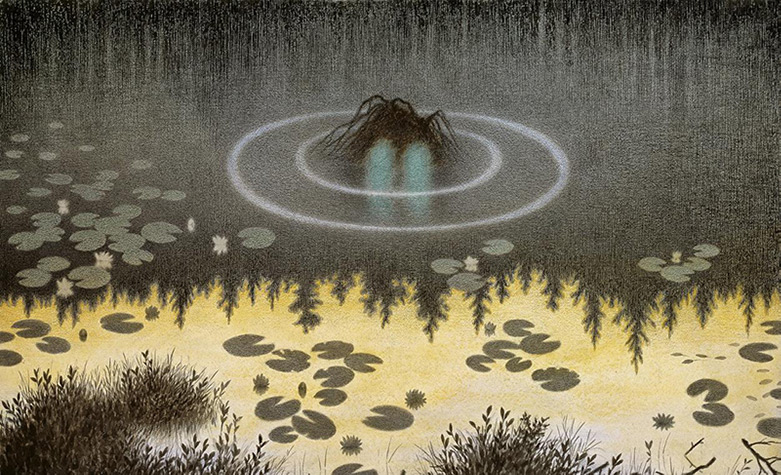
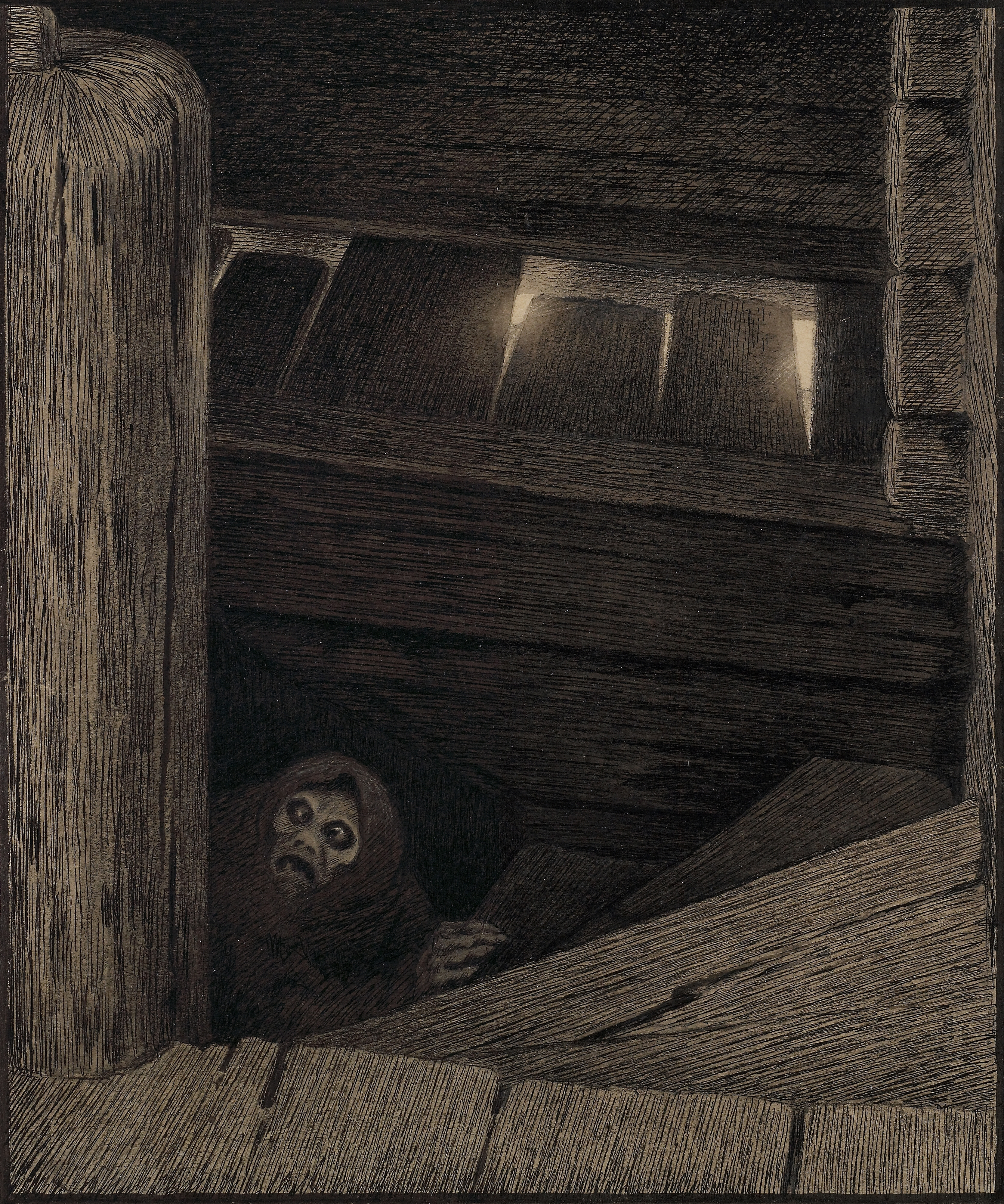
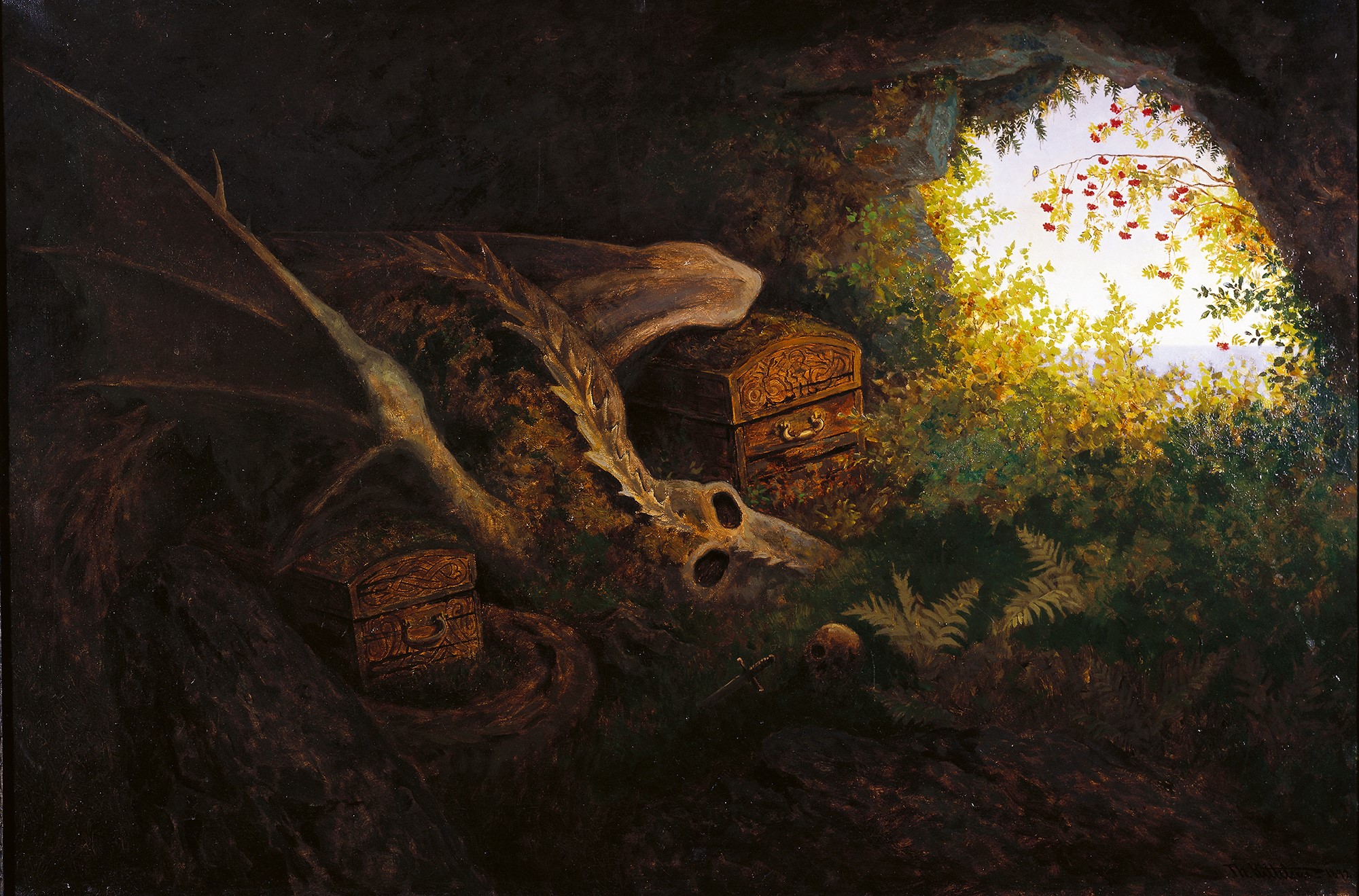
Whatever nature didn't provide in inspiration was complemented by Norwegian artist Theodor Kittelsen. The game's poster is directly based on Kittelsen's Nokken painting from 1904, and when gazing on the misty landscapes in the game it can be hard to tell what was maybe taken from life and what was inspired by Kittelsen's work.
Pedersen also cited games like Skyrim as influences, mostly the sense of walking and exploring, although Northern Journey is not a walking simulator. In terms of how it plays, it's mostly a traditional and simple FPS. There are health and ammo pickups scattered around the levels and you're supposed to find newer and more interesting weapons. The weapons are quite uncommon, though. There are no guns in the game despite the presence of certain types of advanced technology (e.g., the diving sphere you use to explore the Nokkpond). The sling you obtain first is a viable weapon through the entire game, and beyond that you get a bow, throwing axes, multiple types of fast-loading crossbows, and spears. You do get some swords, but as there is no melee combat in the game, you throw the swords like everything else. Weapons also tend to be slow and require careful aiming that accounts for drops over distance while also leading targets, which gets tough when you're being swarmed by skittering bugs. Pedersen is experienced in the use of slings and archery in the real world, so he wanted to draw on that for his game. If nothing else, Northern Journey has the most well-implemented sling ever done in a video game.
Although there's some backtracking around the game's map, it's mostly a linear experience that's well-paced and is quick to make sure you're constantly seeing and doing new things. The only major gameplay issue is that it's easy to get hung up on parts of the environment, or to be a bit screwed over by the physics and end up slipping over a cliff because the character didn't have his footing. There's a lot of ground-level foliage, which is meant to hide enemies but has the downside of making the ground somewhat fuzzy and hard to read when engaged in combat or making difficult jumps. It's nothing insurmountable but it does lead to some frustration.
Leave it to a Norwegian to show how "the Northern Thing" is done. Pedersen has created a beautiful and scary as well as funny and melancholic game. "Happysad" as he describes it. It captures the flavor of folklore and it's weird. Not quirky modern weird but in the way people used to speak of weird tales. If Poul Anderson had lived to see it, I think he would have appreciated this game.
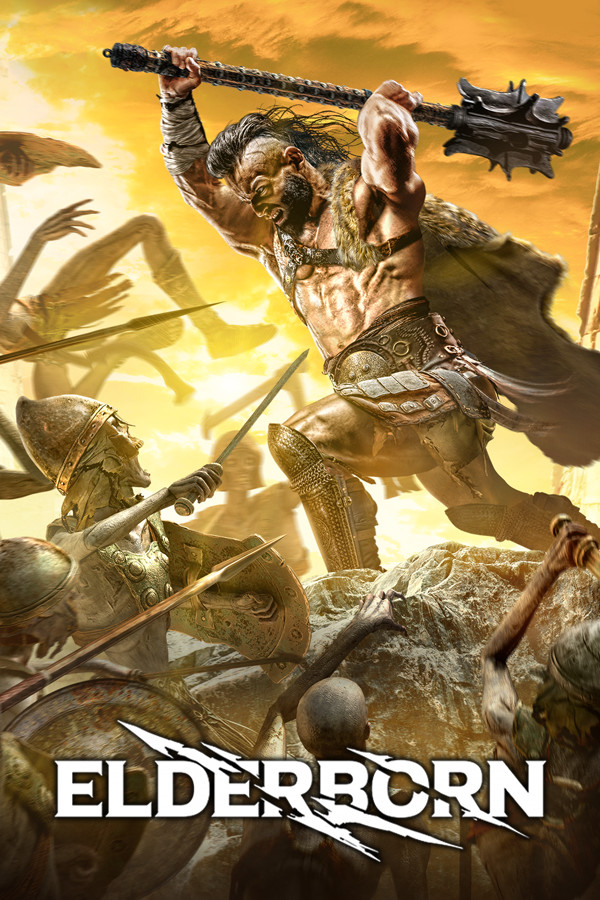
Elderborn is described by its Polish creators, Hyperstrange (Jupiter Hell, Crossbow: Bloodnight, Blood West), as "a Metal AF* Slasher with brutal FPP melee combat and souls-like/RPG character progression. In the times of legend, barbarian tribes need a new dark messiah. Be that merciless slayer. Uncover ancient secrets in the city of doom. Forge your own destiny! *Action Fantasy." The terms "souls-like" and "dark messiah" are particularly notable because the game takes heavily after Dark Messiah of Might and Magic and Dark Souls.
As with Dark Messiah, the game is a first-person melee combat game in which you break through enemy shields by kicking them, although Elderborn lacks Dark Messiah's complicated physics and magic systems. You can at least kick weaker enemies off high ledges to kill them. And like Dark Souls, enemies leave behind experience that can be picked up and cashed in for skill increases at special respawning locations (mostly fountains instead of bonfires). If you're killed, you'll have to trudge back to where you were snuffed to gather up all the experience your previous life had accumulated, but you lose it entirely if you're killed again.
The premise of the game is suitably Howardian. As a member of a barbaric tribe, you're tasked with making a pilgrimage to the golden city of Jurmum, which has fallen into decadence under the "guidance" of its corrupt priesthood and the exploitation of strange technology that powers the city, and by pilgrimage it means you're supposed to kill everything you see there, but few have ever returned from the city. You're given a choice between a male or female warrior (no real difference between them) and in the game's opening you have to slay the other option in an arena before setting out on your quest. You begin in the catacombs beneath the city, then move into the city itself. Along the way you'll battle various types of undead warriors, homicidal lepers, giant scorpions, and Lovecraftian fishmen. Note that many of these enemies aren't friendly with each other and it's often easy to get them to fight each other. There's some unintentional comedy in sometimes walking close enough to trigger an enemy into moving only to see him turn around, run the opposite direction, and start attacking another group of enemies.
Getting good at the combat mostly involves unceasing movement (often utilizing the game's quick-dash ability) and mastering the game's parrying system. A successfully timed parry will stun the enemy and leave them vulnerable to an extra-high damage counterattack. You can also fully heal yourself with a special injection up to three times before needing to kill more enemies to refill the injections. Unlike Dark Souls, there is no stamina meter that forces you to be conservative in dodging, blocking, or attacking, so the game is quite a bit faster than current-day "souls-like" games. Instead, you'll be contending with potentially large mobs of enemies at particular points in the game, racing from one opponent to the next, whittling down their numbers as you go. There are also some minor puzzle-solving aspects, mostly to do with operating some of the peculiar machines in the city.
For a "Metal AF" game, the soundtrack is adequate. It's suitably hard-driving and enhances the mood in parts but it's also not especially memorable, especially with several games today being accompanied by heavy soundtracks, such as Mick Gordon's work on the new Doom games. The graphics are quite good, but there's a certain lack of color to them. The catacombs are heavy on the blue while the city is a lot of brown (see the game's title card/poster above). It's tough to equal masters like Frazetta in nailing a sense of foreboding and violence while still being very colorful.
The weapon selection is varied enough to cover just about any playstyle (I settled on the spears), and there aren't too many games that allow you to unlock the ability to rip a corpse's head off and use it as a projectile.
The most unfortunate thing about the game is simply how short it is. There are essentially two levels, albeit long ones, and then a relatively brief epilogue. The game seems to end right as it's getting going, leaving a sense that you just completed the opening episode of a shareware game only to realize there's no more of it left. Hopefully a more substantial sequel will come some soon.
The Witcher 3 is one of the most celebrated games of the modern era. It iterates on the gameplay style of the Witcher 2 by adjusting the combat system and shifting to a massive open world peppered with an exceptional amount of uniquely crafted content, much of it with full voice acting.
CD Projekt Red clearly wanted to finally get its video game version of Geralt more aligned with the literary version, so the story in its early phases sees Geralt summoned to an audience with the emperor of Nilfgaard, the Germanic empire that invaded the northlands at the end of the previous game. Geralt is soon reunited with Yennefer of Vengerberg, his canonical love interest, who's been serving the emperor as an advisor, and the emperor tasks Geralt with tracking down Ciri, Geralt and Yennefer's adopted daughter because the emperor is her biological father and wants her with him. Ciri, as the long-lost daughter of the queen of Cintra and the descendant of a crossbred elf-human line with incredible powers (sort of the Witcher universe's version of Dune's Kwisatz Haderach), is an important person, both politically and genetically, so she spends a lot of time evading people who want to take advantage of her, and in this game she's on the run from the Wild Hunt, a group of extremely ill-tempered elves from another dimension who like to snatch people and press them into serving their ghostly hunting party. Geralt is revealed to have been in their clutches before he was freed and rendered an amnesiac, explaining how he got into the state he was in as the original game began.
So off Geralt goes to track down leads on Ciri, reuniting with old friends and enemies, and generally having a variety of new adventures. Occasionally, when Geralt finds where Ciri has been, the game will switch to a flashback in which the player gets to control Ciri and enjoy her ability to teleport around the playfield, zipping behind enemies and backstabbing them.
As with many open world games, the overarching story isn't very compelling, little more than a thread to keep players moving into fresh, unexplored areas. What's more notable is what goes on as the player wanders around that world, running into monsters or bandits that need killing, visiting towns and picking up contracts for witcher's work, or just stumbling across strange happenings that need sorting out. When the game is at its best, there is no game that better conveys the sense of being a wandering swordsman simply getting into adventures. The life of a sword-and-sorcery protagonist who's more interested in making some money or satiating some curiosity about strange local rumors instead of saving the whole world. The major subquests, such as the one about the Bloody Baron, often feel like they could pass as well-drawn short stories or novellas in an extra volume of Geralt's adventures. Even the main storyline, to its credit, is really just about Geralt trying to reconnect with his daughter; Ciri might be of world-shaking importance but Geralt is "but a witcher."
The game is a triumph of presentation. The graphics are beautiful, with various environments convincingly rendered with crisp art direction. The music brings a classically Slavic flavor that has never really been popularized outside Eastern Europe. Most notably, the game has a very large amount of unique writing that makes even the most disposable content feel special. Wiping out a generic group of highwaymen will usually yield at least a letter or journal that explains who they were and why they were there, completely unlike any other generic bandit group who have their own brief stories. And the game handles a variety of tones. Much of it is grim and horror-tinged, but there are times it goes for humor or well-earned sentimentality. It brings back the Grimm fairy tale and Arthurian influences that Sapowski worked into his original stories.
Where the game is less triumphant is in most other aspects; i.e., the gameplay. Although it improves on the combat system in The Witcher 2, adding a nice side-hopping move to the full dodge-roll from the previous game, the combat is still rather unsatisfying in many ways. Geralt has a maddening tendency to auto-target the wrong enemies and in more hectic fights the player could end up fighting the controls as much as the characters in the game. Geralt's context-sensitive moves can be hard to predict - sometimes he'll perform a simple quick stab, but many times he winds up with a slow-developing pirouette. And the combat is often formulaic. Many situations come down to dodging or parrying a strike, hitting exactly two counterattacks before the enemy gets its guard up, and then repeating until the fight ends.
The controls for horseback-riding and swimming under water are also frustrating. The player has to keep Geralt facing forward at all times for them to work correctly, lest they start reversing over and over until the player resets the camera behind Geralt and gives the game a moment to settle down. With Geralt's limited air supply, you can literally drown while trying to get the swimming sorted out.
As an RPG, the game feels like it has an identity crisis, similar to its predecessor. Most of the game's design is in line with standard action games and the inclusion of classic RPG mechanics like gathering experience and leveling up feels at odds. Why is Geralt, such an experienced witcher, clowning around much of the game at a low level? Even late in the game, it's possible to encounter random bandits who can slaughter you in a single blow because they're 10 levels ahead of you, so powerful that it's possible you won't even be capable of hurting them no matter how well you've mastered the controls. And the game doesn't even gate off areas with monsters at significantly higher levels. The whole world is open to you right away and it's possible to run afoul of such monsters at any time, leading to pathetic scenes of Geralt fleeing like a wimp from routine drowners or ghouls.
As a major AAA release, The Witcher 3 is also predictably conservative in how it handles exploration and quest design. It insists on holding the player's hand at all times. Although it's possible to switch off HUD elements like the minimap, you'll still need to refer to the map to get anywhere because the game never bothers to use detailed directions when describing objectives. A character might tell you to visit someone in a particular city but they won't give you an address or note landmarks - you have to use your GPS/quest markers to find out where they live. Contrast with a game like Morrowind, where an early quest involves locating Caius Cosades and the player has to work out on their own where he lives based on information provided. Interesting locations in the game world are marked with question marks until the player gets near them, taking some of the fun out of simply wandering the world, wondering what's beyond the next hill or in those ruins off in the distance. Now you just check to see where the markers are and head over, never needing to bother with empty, unmarked spaces.
As a very large game, some pacing issues do occur at times. The game's second major phase, where Geralt visits the island country of Skellige (a nation of pseudo-Celts who follow Norse religion), often demands that Geralt circulate high mountains or sail from island to island. Although it's quite visually stimulating, the relative slowness of the travel can become wearisome and unlocking fast travel options becomes a priority.
Ultimately, the game and the series as a whole exemplify games that succeed based on their storytelling and general ambiance over their actual game design. They resonate with fans who enjoy the characters and the situations they get in, and with those who appreciate games that prioritize choices and consequences, less so with players who would rather just have a nuanced and exciting combat system.
The game does offer a tremendous value for money. In addition to already being a big game, CDPR created two substantial expansions, Hearts of Stone and Blood and Wine. Hearts of Stone provides a major new subplot in which Geralt has to literally beat the devil, taking part in other activities such as organizing a bank heist along the way. It also brings back Shani as a supporting character, giving fans of the first game who missed her some closure.
Blood and Wine is even bigger, so much so that it's almost a full-fledged sequel in its own right (Witcher 3 and 3/4?). Geralt travels to the French high medieval-flavored duchy of Toussaint to hunt a vampire, and it also serves as a homage to the early short story "The Lesser Evil" in how it involves a princess born under a bad sign. Blood and Wine serves as a sort of victory lap for the character and the series. After trudging through so much blood and mud in the northlands, the sunny, colorful climate of Toussaint can be a relief. Sapowski's stories portrayed Toussaint with a bit of a satirical attitude, falling maybe a bit closer to Don Quixote than The Amadis of Gaul, but in the context of the game it's refreshing to explore a place where the beautiful, well-dressed people seem to actually take chivalric virtues seriously (too seriously at times) instead of simply all being bitter-minded cynics and hypocrites. When the expansion closes with Geralt chilling out at the vineyard he's inherited, there's a feeling he's earned his rest and arrived at a better end than what Sapowski chose for him.
It's hard to look at Victor Vran, a monster hunter in pseudo-Elizabethan gear with a wide-brimmed hat, and not think he looks at least a little reminiscent of Solomon Kane.
Victor Vran's mission in his game, designed by Haemimont Games of Bulgaria, is to cleanse the Eastern European-ish city of Zagoravia from an infestation of demons that have completely upended the place. The only survivors left are the city's beautiful young queen, her guards, and some advisors. Many other demon hunters attempted this before Victor, but he's the last one (besides a young woman who also appears shortly into the game). The good news is that Victor has special abilities that he gained from making a deal with the devil in the past (so he's maybe more akin to the movie version of Solomon Kane...).
Victor must use melee weapons, ranged weapons, bombs, and demon powers to exterminate the hellish vermin from Zagoravia. There are undead skeletons (our old friends), giant spiders, vampires, zombies, ghostly apparitions, living gargoyles, and elementals, among many others. The gameplay is inspired by "action RPGs" like Diablo, but with a more direct, action-oriented approach compared to Diablo's furious mouse-clicking gameplay. Victor Vran plays better with a gamepad as Victor doesn't just run and attack but can dodge-roll and even execute wall-jumps to access areas at higher elevations. There are also no classes for players to choose - Victor always begins the game the same for all players but can be slightly customized as he levels up and players decide what style of Victor they prefer. Fundamentally, it's still rather similar to Diablo, though, in the sense that the game is viewed from a distance above the action and Victor must annihilate literal hordes of nasties and then pick up money and weapons they leave behind before progressing. Many of these weapons have only minor distinctions in terms of damage output and specialized effects and are best sold for extra money back at the queen's castle.
Despite the flexibility offered through Victor's abilities, the game isn't very much about elegance in its combat. Overcoming the game's challenges often comes down to simply hammering at everything in front of you and making sure your lifebar doesn't erode faster than theirs, but if it does you can just hit a button for the health potion and renew yourself, and health refills aren't rare. One of the game's attempts to offset this matter of attrition is through challenges for each area, such as requiring that you rush and defeat a certain number of monsters within a restrictive time limit or equipping things that will deliberately handicap you. It's not a very difficult game otherwise, and it's relatively short, which is probably for the best considering its repetitive nature.
The graphics are quite nice. The regions you explore are full of gloomy detail and the environment tends to get smashed up as you battle through without ever losing an important sense of clarity for the player. It's easy to get caught up in just running around the game's crypts, smashing up the sarcophagi, hoping money or health potions will fall out like you're in a world of piñatas. This does tend to happen in a lot of RPGs, where players are trained to rummage through boxes and barrels for special items.
Conceptually, the monster hunter gimmick might remind some of the Witcher, especially in modern times, and the game very much plays into that by casting Geralt of Rivia himself, Doug Cockle, to play Victor. Cockle doesn't do much to differentiate the heroes from each other and if you were only listening to the game you might easily confuse it for another Witcher installment. The game's voice acting is fine, but the story itself is uninspired and generic and feels bolted on top of the game instead of woven into it, which seems to have been the case as the game spent a while in Steam Early Access and the story was apparently one of the final elements added before its official release.
Valfaris is a semi-sequel to Slain, overseen by Slain's team of Andrew Gilmour and Thomas Jenns. While Slain was a straight fantasy that emphasized swordplay, Valfaris shifts to a sci-fi theme in which the hero wields guns as much as melee weapons. It might be coincidental, but the death metal/gothic/space opera mixture of Valfaris makes the game come across like what you might get if someone decided to combine Contra with Warhammer 40K, especially the old school extra++ grimdark 40K of the 1980s.
Slain ends with a Moorcockian twist that the character you've been controlling, Bathoryn, was actually the hero's sentient sword all along, with Bathoryn and his next wielder looking to the stars for the next adventure. Valfaris picks up with its hero, Therion, landing his wolf-shaped spacehip on his home world of Valfaris (and atop of a bunch of bastards he was going to kill anyway), which was apparently once a paradise but has since fallen into a cancerous decline, doomed to soon be swallowed by the star it's orbiting. It's hard to imagine what an idyllic paradise in these games' death metal aesthetic would actually look like, but Therion seems to have been fond of the place before he left. Much as Bathoryn was battling Lord Vroll in Slain, Therion is on a quest to slay his father, Vroll. Somehow, Therion and Bathoryn are brothers, and Therion even gains the option of wielding Bathoryn during the game.
As grim as the game's story and characters are, there is a sense of nobility and honor conveyed through them. Valfaris comes to a tragic end but the hero keeps his square chin up and never loses his resolve. There's no crying in metal. There's even a bit of humor in the form of his female AI sidekick, who has a wiseass personality similar to Cortana in the Halo series.
Valfaris plays quite similarly to Slain in the sense that in many ways it's just Slain with guns added, but that's in no way a bad thing. The extra layer of gameplay provided by the guns makes the combat a bit more lively and requiring different solutions in different situations. The guns, which are named like all the other weapons in these games (e.g., the Bastard, the Hellhammer) can be upgraded for extra effects. And much like Slain, the game is tough but fair, requiring that the player really learn how to play it instead of button-mashing through.
Graphically, it's even lusher and more impressive than Slain, and it features another very good, heavy soundtrack by former Celtic Frost member Curt Victor Bryant. There are some instances in which the game's art direction can get a bit out of hand and obscure the player's view of the action, overwhelming parts of the screen with particle and lighting effects that completely cover up the characters. Even despite this, it's a dazzling game to look at.
Valfaris does tell a complete story, but much like its predecessor it ends with a hook for another sequel, which will apparently be more of a horizontal shoot-em-up that continues Therion's journey.
The reason it's called Batbarian is because you control a barbarian and his sidekick, a magical bat. The game opens with them being chased off a cliff by a horde of ogres. The barbarian falls so long that the game introduces you to its sense of humor by doing a gag based on the guy falling so long that he starts getting bored. Eventually he hits the ground, deep inside a cavern. He picks himself up, reunites with his bat friend, and they head off to figure out how to escape this strange place.
The game is a Metroidvania with the gimmick that the bat is luminous and can be manipulated by tossing different kinds of fruit for it to eat, and you can get power-ups that allow you to switch among different elemental affinities. Up against an ice-based enemy? Switch the bat to fire mode to make the enemy thaw enough for you to damage it with your sword. Some switches are operated by light, so you'll need to toss a fruit over to the switch so the bat's light will turn on the switch and open the door or create the platform you need to advance. It's an interesting concept in a genre that has rapidly become crowded over the last decade.
It's a light-hearted, humorous game, with the humor slanted more toward farce. It's not funny in the same way as Age of Barbarian, where the humor is based on a specific familiarity with the genre, but more like something you'd find in the old Dragon magazine comic strips, broadly poking at fantasy cliches. Sometimes it's genuinely funny, but most of the time it's merely smile-inducing.
It's a pretty nice-looking game. The graphics are a bit on the miniaturized side, but they still convey a lot of personality and atmosphere. On the downside, between the player character, the bat, and the extra sidekicks you can acquire through the course of the game, things can get very chaotic when combat picks up a lot. Are you tracking your guy or your partners along with the bad guys?
It's also probably one of the more challenging examples of its genre. Metroidvanias tend to emphasize exploration more than anything else and often make the player feel very powerful by the end thanks to all the powers you gain, but Batbarian likes to make the player work for everything by throwing out increasingly tricky combinations of enemies and requiring deft handling of the hero, the bat, and your partner. Although there's an RPG-like leveling system, upon a level-up the game presents the player with a slot machine that, based on when you click, will determine if your offense, defense, or "awareness" increase (awareness seems to increase the radius of the bat's illumination?). The slot machine isn't too hard to use, but it's also a needless bother and if you're not paying attention to it, you might get stuck picking up more awareness increases than is advisable and then handicapping yourself in terms of attack/defense power by the later stages of the game.
The biggest issue the game has is that it's yet another pretty good Metroidvania in a genre that's stuffed with similarly pretty good examples. You could pick it up and have a decent time playing it, but you could say that about many other games as well and when really top level games like Hollow Knight are out there, you need to be better than just decent to stand out. The barbarian theme is amusing but not explored very deeply beyond gags about how he expresses himself in dialogue scenes (do you pick the brutish option or the eloquent one?).
There are so many classic sword and sorcery stories centered on thieves - e.g., The Tower of the Elephant, The Tale of Satampra Zeiros, Ill Met in Lankhmar, Liane the Wayfarer, etc. - and Thief: The Dark Project seems to take after them so well, but the funny thing is that in looking over its development history, Thief's final form seems to have been largely an accident.
The germination of it began with plans at Looking Glass Studios for some kind of sword-fighting/melee combat game, including one that would have involved hacking up communist zombies. Before long, the developers shifted focus to an Arthurian-themed game called Dark Camelot, which would have inverted the lore, making King Arthur the villain and Mordred the hero (very edgy 90s). Dark Camelot had a troubled development period until the developers noticed that missions involving sneaking around were more involving than the rest, so they shifted focus again, ditching the King Arthur stuff in favor of full-time thieving, and renaming the game The Dark Project. The setting mutated further, putting players in a steampunk city only known as The City, which is under the control of a religious order called the Hammerites, who seem like what might have happened if medieval Freemasons had taken over the Catholic Church.
The player controls a man named Garrett. The game explains in one of its stylish, Nine Inch Nails-esque cutscenes that Garrett was a street urchin who tried to pick the pocket of a man who happened to be part of a secret sect called the Keepers. The man adopted Garrett and had him trained in the ways of the Keepers (the opening tutorial covers this period), but Garrett turned out to be a rebellious and amoral type who struck out for himself, using his skills to become an independent master thief.
The game begins with Garrett pursuing his regular work (i.e., robbing a rich noble's mansion), but as it progresses, Garrett finds himself caught up in a hard-boiled story in which he's hired by shady benefactors to steal accursed prizes and finds himself exploring increasingly weird, sinister environments.
Unlike most games, Thief's story is clearly told and doesn't fall prey to sprawling or becoming overambitious. Garrett does a job, that leads to another job, this job attracts the attention of a femme fatale who offers Garrett a job he might not normally do but he takes it anyway, this leads to yet another job that pulls him even more out of his comfort zone but the pay is too good to turn down (plus, beautiful woman). Double-crosses happen and by the end Garrett is in way over his head against a Pan-like figure called the Trickster God. Everything flows logically until it reaches a logical end. In the right hands, it could reasonably be adapted as a traditional story and not lose much.
One of the lessons Looking Glass learned after creating Ultima Underworld is that, contrary to prevailing wisdom, games become less immersive the more players have to interact with NPCs (humans simply have far more responses to situations than what any game could account for), so when they designed System Shock they made it so that players would never do more than listen to what NPCs were saying and they furthered this in Thief. There are no dialogue trees and no choices to be made. Although Garrett is a relatively distinct character in the sense that he has a certain job and a personality suited to that job, his reactions to story developments are almost entirely kept to the brief cutscenes that set the context for his next mission. He'll make very occasional wry comments on things he sees that don't rock the boat too much ("Looks like these stairs have seen better days"). Otherwise, players are free to find what they encounter as funny or disturbing as they'd like and they're free to react how they'd like within the game's constraints.
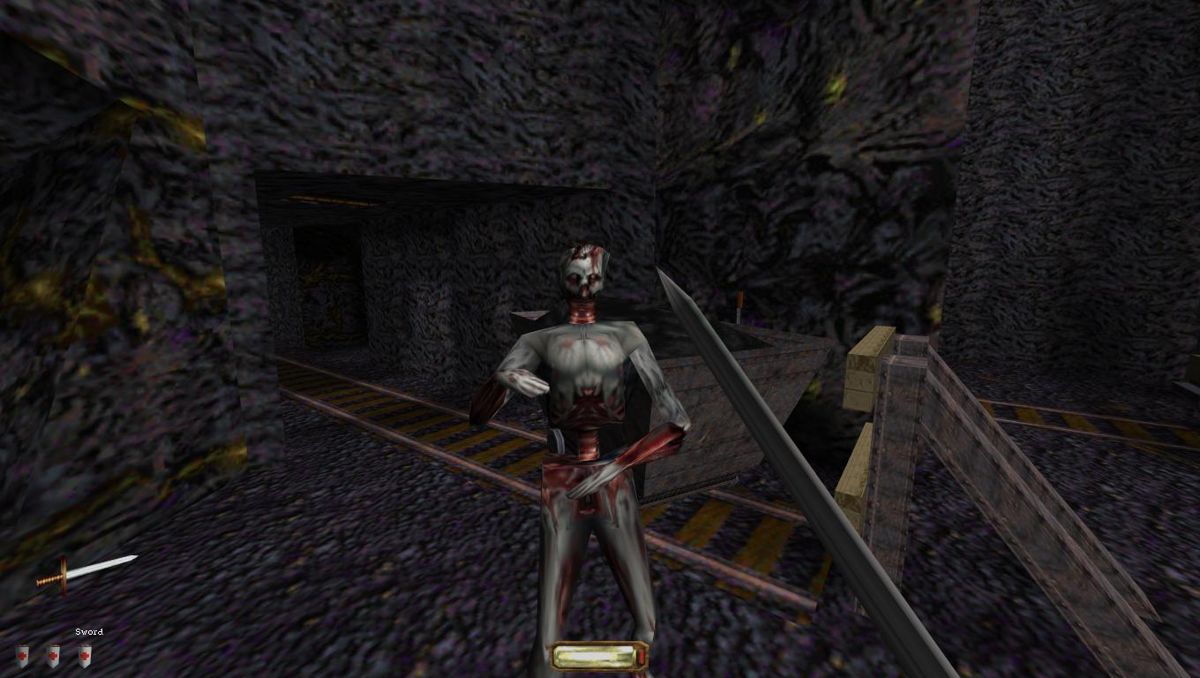
What the players will encounter starts out relatively normal, with Garrett being up against armored guards protecting a rich man's house. In the second mission, Garrett has to infiltrate a prison through some mines beneath, but these mines have undead corpses shambling around them. In the next mission, Garrett robs a massive tomb that is crawling with undead - it's this point that the game's sword and sorcery content, the sense of adventure mingling with supernatural horror with a vulnerable hero exploring forbidden territory, is arguably at its strongest. A later mission, in which Garrett is hired to burglarize another mansion, starts out normal enough but as Garrett ascends the floors he's confronted by bizarre sights like twisting hallways, rooms that are upside down, hallways that play tricks on perspective, rooms that open into infinite voids, and tunnels that seem to shrink passersby down to rodent size. It's Lewis Carroll given a very Lovecraftian twist.
There are no expository dumps in the game. After all, why would Garrett, someone who lives there, need someone to explain How It All Works to him? Between bits of conversation, papers and books the player can read, and simply observing how the world works, it's possible to glean that the setting's history involves some kind of calamity that unleashed an undead plague on the world, and that the Hammerites' ascension involved their ability to fight back against these forces and wall off the most afflicted parts of the city. The fact that they're such humorless fanatics possibly is because of the pressures they face in managing this existential threat. But it's mostly down to interpretation.
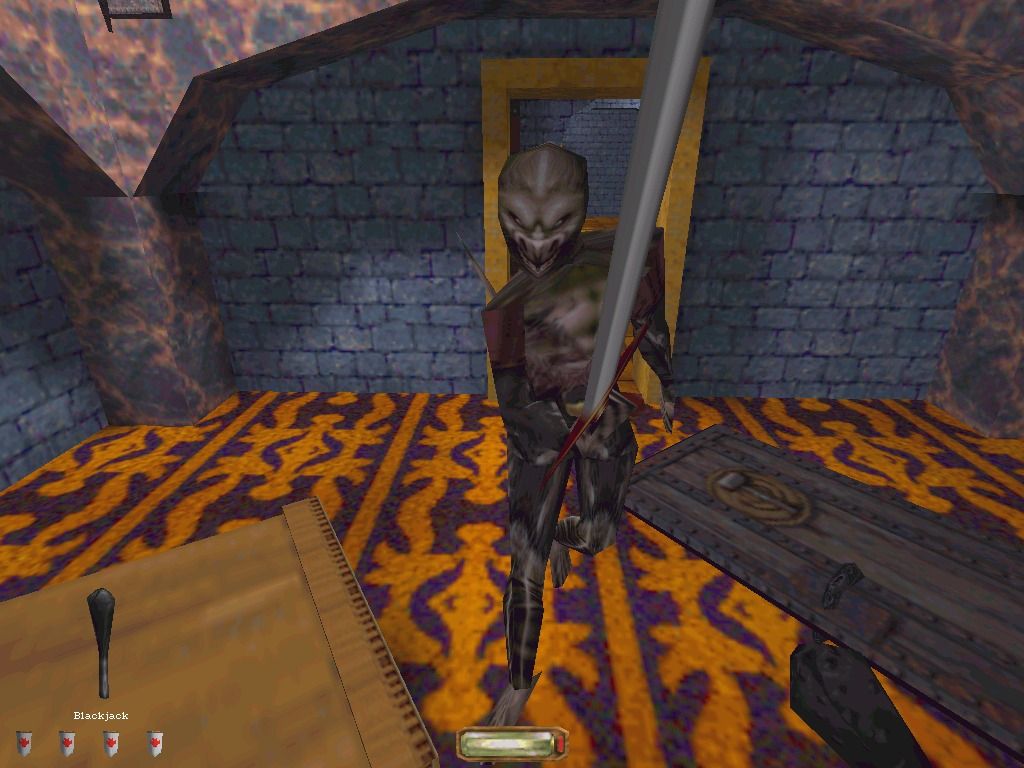
Oh, right, how does it play? As a thief, it's all about staying out of sight and making as little noise as possible. Like the Shadow himself, Garrett practically vanishes in deep shadows. On soft surfaces, he makes very little noise, but metallic or hard-tiled floors are terrifyingly hard to keep quiet on. To help him along, he's got a Green Arrow-like array of trick arrows he can use, such as arrows with vials of water that somehow can silently douse a blazing torch or arrows that sprout moss to give Garrett an instant carpet to run on silently. Garrett's shadow coverage and detectability are indicated through a very simple icon on the screen. Garrett can kill or club enemies from behind, but if he leaves their bodies lying in the open, guards will become suspicious if they discover them. Garrett does have a sword, but he's no Conan or Gray Mouser in swordsmanship and face-to-face encounters are to avoided if at all possible. Although Thief does show its age in its graphics and some AI limitations of the enemies, it's actually still superior to many modern stealth games, especially in how it uses sound to differentiate surfaces. Another nice feature is in how it handles difficulty - instead of the classic move of giving enemies more health or putting more enemies in a level, kicking up Thief's difficulty simply adds more objectives to your mission list, so you're actually encouraged to explore more thoroughly and see more of what the game has to offer.
The game can be a bit rough in controls. Garrett's mantling ability doesn't always work predictably, and his aim with his blackjack or sword can sometimes be infuriatingly picky (fortunately, enemies don't always notice the weapon fanning through space behind their heads). The physics sometimes mean Garrett hilariously struggles to get up a simple step while crouching. And although most of Thief's game time is absorbing to play, in its later stages it sometimes waffles on its own stealth concept and seems to encourage Garrett to fight and generally do things to which the game engine isn't ideally suited, a problem similar to the Tomb Raider games from the same era. Some missions are just not as good as others. Return to the Cathedral in particular is notorious for going from a white knuckle horror experience to exasperation as players have to constantly double-back over the area to fill a lengthy "Oh, just one more thing..." shopping list for an addle-brained Hammerite ghost.
Thief was very well-received by PC players of the time and despite its age is still today rightfully regarded as a first-rank classic. It spawned a sequel that gained even more acclaim; a second sequel that had a more mixed reception but is still considered to have some very good qualities, especially if its modded; and then a modern reboot by a different studio that most people feel just missed the point.
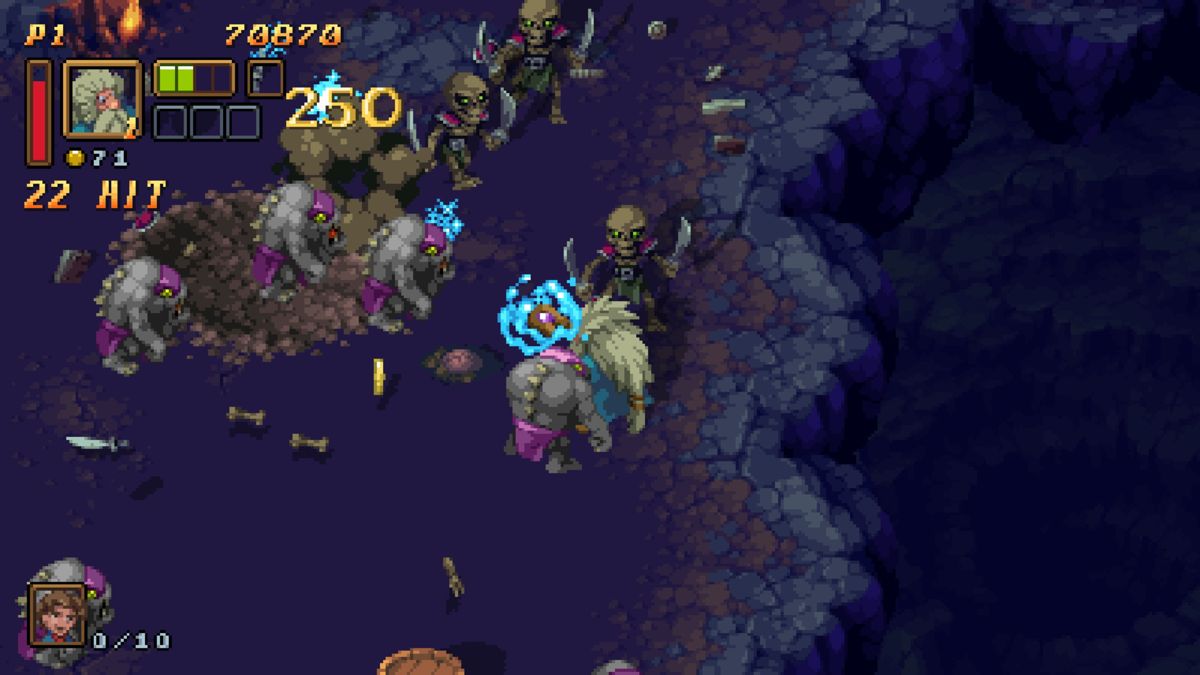
Battle Axe is the Kickstarted brainchild of Henk Nieborg, who wanted to create a game inspired by Gauntlet, Golden Axe, Knights of the Round, and Capcom's Dungeons & Dragons games. The game itself doesn't explain much of a story (not a big deal), but the Kickstarter campaign outlines a Seven Samurai-like scenario in which an evil sorceress sends her orks out from their northern wastelands every seven years to round up new slaves. The player chooses from a selection of three heroes who have answered the pleas for help from the populace: a red-haired pirate who lugs a cannon on his shoulder, a dark elf woman who wields twin blades, and an old wizard.
Nieborg got his start in the early 90s, coming out of the German demoscene and doing graphics for Thalion, working on Ghost Battle, Lionheart, and Ambermoon. After Thalion dissolved, Nieborg's art showed up most prominently in The Misadventures of Flink and the Lemmings spin-off, The Adventures of Lomax. His pixel art stands out especially for its verdant colors and details. He's hung around the industry and has worked in 3D, but with the resurrection of pixel art in indie games, there's now an opening for him to be appreciated for his art in ways that weren't there before. Lots of games feature pixel art, much of it well-done, but there's a repetitiveness to a lot of it, as if the creators were all imitating or taking their lessons from the same sources. Nieborg is an original with his own style. He's one of those sources that the newer developers are aping, much like how many fantasy artists take cues from Frazetta but rarely get the sense of color and mood that Frazetta was so great at.
So Battle Axe is a very nice-looking game. It's on the cartoony side but only just so. It's not meant to be really heavy in terms of mood. A recurring aspect of the four levels is that the action mostly happens on a floating plane, so a bit of parallax scrolling can happen in the background despite the overhead view. Nieborg chose to base the game's resolution on the Sega Megadrive, but it looks more advanced than what a real 16-bit console could do, more like something that would have been released for the Neo Geo. It really does feel like a long-lost Neo Geo game, albeit one with music by Manami Matsumae, who worked on Capcom games like Magic Sword.
In terms of how it plays, Battle Axe does play a bit like Gauntlet in the way it involves monster generators that have to be wrecked, but what it most reminds me of is a fantasy take on Shocktroopers (see? Just like a Neo Geo game). It's fast-moving and quite challenging even on the easy setting. It's easy to get tripped up on traps, especially since the view is a bit more zoomed in than in Gauntlet. The screen can get a little busy at times, somewhat obscuring the gameplay, but it's doesn't cross the line into feeling unfair (contrast with Xeno Crisis, a game Nieborg didn't design but contributed graphics to. A decent but often frustrating experience). Each character has melee or ranged attacks and a rechargeable special move. The game has attracted some criticism for its short length (only about 30 minutes to complete), but that ignores that the game's difficulty will require most players to spend some hours learning the stage design and monster placement and figuring out which characters are most agreeable to their style. There are no continues - you have to finish it in one shot, die and you have to restart. The game is relatively expensive for an indie production, though, and it's advisable to wait for a sale on it.