Lionheart for the Amiga might be described as being like Thundercats except not lame. The story of the game is that Valdyn, a half-man/half-cat swordsman nicknamed Lionheart, is sent on a quest to retrieve the Cat People's priceless Lionheart jewel, which has been stolen by the evil wizard Norka. As an extra incentive, Valdyn's woman was turned to stone by Norka, so he needs to find a cure for her, too. Shortly after beginning his quest on the back of a flying dragon, however, Valydn is shot down by Norka's airship and crash lands in a forest far from his objective, so now he has to fight all the way across the land, through forests, swamps, volcanic lands, and the city and fortress.
The game was created by a team at German publisher Thalion and it's one of the great visual feasts of its era as Henk Nieborg really knocked himself out with the pixel art, pushing the Amiga as far as it could be pushed for 2D graphics. As graduates of the demoscene, Thalion was known for having beautiful games and Lionheart is arguably its masterpiece. Every single element of the game is lushly rendered, from the multi-hued skies to the verdant plantlife, and the parallax background scrolling. There are effects used for the opening and closing cutscenes that are never re-used in the gameplay. And the sound is exceptional for the Amiga, with simultaneous music and sound effects, something Commodore machines often traded off on because of the limited sound channels available. Valdyn himself is very smoothly animated and has numerous poses that also lead to their own specific animations; e.g., step to the edge of a platform and he'll make a show of maintaining his balance. Slide down a steep surface and Valdyn will unveil a new sword-swinging animation specific to that situation. It's the kind of character-based design that was highly valued in the 16-bit era, when every company was hoping a game character would show personality and break out as a popular mascot.
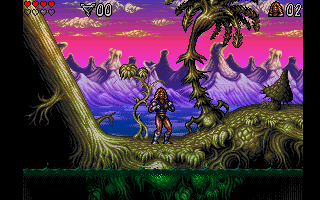
The game doesn't just look great, it plays well, too. Although there's a strong Rastan influence on the game, it plays a bit differently in that Valdyn has to stand still while attacking. Hold the button down and push forward and Valdyn will perform a straight swing of his sword, push up and he'll do an overhead strike, push backward and he'll do a spinning reverse attack. Kneel down, hold the button and push forward and he'll do a low kick. It takes a short while to get used to it but it's not a bad system when you settle down with it, and the game isn't so blisteringly paced that it rushes at you before you've had a chance to practice. Jumping is generally easy to control with the possible exception in some instances of gaps that need a fast running start before Valdyn can clear them.
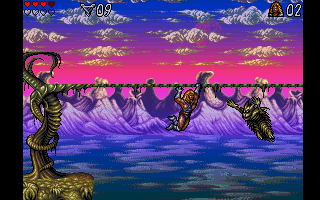
Like a lot of games of the time, levels are full of collectibles for extra lives, attack power-ups, and health refills. Also be sure to find the hidden level to get the magical amulet that unlocks the best ending for the game.
If there's a major flaw in the game, it's that the game is just really long for a game of its genre. Levels play out three or four times as long as those in similar action games, and the game is quite difficult, so memorizing and executing the right path through the game is even more exhausting than usual. It can be done, the game is mostly fair in how it's designed, but there are times when it crosses the line from feeling thrilling to "Huh, this is going on a bit, isn't it?"
The Amiga library is in an awkward place in retrospect. The system was well ahead of its time, delivering 16-bit graphics and sound in 1985, but most of its games were designed for a single-button controller that rapidly went out of date, so players used to advancements in console gaming in particular tend to deride most Amiga efforts at competing with Nintendo and Sega games. Lionheart stands as an example that in the right hands the Amiga was well up to the task of competing.
Although there were no sequels to Lionheart made - Thalion didn't last much longer - Valdyn did reappear in Thalion's classic RPG, Ambermoon, as a recruitable party member. And in recent times, Lionheart was ported to Windows in a freely available version.