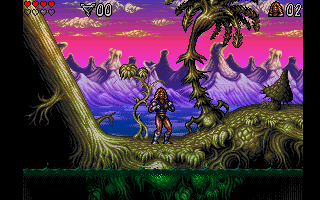
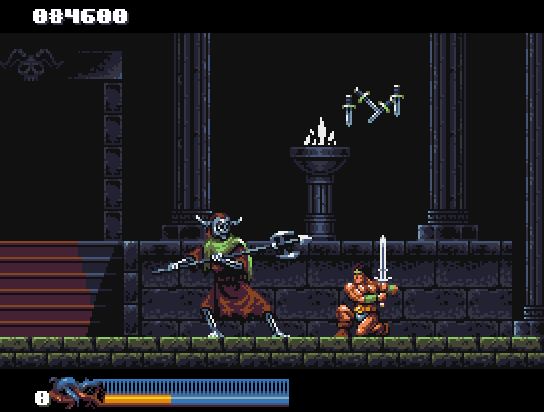
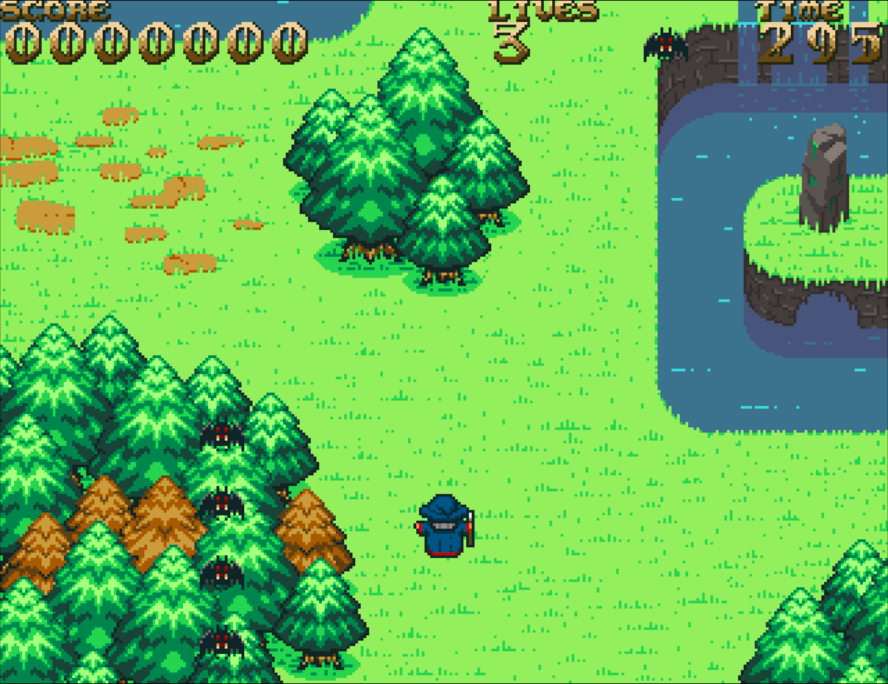
Lionheart for the Amiga might be described as being like Thundercats except not lame. The story of the game is that Valdyn, a half-man/half-cat swordsman nicknamed Lionheart, is sent on a quest to retrieve the Cat People's priceless Lionheart jewel, which has been stolen by the evil wizard Norka. As an extra incentive, Valdyn's woman was turned to stone by Norka, so he needs to find a cure for her, too. Shortly after beginning his quest on the back of a flying dragon, however, Valydn is shot down by Norka's airship and crash lands in a forest far from his objective, so now he has to fight all the way across the land, through forests, swamps, volcanic lands, and the city and fortress.
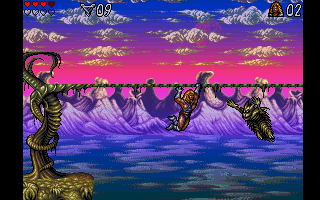
The game was created by a team at German publisher Thalion and it's one of the great visual feasts of its era as Henk Nieborg really knocked himself out with the pixel art, pushing the Amiga as far as it could be pushed for 2D graphics. As graduates of the demoscene, Thalion was known for having beautiful games and Lionheart is arguably its masterpiece. Every single element of the game is lushly rendered, from the multi-hued skies to the verdant plantlife, and the parallax background scrolling. There are effects used for the opening and closing cutscenes that are never re-used in the gameplay. And the sound is exceptional for the Amiga, with simultaneous music and sound effects, something Commodore machines often traded off on because of the limited sound channels available. Valdyn himself is very smoothly animated and has numerous poses that also lead to their own specific animations; e.g., step to the edge of a platform and he'll make a show of maintaining his balance. Slide down a steep surface and Valdyn will unveil a new sword-swinging animation specific to that situation. It's the kind of character-based design that was highly valued in the 16-bit era, when every company was hoping a game character would show personality and break out as a popular mascot.
The game doesn't just look great, it plays well, too. Although there's a strong Rastan influence on the game, it plays a bit differently in that Valdyn has to stand still while attacking. Hold the button down and push forward and Valdyn will perform a straight swing of his sword, push up and he'll do an overhead strike, push backward and he'll do a spinning reverse attack. Kneel down, hold the button and push forward and he'll do a low kick. It takes a short while to get used to it but it's not a bad system when you settle down with it, and the game isn't so blisteringly paced that it rushes at you before you've had a chance to practice. Jumping is generally easy to control with the possible exception in some instances of gaps that need a fast running start before Valdyn can clear them.
Like a lot of games of the time, levels are full of collectibles for extra lives, attack power-ups, and health refills. Also be sure to find the hidden level to get the magical amulet that unlocks the best ending for the game.
If there's a major flaw in the game, it's that the game is just really long for a game of its genre. Levels play out three or four times as long as those in similar action games, and the game is quite difficult, so memorizing and executing the right path through the game is even more exhausting than usual. It can be done, the game is mostly fair in how it's designed, but there are times when it crosses the line from feeling thrilling to "Huh, this is going on a bit, isn't it?"
The Amiga library is in an awkward place in retrospect. The system was well ahead of its time, delivering 16-bit graphics and sound in 1985, but most of its games were designed for a single-button controller that rapidly went out of date, so players used to advancements in console gaming in particular tend to deride most Amiga efforts at competing with Nintendo and Sega games. Lionheart stands as an example that in the right hands the Amiga was well up to the task of competing.
Although there were no sequels to Lionheart made - Thalion didn't last much longer - Valdyn did reappear in Thalion's classic RPG, Ambermoon, as a recruitable party member. And in recent times, Lionheart was ported to Windows in a freely available version.
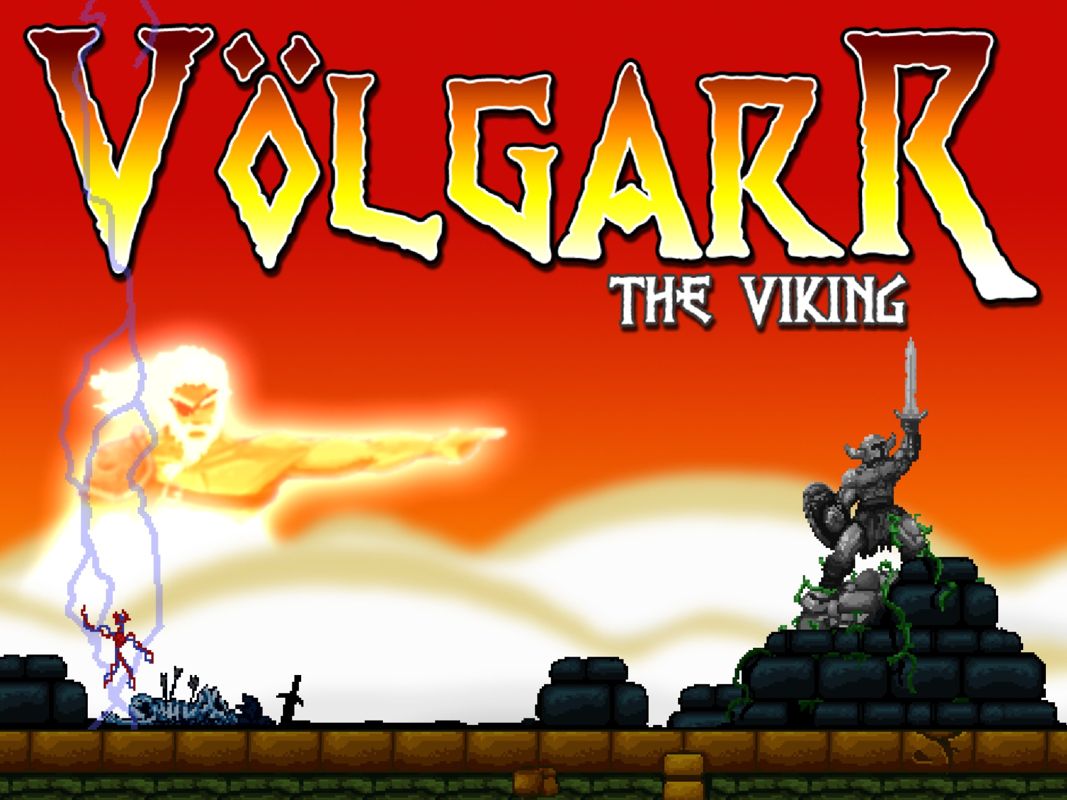
Volgarr the Viking was one of the old Kickstarter success stories, a throwback to Rastan intended to be particularly challenging and gameplay-heavy. "A game with no real challenge is like a cheeseburger with no meat...We're here to put the meat back in the cheeseburger!" the creators, Crazy Viking Studios, said, and they meant it. Volgarr the Viking is a tough game that demands practice and memorization of the best ways to overcome difficult parts.
Being a viking, Volgarr is resurrected by Odin and sent out to fight whatever happens to be in front of him. That's about the extent of the story, although there are multiple endings based on how you play and the endings reveal certain things, such as how Fafnir the Dwarf was transformed into a dragon. The creators weren't kidding when they talked about a "time when games were about the game, not about the cutscenes or cinematic presentation."
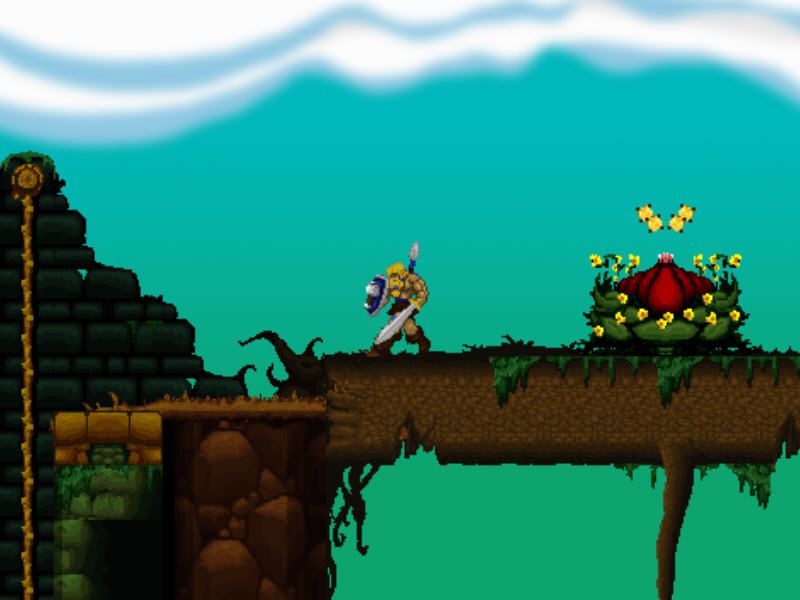
The pixel art isn't a lush knockout on the level of Henk Nieborg's work or the Metal Slug games, but it's solid enough and the graphics are very clear, with characters easy to distinguish from backgrounds at all times, which matters in a challenging gameplay-first game. Despite the Norse theme of the game, Volgarr will cut his way through a variety of Lovecraftian fishmen and lizardmen and other giant bugs and sea creatures.
The music is deliberately non-retro and features stirring compositions by Kochun Hu that stand up well to anything short of Basil Pouledoris's Conan the Barbarian score. There are many sword-and-sorcery B-movies that wish they had music as good as this game does.
To get into the details of how it plays, Volgarr can swing his sword and also throw spears that when thrown into walls also serve as platforms for him to jump on to reach high places. He can move while attacking with the sword but must stop in place to throw a spear. He can also double-jump in midair and stab downward while falling. Similar to Rastan but with a few extra wrinkles thrown in and making progress mostly means knowing which sequence of moves to make in particular situations. Volgarr also has various layers of protection. Get hit once and he'll lose his helmet, get hit again and he'll die. His shield can block attacks but it will break unless a reinforced version of the shield is picked up.
Unlike a lot of modern games, Volgarr doesn't feature liberal use of checkpoints or saving, so if someone plans to get good at the game, they'll do best to carve out some decent time for the game and be willing to die and retry many times until they master just a single level, never mind the whole game. And then even more so if someone wants to get the best possible ending.
Sword of Ianna is a sequel/demake of Blade of Darkness created by the Spanish Retroworks. The premise is that the player controls Jarkum, a descendant of the barbarian Tukaram from Blade of Darkness, who is called by the goddess Ianna to retrieve her sword and defeat another great evil.
What it shares in common with its inspiration is a similar difficulty level in that it tries to replicate the perilous, thin-margined combat of Blade of Darkness in a 2D platformer. Simple enemies can be dispatched quickly but if you don't respect them they can also inflict a lot of punishment on you and leave you handicapped going forward if you can't secure enough healing items. There's also a lot of running, jumping, and climbing involved as Jarkum has to navigate environments inspired by the original game, solving simple puzzles such as finding levers to open gates while avoiding traps. The combat uses the old method of pushing the action button to draw your sword, then holding the button and pushing a joystick direction to execute certain attacks. When not in combat, you can run and climb up or down ledges. The game does feature frequent checkpoints, so dying doesn't cost much of a penalty in terms of time lost. Like many modern games, even the more difficult ones still want you to succeed and progress all the way through to the end.
The game was released for the MSX, ZX Spectrum, and Amstrad CPC computers, the three most popular PCs in Spain in the 80s and represents each system quite well, although the MSX version is probably the most well-rounded of the three. If a game like it had been released back then, it would have been heralded as a classic, with well-drawn graphics featuring large, well-animated characters and moody environments - orc fortresses, musty tombs, and temples of evil based on the original Blade of Darkness settings. The enemies from Blade of Darkness, such as the orcs, dual-sword-wielding skeletons, and golems, also make returns in 2D form. And it has a memorable soundtrack that emphasizes a sense of danger and mystery. One doesn't need to have played Blade of Darkness to get Sword of Ianna, but it adds a little extra layer of appreciation to what the developers present.
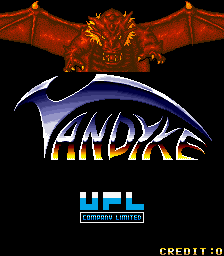
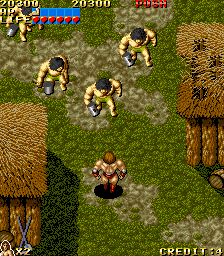
Vandyke is an overhead, vertically scrolling arcade game released by Japanese studio UPL (Universal Play Land). You control the typical muscular barbarian-type hero as he slices through hordes of monstrous enemies. You start out swinging a sword but can power-up by picking up alternate weapons such as a very long flail, bombs, or boomerang-like throwing stars. The game is very accessible, with easy to pick up controls (attack and jump), appealing graphics and music, and a fast pace.
You start out fighting enemies like giant scorpions, toads, and cavemen. The first boss is a mutant elephant with a snake-like man for a trunk. Level 2 introduces the undead skeletons and giant bats, with a medusa-like boss. So far, so normal.
Level 3 is when things start getting a little offbeat. Immediately after starting, the player is beset by what appear to be sashaying, giggling leather daddies with clawed gauntlets on their right hands. Combined with other odd enemies like the men trapped inside rolling disks and the way the hero (it's not clear if his name is truly Vandyke or why the game is called Vandyke at all) strikes bodybuilder poses whenever he grabs a health power-up, it becomes apparent that the game is something of a send-up. It doesn't go into all-out parody, but it's clearly not taking itself very seriously, either.
Beyond that, there's not much to say about Vandyke. It's a fun play but gets quite challenging by the end, and the reward for completing it is a simple screen of the hero looking content, not much more than a simple "Thanks for playing!" message. UPL and the particular creators' output was eclectic, but they didn't do any similarly themed games before or after Vandyke.
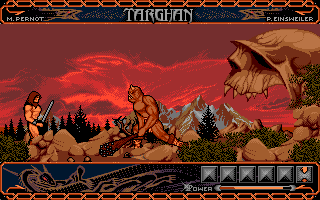
Targhan was the creation of Silmarils, a French studio with a knack for visually striking games with lush pixel art. The game's manual includes some backstory about where the hero, Targhan, comes from, stating that he comes from a village called Edengarfin and that he had grown up to be a great chief of his tribe, but that he left because a legend of an "Evil One" with a great secret kept him restless. The game covers Targhan's quest to defeat this evil wizard.
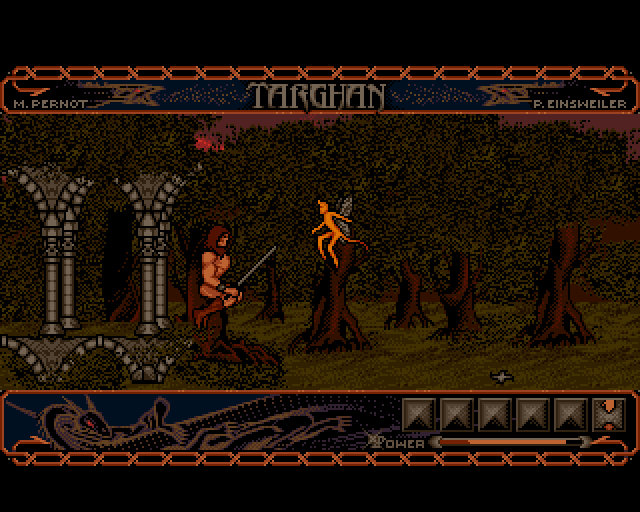
Targhan has the classic sword-and-sorcery hero's uniform: a great, chiseled physique; a long, thick mane of hair; short trunks with a belt; boots; metal wrist bands; a sword; and that's it. He can pick up a maximum of five sub-items like shurikens to use for distance attacks, healing potions, and necessary quest items like keys. He wanders through verdant European forests with deer trotting through the background, to crumbling ruins, to imposing castles. Most of the enemies are humanoids, sometimes rat-headed men and sometimes just men in scary-looking armor. Somewhat at odds with the S&S vibe is that you'll sometimes come up against elf woman archers and in one section you apparently invade a village of dwarves nestled among treetops, killing every guard that gets in your way. It seems the elves and dwarves are as bad as everyone else in this land.
Targhan resembles sideways hack-and-slash games like Rastan but in motion it's quite different. The animation is a bit stiff and the controls seem perhaps influenced by Barbarian's style of holding the fire button while moving the joystick to perform combat moves. When Targhan goes into combat against a humanoid opponent, the fighting is definitely more Barbarian-style, with the opponents hammering at each other until one falls, so it's important to master the timing needed to connect with your swings and hit the enemy before he hits you. Perhaps the creators envisioned a system of thrilling swordfights with impressive attacks and counterattacks, but in practice the most effective technique is generally to just hold the button down and never stop swinging straight ahead. The enemy will try to close in get hit, bounce back, and repeat until dead. For flying enemies like bats, just wait until they descend to attack and then nail them with one swing.
Assuming one gets sufficiently comfortable with the fighting and jumping, the game really becomes a puzzle/adventure game, about knowing which way to go first and which objects to gain to unlock deeper parts of the game. Occasionally Targhan will find scrolls with bits of text that provide hints, but also you just have to work it out through trial and error. For instance, one of the first things necessary is to explore an underground cave system, but obviously you can't see in the dark. The solution is to go back to the surface and wander until you see a small yellow pixie-like creature approaching you. Instead of killing it (which is possible), allow the creature to approach, where it becomes apparent that it's friendly and it begins to follow you. When you return to the caves, it transforms into a floating light source that allows you to navigate the caves without any issue. Like classic adventure games like King's Quest, it's probably helpful to try to map the game out and figure out where all important objects are and the most efficient path to collecting and using them. Then you just have to survive all the fights and vanquish the wizard to get an anticlimactic ending.
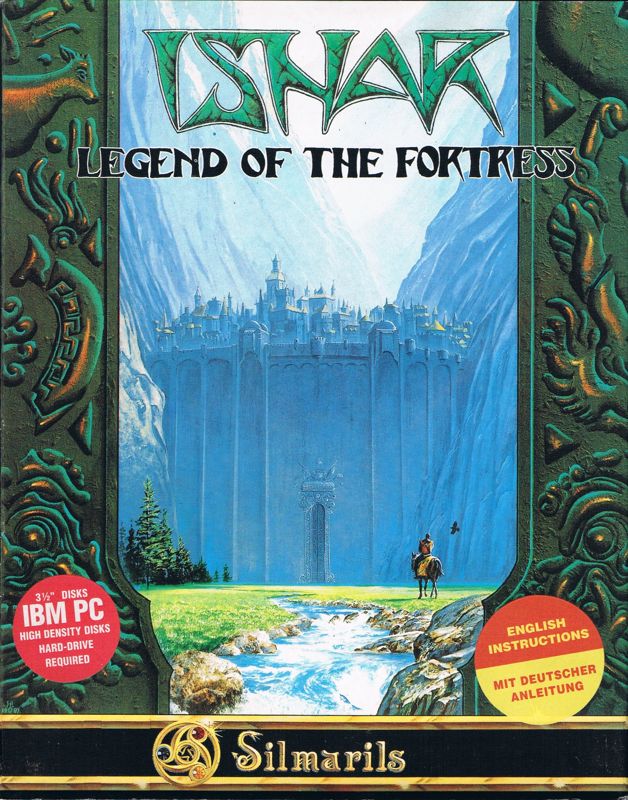
Targhan's no hidden gem but it's not a bad game to play as long as one is patient and willing to put up with its shortcomings for the sake of exploring its little fantasy world for a while. Although it didn't spawn any direct sequels, it wasn't the end of Targhan as a video game hero as Silmarils brought him back a couple of years later as a recruitable companion in its RPG, Ishar: Legend of the Fortress. He's classed as a barbarian in that game and is a tough fighter.
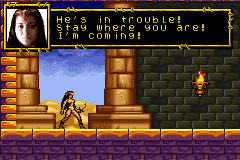
Scorpion King: Sword of Osiris was released to tie-in with...The Scorpion King movie that spun off from Stephen Sommers's Mummy films. Often this means death for video games, but Sword of Osiris had the good fortune of being developed by WayForward Technologies, which around the time of the game's release had begun to distinguish itself by creating games that hearkened back to the glories of 16-bit console gaming in an era where 3D game design was still finding itself.
The game is meant as a sequel to the film and begins with the player controlling Kelly Hu's character, Cassandra, who is lured to a temple only to find that the villains, the wizard Menthu and his partner Isis, have tricked her into thinking they were keeping the Scorpion King Mathayus prisoner.
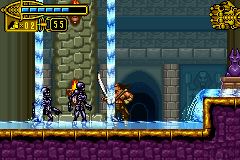
It's one of those fake-out levels video games sometimes use, where the player controls a side character who's meant to be killed/lose the big boss fight at the end of the level. Menthu and Isis defeat Cassandra and kidnap her while the real Mathayus enters the temple to rescue her, so the player repeats the same level but in a slightly different way because Mathayus, being the Rock, plays differently than Cassandra. He can switch between a sword (strong but more limited range) or dual sickles (weaker but covering more area), and he can use the sword to walljump to get to higher platforms. Once completing the introductory level, the object of the game is laid out: Cassandra mentally contacts Mathayus and directs him to uncovering a magical gauntlet called the Hero's Gauntlet, which will help him find the Sword of Osiris, the only weapon that can destroy the Scorpion Stone, which the villains are planning to use to conquer the world. The Hero's Gauntlet, similar to Thanos's Infinity Gauntlet, has four notches in the knuckles that are unlocked after the Mathayus defeats the boss enemy for each level. Picking up fire jewels sometimes dropped by enemies powers up Mathayus's weapons, lighting them up with flame and dealing double damage with each attack but taking hits from enemies depowers them until more jewels are found.
Sword of Osiris isn't a particularly difficult game. Enemies tend to have easy patterns to recognize and adapt to and the game generally avoids the sort of dirty tricks that were common in 1980s and 90s games; e.g., blind jumps leading to instant death. The main thing to grasp in terms of overcoming it is knowing which weapon to use in which situations. It's also not a very long game, with only seven levels, but ultimate victory could be delayed in that gaining the Sword of Osiris, needed to defeat the final enemy and unlock the true ending, can only be done by locating six runes that lie within treasure rooms hidden in each level beyond the opening. Being thorough will allow the player to find the runes but it's easy to miss one or two before you know what to do and that means restarting the game and going back through earlier levels. The game does have a simple password feature to note progress, so it doesn't have to be completed all at once.
WayForward's game are generally not very ambitious in terms of design, but they tend to be very competent and reliably fun meat-and-potatoes action games while sporting excellent pixel art and animation. Sword of Osiris was one of the first games that showed what the company could do - the next game it released after was Shantae, which is now known as a classic Gameboy Color title and the foundation of the company's signature franchise. Sword of Osiris is vibrantly colorful and adequately scratches an itch one might have for some classic side-scrolling hacking, slashing, and platforming. It's superior to any of Rastan's home ports, for one thing, and if it was released today with the license scrubbed off of it, it would probably be welcomed as a quality entrant in the retro game design scene. There's also an argument to be made that it might be better than its source material. The Scorpion King movie was serviceable but it didn't spark a sword-and-sorcery revival despite somehow spawning four more direct-to-video sequels. Sword of Osiris is probably more well-crafted as a game than The Scorpion King is as a movie, although neither is essential.
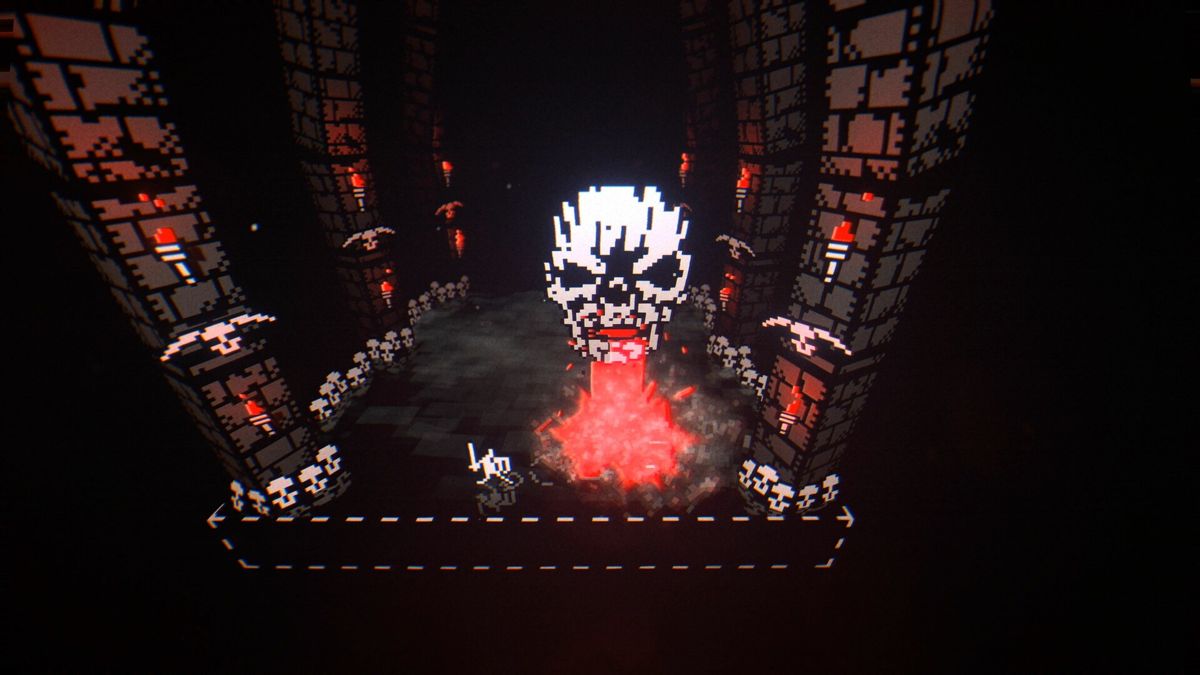
Bleak Sword was originally released on Apple Arcade in 2019, but got an expanded DX edition this year. It was intended by designer Luis Jiminez to do something like Dark Souls on a touchscreen, so it's all about brutal combat with a simple interface. You attack or dodge, with some basic variations, and defeating enemies requires you to study their patterns, make sure you're not in the way when they go for a big attack, and then let them have it while they're open. It's actually a pretty easy game, at least on the PC.
It has a striking presentation. The music is by Jim Guthrie, who was a big factor on Sword & Sworcery, which Jiminez cited as a major influence. The non-boss enemies are small and rendered in minimal pixel art graphics, but what leaps out about the graphics are the diorama-like arenas where the battles take place, some of which add environmental hazards like out of control mine carts.
The game definitely falls more in line with the modern grimdark style, especially the type popularized by Dark Souls. It's a grungy, seemingly hopeless world overrun with demons and slimy predators. Lots of undead and necromancy, with a hero who dutifully trudges through everything because it's really the only thing he can do. Just kill as much as he can until he hopefully ends whatever curse the king has foolishly unleashed. There's a sense of delirium that hangs over everything.
This year's Amiga Game Jam happens to have had the theme of sword and sorcery. There were nine submissions made between October 31 and July 31, and voting is still underway for the next 11 days. Seems like a good idea to have a brief look at the entries (note that most are more like demos or even "proof of concept" than fully completed games).
Rogue Declan Zero, by nivrig, is a "challenging, procedurally-generated, roguelite twin-stick shooter" in which you have to control Sir Declan as he fights through dungeons, closing hellgates that wizards have opened beneath the castle.
It plays a bit like a fantasy version of Robotron and as Rogue-lite games go the difficulty curve seems relatively gentle. It's pretty generic fantasy - people often have differing ideas of what "sword and sorcery" means, as we'll see in some of the other entries - but it's fun, easy to get into, and the dungeons are just short enough to make it easy to play just one more.
******
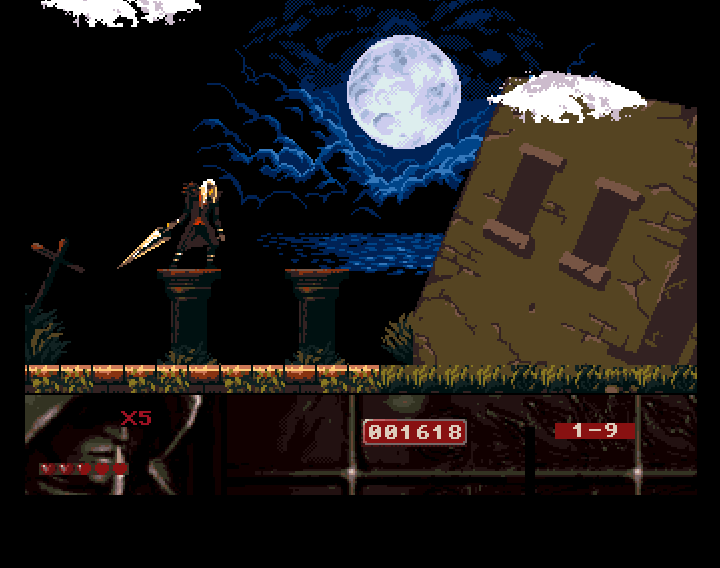
Gothicvania, by Amiten Games, is clearly inspired by Castlevania. Infernal creatures are menacing the town of Valencia and it's up to warrior-sorcerer Sir Lucas to use his magical, fire-spewing sword to defeat them.
This could be a pretty good Castlevania clone if it's completed and such a game would be welcome on the Amiga since the official Castlevania port currently has a 2.98 turd rating on LemonAmiga. As it stands right now, Gothicvania is pretty rough around the edges, with awkward animation and collision detection. Hopefully the creators will continue working on it and fleshing it out.
******
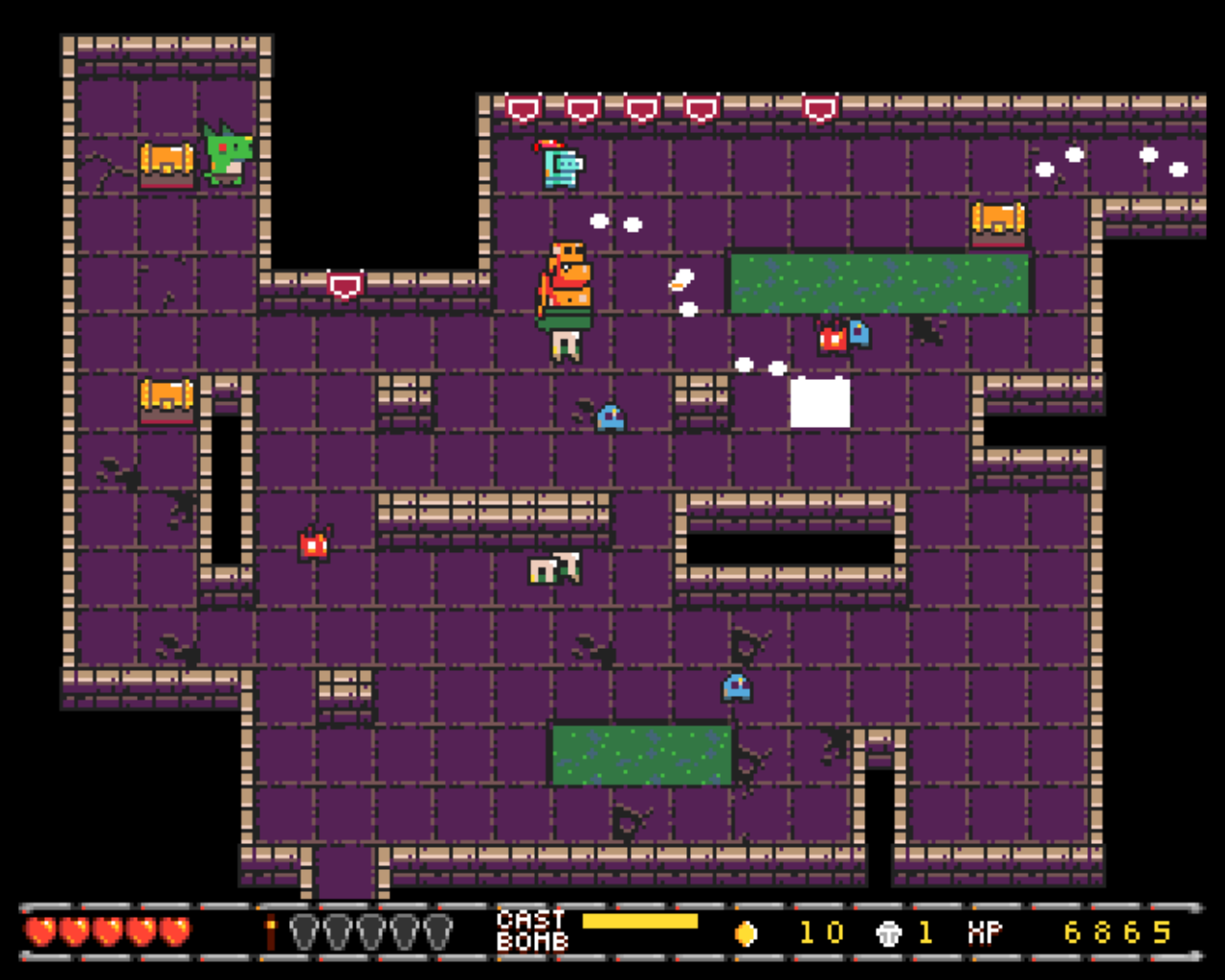
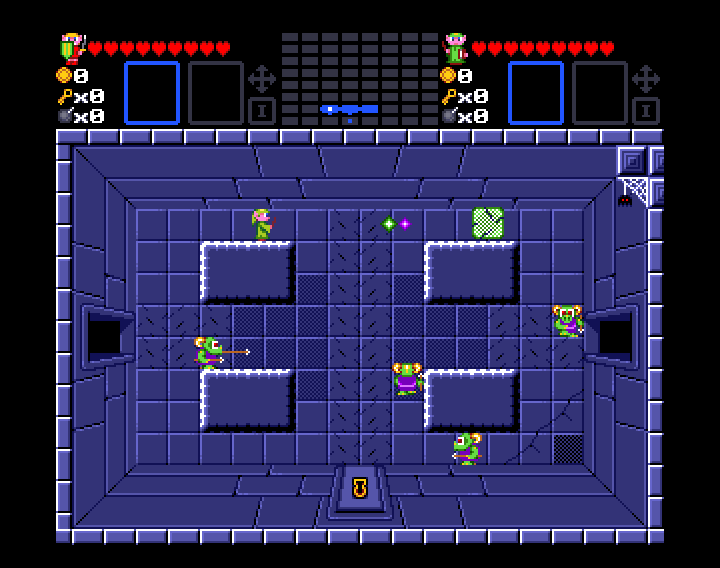
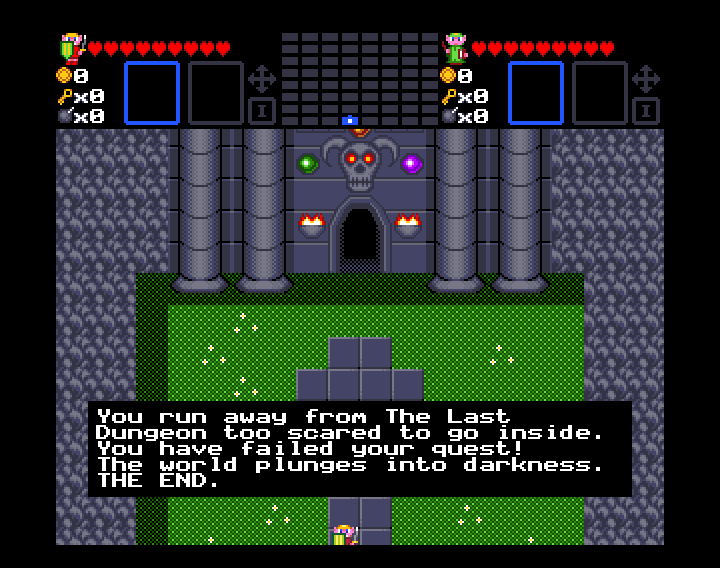
The Last Dungeon, by PixelPlop, is a Zelda clone, specifically the dungeons that you play in the original NES Zelda. Unlike Zelda, you get a choice of protagonists, a barbarian or a wizard (literally sword and sorcery), and it's got a slightly grittier feel than Zelda, with details like bloody pentagrams on the floors and grislier enemies.
As an an attempt at recreating that Zelda feel, it works quite well and really just needs a bit of polishing at this point.
******
Rastan, by basementApe, is exactly what it seems to be: porting the original arcade game to the Amiga 500 as closely as possible. Rastan was ported to numerous systems but the Amiga never got it for some reason, but this version is gathering a lot of interest because it looks and sounds fantastic. It's not an exact translation - aspects of the arcade like the swinging vines have been replaced by moving platforms and the controls haven't been fully implemented - but if things keep up this could end up being the best home version of the game, exceeding even the Apple IIgs version.
******
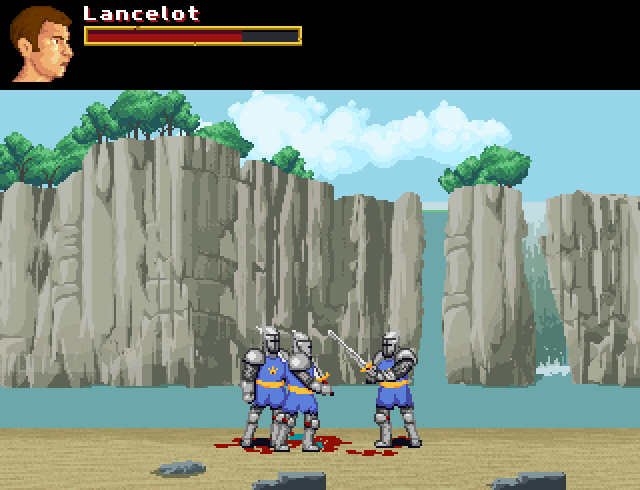
King Arthur: Rise of the Round Table, by Latebit, is a beat-'em-up in which you control Sir Lancelot as he battles a gang of enemy knights. It doesn't last long (defeating all the knights seems to just restart the demo) but there's some quality pixel art, the combat is easy to pick up (high, middle, and low attacks) and the overall look and gory style recall the classic Moonstone. There's some real potential if they stick with it and expand it into a full game.
******
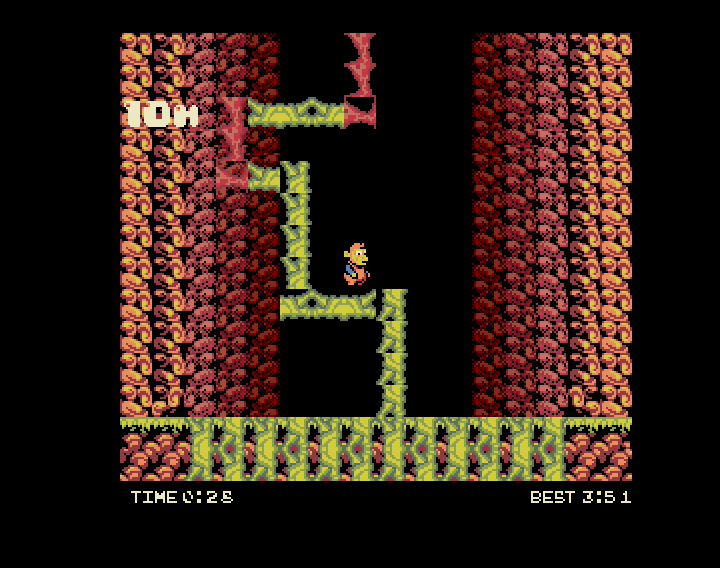
Jack in the Pit, by earok, involves you being knocked from a cloud into a deep pit, so you have to grow a beanstalk all the way back up while various elements try to rip it down from underneath you. The game was apparently created in only 48 hours but it's an impressive piece of work that looks and plays better than many games that have more protracted development times. It's not entirely clear how it fits the theme aside from being broadly fantasy, but at least it's fun.
******
Caravandalf, by Peter and Gordon Mackay, is a caravan shooter (trying to get as high a score as possible within a time limit) in which you control a wizard (Gandalf the Grey?) as he soars through the air blasting enemies. It could definitely use some music, but it's a fast-paced bit of fun for what it is.
******
Holiday, by lifeschool22, is a "photo RPG" that tasks you with surviving a vacation to Spain in 2018. You have to find items like sunscreen to help you survive the oppressive heat. What does this have to do with sword and sorcery? *shrug* Game jams!
******
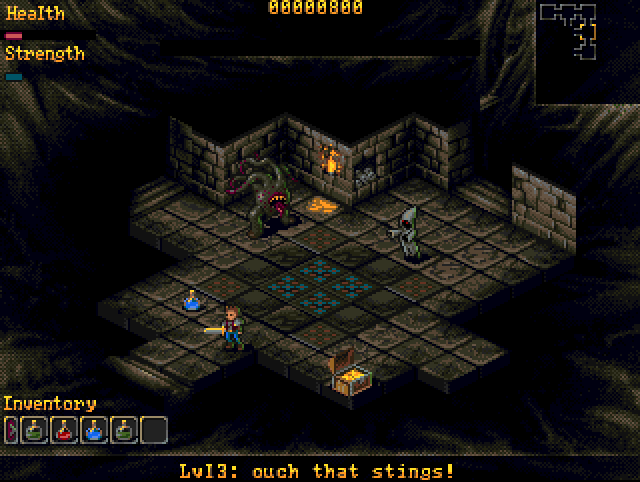
Roguecraft, by Badgerpunch Games, is an Amiga expansion of Rogue 64, a Rogue-like C64 game the creators did a couple of years ago. It's the usual Rogue-like game in that you explore a randomized dungeon, most likely getting killed repeatedly as you learn how the game works and what potions do, but this one has a lot of style.
Not counting Rastan, which at least has the advantage of a classic arcade game providing a blueprint, this is the most impressive overall submission. The impressive graphics are reminiscent of HeroQuest and it generally seems like a fully finished game. It will be interesting to see how the judging goes, but the best of the lot would seem to be between this and Rastan.
Konami got in on the Gauntlet craze with its own 3-player take-off (its first 3-player game) called Dark Adventure, but they gave their game a different slant by favoring a pulpy, Indiana Jones theme instead of Dungeons & Dragons.
Dark Adventure's attract mode informs us that our three heroes, Condor (i.e., Indiana Jones), a pretty blonde reporter named Labryna, and Zorlock, another archeologist who seems inspired by Belloq from Raiders of the Lost Ark, are holding a press conference to announce the discovery of a strange sarcophagus. Condor slides open the lid, the box explodes with light, and the three characters vanish as a voice declares, "Those who tamper with the sacred ark...are DOOMED!" On starting the game, the heroes appear in a strange land of demons and the only way out is to fight their way through to the demon king and slay him.
Condor of course has a whip, Labryna a sword, and Zorlock a spear, and each can also fling sticks of dynamite around. As with Gauntlet, the characters' health steadily (and quickly) declines and can only be restored by picking up soda cans that occasionally appear. The monsters mostly appear from stone generators and exits must be unlocked by finding keys. Complicating things, however, is that levels often feature multiple exits and taking the wrong one can cause the players to loop back to levels they've already played. More powerful weapons, such as laser guns or bazookas can also be found occasionally, or power-ups that can speed up the characters or extend their melee range.
Dark Adventure makes a strong first impression. The graphics are quite nice, with an appropriately dark color scheme and characters that are taller and more detailed than Gauntlet's. The first level features you battling hordes of minotaurs and then suddenly the music picks up as a giant sword-wielding slime monster starts chasing after you, booming with each footstep. Killing this creature will cause it to collapse back into the muck, but if you linger too long the monster will reappear, so there's a sense of urgency created. Unfortunately, the game isn't consistent in keeping up this atmosphere and it feels like it played its best hand right away. There are some cool monsters and sights still to be seen - e.g., demonic trees that try to ensnare you, bat-winged men similar to those Solomon Kane fought in Wings of the Night, and lava-based levels with their own giants - but not much with the impact of that muck giant chasing you on the very first level. Among other creatures the come against you are rats, giant spiders, bats, and the undead skeletons do finally arrive relatively late in the game.
Konami also produced an alternate version for two-player cabinets called Devil World.
Devil World deletes the Zorlock character as an option, and includes some significant changes such as ditching the non-linear progression and starting the characters out with ranged weapons that can be upgraded with a Gradius-style system in which you pick up orbs that can be saved up and traded in when you have enough for whichever weapon you want. On the downside, the game is stripped down a bit in its rogues gallery and its audio presentation.
It never got a home port. Perhaps it just didn't make much money in arcades but it seems like the concept would have been good for an NES adaptation that could have shifted the design more toward something like a more horror-tinged The Legend of Zelda, similar to what Blood Omen did years later.
Diablo is something of a video game precursor to the grimdark movement that has been prevalent in modern fantasy. It begins with the player (players if you're playing online with friends, a big deal on its release) choosing a class - warrior, rogue (archer/thief), or sorcerer - and then entering the town of Tristram. You chat up the few inhabitants and are directed to the nearby church to investigate a case of the archbishop leading many of the townspeople to their deaths in the catacombs beneath the church. Soon you're fighting through hordes of creatures, going back to town to rest up and sell valuables, being given more things to investigate, and are gradually lead deeper and deeper under the earth until you're effectively in Hell. It turns out the source of the town's troubles is that a major demon, Diablo, has been confined deep under the surface but is now stirring and drawing evil to it. Success in conquering the Diablo only results in a downbeat ending. Some popular saying about gazing into an abyss might be relevant.
Reading the game's manual reveals an extensive backstory that describes a Manichean and Moorcockian conflict between angels and devils who represent Law and Chaos, with man somehow being the key to swaying the war one way or the other, and then a history of the town and how it got to its present state. It would probably be better to avoid reading the manual's story, though, as the game's atmosphere is much thicker if the player simply explores and discovers things along the way. Despite being a sword-swinging dungeon crawler, the game feels akin to supernatural horror films like Lucio Fulci's Gates of Hell trilogy, where things follow a sort of nightmare logic and there is no happy ending but just an impulse to push ever deeper in a hope to survive or at least find some answer along the way.
As a game, Diablo was intended by David Brevik to take the old concept of Rogue and its imitators, the randomized dungeon delving, and to simply make it digestible to mainstream audiences. Slick graphics and audio instead of ASCII characters and PC speaker bloops, and easy, streamlined controls based around the mouse instead of numerous keyboard commands. See something you want to attack or someplace you want to go? Just click on it. (There will be so much clicking that you will take a few years off your mouse's life by playing Diablo.) The emphasis is on being able to jump right in and start beating up skeletons instead of wringing hands over rolling up the best character and fussing over their appearance. It was very successful and represented another major step in Blizzard's march to the top of the game industry. To some it also heralded a decline in classic computer role-playing games, another example of video games becoming simpler, dumber, and more action-oriented while claiming to be more highly evolved because of improved graphics and sounds. One way or the other, after Diablo it was common for "action role-playing games" to mimic Diablo's interface, with a red health orb on the left, a blue magic/mana orb on the right, and a hot bar running along the bottom between them.
Diablo does have a certain strategic element, despite its simplified gameplay, which is its emphasis on optimizing a character through picking which stats to upgrade with leveling up while also outfitting the character with the most effective combination of equipment. Another way in which Diablo was highly influential was its stressing of looting the environment even beyond what most traditional RPGs encouraged. Playing Diablo in some respects feels like shopping in how you slaughter a group of enemies and then quickly riffle through whatever they drop to determine what would be good to sell back in town and what would be good to swap for whatever you're currently wearing. By the end of the game you'll be discarding some absurdly effective items because you've already got epic armor and weapons and can't be bothered to even pick the stuff up to sell.
Diablo had one highly regarded sequel, another sequel that was highly controversial, and another sequel that just released that is also highly controversial. The general trend has been toward less grittiness, more epic storytelling, and the kind of broader, more exaggerated art associated with Blizzard's later, post World of Warcraft games, but the original game still has a foreboding and more personal mood and style.
A little while after doing Black Tiger, Capcom took another crack at "Heroic Fantasy" with Magic Sword. Up to two players can take control of a hero who must ascend 51 floors of the Dragon's Tower, defeat the wizard, Drokmar, and destroy the Black Orb that gives him his power. Wizards and their towers...
Unlike Black Tiger's leaping and climbing gameplay, Magic Sword places more emphasis on plain hacking and slashing through mobs of enemies, although some areas do require the player to leap across deadly pits. Magic Sword's primary gimmick is that the player can collect keys that unlock prison cells throughout the tower, freeing their inhabitants (who call out to you with poorly translated lines like "Get rid of me!") so they can fight alongside you. The other party members - Amazon, Big Man, Ninja, Thief, Wizard, Priest, Knight - have particular strengths and weaknesses. Collecting a magic ring will allow you to recruit a Lizardman, arguably the best companion, to your side. The player can also collect various power-up items that have effects such as raising attack or defense or revealing locations of hidden chests. Altogether, the game has a lot of options to test out so the player can settle on what they like best.
At first the number of floors to go through will seem daunting, but as it turns out most of the floors can be cleared very quickly, especially if you just want to move along instead of trying to clear out every single chest on every floor. Every few levels a boss enemy will be revealed, usually a variation of a dragon or chimera. The pacing and user-friendly controls and gameplay help offset the game's running time, making it easy to jump in and start cutting through the enemies, who respawn quickly, freeing prisoners, breaking open treasure chests, and charging for the doors to the next floor.
The graphics are of Capcom's usual high quality, colorful and with well-defined characters. The main hero, shirtless with his long braided blonde hair, is reminiscent of John Jakes's Brak the Barbarian. Manami Matsumae contributes a dramatic musical score. A relatively uncommon feature for arcade games but something that had been appearing in some PC and console games at the time was giving the player a choice between a good or bad ending after defeating the wizard. You could either destroy the Black Orb as directed, or allow yourself to be corrupted by taking it for yourself.
Gauntlet II, once again designed by Ed Logg, is so similar to the original that it feels more like an expansion to the original game than a true sequel. In fact, it was sold as a conversion kit for the original arcade cabinets. It looks and sounds largely the same, but it adds a lot of gimmicks, mostly involving the environment.
Players are now free to choose the same class if they want, with their characters distinguished by their color. Players can push certain blocks around, there are more environmental traps like pools of acid that shift about, teleporters, and force fields that drain health. One of the most entertaining additions is the addition of a Tag mode in which a character can become "it," causing every monster to seek them out until the player can tag a partner and make them "it" (becoming "it" in single player mode makes no difference since the monsters all want to kill you regardless). It's possible to pick up items allowing extra abilities to the player, such as ricocheting shots off walls.
There are a handful of new monsters to fight, the most noteworthy being a giant fire-breathing dragon that takes an enormous amount of punishment before going down.
Although it has a lot of the same flaws as the original, the additional gameplay elements lend it a little more longevity and liveliness as the game can keep the surprises coming for a while.
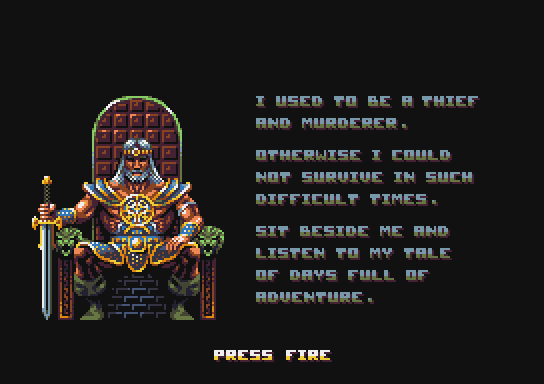
After the dud that was Nastar, Taito concluded its Rastan arcade trilogy with a more respectable effort. In Warrior Blade: Rastan Saga Episode III, we pick back up with old Rastan on his throne, telling more stories of his adventurous past. This time around, he and his friends Dewey the ninja(?) and Sofia, a whip-wielding former princess turned thief, battle foul creatures as they try to claim the jewels of Depon. But of course the story isn't the reason anyone plays a game like this. It's about evoking a certain mood, which is also for the best because the English text translation is lousy, even if no one outside Japan saw it on initial release because the game wasn't released abroad.
The game doesn't appear to share much talent with the previous two games in the series, aside from Masahiro Takaki on music, and it seems that the big plan for the game and getting the series back on track was to largely ape Golden Axe. Instead of a purely horizontally scrolling experience, characters have a bit more room to maneuver up and down and it plays like a traditional brawling game as cooperative players try to take down groups of enemies without being surrounded and struck down from behind. Instead of simply swinging his sword, Rastan has a set of moves he can use, such as charging attacks and even grabbing enemies so he can bash their faces with the pommel of his sword or fling them at their partners. It's mostly standard stuff for the genre, only distinguished by the fact that few games besides this and Golden Axe use a S&S theme.
The graphics look great. The characters are large and well-detailed. Rastan in particular looks very much the Conan clone he was always intended to be, like he stepped out of a John Buscema or Neal Adams drawing. Enemies include classic sword-and-sorcery types like serpent men, rival tribesmen, armored knights, living skeletons (of course), fishmen, and cloaked wizards. Some of the boss enemies are quite befitting of the genre, such as the skeleton of a dead king on his throne that moans "help me" as demons fly out of his carcass, or a giant tentacled sea monster. The stages, most of which can be selected in any order, have names like The Enchanted Castle of Zananstaff, Mahadidekaradi Spiral Tower, or The Palace of Black Demon Religion. There are also interlude stages in which the heroes engage in battles on horseback or while rising into the clouds on the backs of dragons. The heroes themselves don't use a lot of magic, but amusingly you can occasionally summon a wizard and can force him to cast screen-clearing spells on your behalf by booting him in the ass until his meter is spent.
In its own time, the most eye-popping thing about the game was that it used a gimmick Taito had previously busted out for its Darius and Ninja Warriors games, which was to place two monitors side-by-side in one cabinet to create a widescreen image. Not a big deal now, but it really made games standout in arcades back then.
At the game's conclusion, Rastan, mercenary as ever, divvies up the winnings with his friends and parts ways with them, frustrated that he hadn't found what he was looking for and continuing to seek a kingdom for himself. And that was the end of Rastan's adventures in video games, not counting a half-assed attempt years later to throw him in a different barbarian-themed console fighting game.
A couple of years after releasing Rastan, Taito and designer Hiroshi Tsujino unleashed Cadash, which might serve as an indication of how the tides had shifted in fantasy since the decade had begun. Cadash broadly resembles Rastan in that both games were side-scrolling hack-and-slash types (there was no crossover between the teams behind each game), but while Rastan was a pure sword-and-sorcery experience that was made to be a sort of unofficial Conan game, Cadash is a multiplayer, party-based game that tilts more toward the sort of high fantasy that had come to dominate the genre by 1990.
Up to four players can play Cadash simultaneously, each person choosing from a fighter (the closest to the older Conan/Rastan type), a magician, a priestess, or a ninja, each of course with particular strengths and shortcomings. Perhaps following Gauntlet's example a bit, or simply riding the RPG mania that gripped Japan after Dragon Warrior and Final Fantasy blew up, each character has a set of hit points, upgradable equipment, and experience levels, and before getting to the monster fighting players can wander a town speaking to NPCs to get hints about what to do; e.g., when in the gnome village, you need to find a magical item that will shrink you down to their level so you can enter their homes and shops and teleport to the next continent over. Instead of simply going in one direction, the dungeons are somewhat nonlinear and exploration could lead to finding chests with extra power-ups, although a time limit meant the players needed to stay focused on the goal.
By the time Cadash was released, people were starting to perceive Dungeons & Dragons as less of the classic sword-and-sorcery experience it was at the start, where adventures were often just about taking care of localized issues or simply raiding dungeons while picking up a lot of cash, and more like epic adventures where parties were akin to Tolkien's Fellowship of the Ring and the fate of the world, if not all creation, was at stake. The story in Cadash is that demons are rising up to conquer the surface world behind their leader, Baalogue, whose name is a mistranslation of Balrog. Baalogue kidnaps the king's daughter, so the king hires the heroes to get her back and end the menace.
It's a reasonably entertaining game, especially with more than one player, and it being not terribly long offsets how the level design can be a bit dull. It's not nearly as visually or musically inspired as Rastan, but it's not bad in those aspects, either.
The Witcher 3 is one of the most celebrated games of the modern era. It iterates on the gameplay style of the Witcher 2 by adjusting the combat system and shifting to a massive open world peppered with an exceptional amount of uniquely crafted content, much of it with full voice acting.
CD Projekt Red clearly wanted to finally get its video game version of Geralt more aligned with the literary version, so the story in its early phases sees Geralt summoned to an audience with the emperor of Nilfgaard, the Germanic empire that invaded the northlands at the end of the previous game. Geralt is soon reunited with Yennefer of Vengerberg, his canonical love interest, who's been serving the emperor as an advisor, and the emperor tasks Geralt with tracking down Ciri, Geralt and Yennefer's adopted daughter because the emperor is her biological father and wants her with him. Ciri, as the long-lost daughter of the queen of Cintra and the descendant of a crossbred elf-human line with incredible powers (sort of the Witcher universe's version of Dune's Kwisatz Haderach), is an important person, both politically and genetically, so she spends a lot of time evading people who want to take advantage of her, and in this game she's on the run from the Wild Hunt, a group of extremely ill-tempered elves from another dimension who like to snatch people and press them into serving their ghostly hunting party. Geralt is revealed to have been in their clutches before he was freed and rendered an amnesiac, explaining how he got into the state he was in as the original game began.
So off Geralt goes to track down leads on Ciri, reuniting with old friends and enemies, and generally having a variety of new adventures. Occasionally, when Geralt finds where Ciri has been, the game will switch to a flashback in which the player gets to control Ciri and enjoy her ability to teleport around the playfield, zipping behind enemies and backstabbing them.
As with many open world games, the overarching story isn't very compelling, little more than a thread to keep players moving into fresh, unexplored areas. What's more notable is what goes on as the player wanders around that world, running into monsters or bandits that need killing, visiting towns and picking up contracts for witcher's work, or just stumbling across strange happenings that need sorting out. When the game is at its best, there is no game that better conveys the sense of being a wandering swordsman simply getting into adventures. The life of a sword-and-sorcery protagonist who's more interested in making some money or satiating some curiosity about strange local rumors instead of saving the whole world. The major subquests, such as the one about the Bloody Baron, often feel like they could pass as well-drawn short stories or novellas in an extra volume of Geralt's adventures. Even the main storyline, to its credit, is really just about Geralt trying to reconnect with his daughter; Ciri might be of world-shaking importance but Geralt is "but a witcher."
The game is a triumph of presentation. The graphics are beautiful, with various environments convincingly rendered with crisp art direction. The music brings a classically Slavic flavor that has never really been popularized outside Eastern Europe. Most notably, the game has a very large amount of unique writing that makes even the most disposable content feel special. Wiping out a generic group of highwaymen will usually yield at least a letter or journal that explains who they were and why they were there, completely unlike any other generic bandit group who have their own brief stories. And the game handles a variety of tones. Much of it is grim and horror-tinged, but there are times it goes for humor or well-earned sentimentality. It brings back the Grimm fairy tale and Arthurian influences that Sapowski worked into his original stories.
Where the game is less triumphant is in most other aspects; i.e., the gameplay. Although it improves on the combat system in The Witcher 2, adding a nice side-hopping move to the full dodge-roll from the previous game, the combat is still rather unsatisfying in many ways. Geralt has a maddening tendency to auto-target the wrong enemies and in more hectic fights the player could end up fighting the controls as much as the characters in the game. Geralt's context-sensitive moves can be hard to predict - sometimes he'll perform a simple quick stab, but many times he winds up with a slow-developing pirouette. And the combat is often formulaic. Many situations come down to dodging or parrying a strike, hitting exactly two counterattacks before the enemy gets its guard up, and then repeating until the fight ends.
The controls for horseback-riding and swimming under water are also frustrating. The player has to keep Geralt facing forward at all times for them to work correctly, lest they start reversing over and over until the player resets the camera behind Geralt and gives the game a moment to settle down. With Geralt's limited air supply, you can literally drown while trying to get the swimming sorted out.
As an RPG, the game feels like it has an identity crisis, similar to its predecessor. Most of the game's design is in line with standard action games and the inclusion of classic RPG mechanics like gathering experience and leveling up feels at odds. Why is Geralt, such an experienced witcher, clowning around much of the game at a low level? Even late in the game, it's possible to encounter random bandits who can slaughter you in a single blow because they're 10 levels ahead of you, so powerful that it's possible you won't even be capable of hurting them no matter how well you've mastered the controls. And the game doesn't even gate off areas with monsters at significantly higher levels. The whole world is open to you right away and it's possible to run afoul of such monsters at any time, leading to pathetic scenes of Geralt fleeing like a wimp from routine drowners or ghouls.
As a major AAA release, The Witcher 3 is also predictably conservative in how it handles exploration and quest design. It insists on holding the player's hand at all times. Although it's possible to switch off HUD elements like the minimap, you'll still need to refer to the map to get anywhere because the game never bothers to use detailed directions when describing objectives. A character might tell you to visit someone in a particular city but they won't give you an address or note landmarks - you have to use your GPS/quest markers to find out where they live. Contrast with a game like Morrowind, where an early quest involves locating Caius Cosades and the player has to work out on their own where he lives based on information provided. Interesting locations in the game world are marked with question marks until the player gets near them, taking some of the fun out of simply wandering the world, wondering what's beyond the next hill or in those ruins off in the distance. Now you just check to see where the markers are and head over, never needing to bother with empty, unmarked spaces.
As a very large game, some pacing issues do occur at times. The game's second major phase, where Geralt visits the island country of Skellige (a nation of pseudo-Celts who follow Norse religion), often demands that Geralt circulate high mountains or sail from island to island. Although it's quite visually stimulating, the relative slowness of the travel can become wearisome and unlocking fast travel options becomes a priority.
Ultimately, the game and the series as a whole exemplify games that succeed based on their storytelling and general ambiance over their actual game design. They resonate with fans who enjoy the characters and the situations they get in, and with those who appreciate games that prioritize choices and consequences, less so with players who would rather just have a nuanced and exciting combat system.
The game does offer a tremendous value for money. In addition to already being a big game, CDPR created two substantial expansions, Hearts of Stone and Blood and Wine. Hearts of Stone provides a major new subplot in which Geralt has to literally beat the devil, taking part in other activities such as organizing a bank heist along the way. It also brings back Shani as a supporting character, giving fans of the first game who missed her some closure.
Blood and Wine is even bigger, so much so that it's almost a full-fledged sequel in its own right (Witcher 3 and 3/4?). Geralt travels to the French high medieval-flavored duchy of Toussaint to hunt a vampire, and it also serves as a homage to the early short story "The Lesser Evil" in how it involves a princess born under a bad sign. Blood and Wine serves as a sort of victory lap for the character and the series. After trudging through so much blood and mud in the northlands, the sunny, colorful climate of Toussaint can be a relief. Sapowski's stories portrayed Toussaint with a bit of a satirical attitude, falling maybe a bit closer to Don Quixote than The Amadis of Gaul, but in the context of the game it's refreshing to explore a place where the beautiful, well-dressed people seem to actually take chivalric virtues seriously (too seriously at times) instead of simply all being bitter-minded cynics and hypocrites. When the expansion closes with Geralt chilling out at the vineyard he's inherited, there's a feeling he's earned his rest and arrived at a better end than what Sapowski chose for him.
It's hard to look at Victor Vran, a monster hunter in pseudo-Elizabethan gear with a wide-brimmed hat, and not think he looks at least a little reminiscent of Solomon Kane.
Victor Vran's mission in his game, designed by Haemimont Games of Bulgaria, is to cleanse the Eastern European-ish city of Zagoravia from an infestation of demons that have completely upended the place. The only survivors left are the city's beautiful young queen, her guards, and some advisors. Many other demon hunters attempted this before Victor, but he's the last one (besides a young woman who also appears shortly into the game). The good news is that Victor has special abilities that he gained from making a deal with the devil in the past (so he's maybe more akin to the movie version of Solomon Kane...).
Victor must use melee weapons, ranged weapons, bombs, and demon powers to exterminate the hellish vermin from Zagoravia. There are undead skeletons (our old friends), giant spiders, vampires, zombies, ghostly apparitions, living gargoyles, and elementals, among many others. The gameplay is inspired by "action RPGs" like Diablo, but with a more direct, action-oriented approach compared to Diablo's furious mouse-clicking gameplay. Victor Vran plays better with a gamepad as Victor doesn't just run and attack but can dodge-roll and even execute wall-jumps to access areas at higher elevations. There are also no classes for players to choose - Victor always begins the game the same for all players but can be slightly customized as he levels up and players decide what style of Victor they prefer. Fundamentally, it's still rather similar to Diablo, though, in the sense that the game is viewed from a distance above the action and Victor must annihilate literal hordes of nasties and then pick up money and weapons they leave behind before progressing. Many of these weapons have only minor distinctions in terms of damage output and specialized effects and are best sold for extra money back at the queen's castle.
Despite the flexibility offered through Victor's abilities, the game isn't very much about elegance in its combat. Overcoming the game's challenges often comes down to simply hammering at everything in front of you and making sure your lifebar doesn't erode faster than theirs, but if it does you can just hit a button for the health potion and renew yourself, and health refills aren't rare. One of the game's attempts to offset this matter of attrition is through challenges for each area, such as requiring that you rush and defeat a certain number of monsters within a restrictive time limit or equipping things that will deliberately handicap you. It's not a very difficult game otherwise, and it's relatively short, which is probably for the best considering its repetitive nature.
The graphics are quite nice. The regions you explore are full of gloomy detail and the environment tends to get smashed up as you battle through without ever losing an important sense of clarity for the player. It's easy to get caught up in just running around the game's crypts, smashing up the sarcophagi, hoping money or health potions will fall out like you're in a world of piñatas. This does tend to happen in a lot of RPGs, where players are trained to rummage through boxes and barrels for special items.
Conceptually, the monster hunter gimmick might remind some of the Witcher, especially in modern times, and the game very much plays into that by casting Geralt of Rivia himself, Doug Cockle, to play Victor. Cockle doesn't do much to differentiate the heroes from each other and if you were only listening to the game you might easily confuse it for another Witcher installment. The game's voice acting is fine, but the story itself is uninspired and generic and feels bolted on top of the game instead of woven into it, which seems to have been the case as the game spent a while in Steam Early Access and the story was apparently one of the final elements added before its official release.
Valfaris is a semi-sequel to Slain, overseen by Slain's team of Andrew Gilmour and Thomas Jenns. While Slain was a straight fantasy that emphasized swordplay, Valfaris shifts to a sci-fi theme in which the hero wields guns as much as melee weapons. It might be coincidental, but the death metal/gothic/space opera mixture of Valfaris makes the game come across like what you might get if someone decided to combine Contra with Warhammer 40K, especially the old school extra++ grimdark 40K of the 1980s.
Slain ends with a Moorcockian twist that the character you've been controlling, Bathoryn, was actually the hero's sentient sword all along, with Bathoryn and his next wielder looking to the stars for the next adventure. Valfaris picks up with its hero, Therion, landing his wolf-shaped spacehip on his home world of Valfaris (and atop of a bunch of bastards he was going to kill anyway), which was apparently once a paradise but has since fallen into a cancerous decline, doomed to soon be swallowed by the star it's orbiting. It's hard to imagine what an idyllic paradise in these games' death metal aesthetic would actually look like, but Therion seems to have been fond of the place before he left. Much as Bathoryn was battling Lord Vroll in Slain, Therion is on a quest to slay his father, Vroll. Somehow, Therion and Bathoryn are brothers, and Therion even gains the option of wielding Bathoryn during the game.
As grim as the game's story and characters are, there is a sense of nobility and honor conveyed through them. Valfaris comes to a tragic end but the hero keeps his square chin up and never loses his resolve. There's no crying in metal. There's even a bit of humor in the form of his female AI sidekick, who has a wiseass personality similar to Cortana in the Halo series.
Valfaris plays quite similarly to Slain in the sense that in many ways it's just Slain with guns added, but that's in no way a bad thing. The extra layer of gameplay provided by the guns makes the combat a bit more lively and requiring different solutions in different situations. The guns, which are named like all the other weapons in these games (e.g., the Bastard, the Hellhammer) can be upgraded for extra effects. And much like Slain, the game is tough but fair, requiring that the player really learn how to play it instead of button-mashing through.
Graphically, it's even lusher and more impressive than Slain, and it features another very good, heavy soundtrack by former Celtic Frost member Curt Victor Bryant. There are some instances in which the game's art direction can get a bit out of hand and obscure the player's view of the action, overwhelming parts of the screen with particle and lighting effects that completely cover up the characters. Even despite this, it's a dazzling game to look at.
Valfaris does tell a complete story, but much like its predecessor it ends with a hook for another sequel, which will apparently be more of a horizontal shoot-em-up that continues Therion's journey.
The reason it's called Batbarian is because you control a barbarian and his sidekick, a magical bat. The game opens with them being chased off a cliff by a horde of ogres. The barbarian falls so long that the game introduces you to its sense of humor by doing a gag based on the guy falling so long that he starts getting bored. Eventually he hits the ground, deep inside a cavern. He picks himself up, reunites with his bat friend, and they head off to figure out how to escape this strange place.
The game is a Metroidvania with the gimmick that the bat is luminous and can be manipulated by tossing different kinds of fruit for it to eat, and you can get power-ups that allow you to switch among different elemental affinities. Up against an ice-based enemy? Switch the bat to fire mode to make the enemy thaw enough for you to damage it with your sword. Some switches are operated by light, so you'll need to toss a fruit over to the switch so the bat's light will turn on the switch and open the door or create the platform you need to advance. It's an interesting concept in a genre that has rapidly become crowded over the last decade.
It's a light-hearted, humorous game, with the humor slanted more toward farce. It's not funny in the same way as Age of Barbarian, where the humor is based on a specific familiarity with the genre, but more like something you'd find in the old Dragon magazine comic strips, broadly poking at fantasy cliches. Sometimes it's genuinely funny, but most of the time it's merely smile-inducing.
It's a pretty nice-looking game. The graphics are a bit on the miniaturized side, but they still convey a lot of personality and atmosphere. On the downside, between the player character, the bat, and the extra sidekicks you can acquire through the course of the game, things can get very chaotic when combat picks up a lot. Are you tracking your guy or your partners along with the bad guys?
It's also probably one of the more challenging examples of its genre. Metroidvanias tend to emphasize exploration more than anything else and often make the player feel very powerful by the end thanks to all the powers you gain, but Batbarian likes to make the player work for everything by throwing out increasingly tricky combinations of enemies and requiring deft handling of the hero, the bat, and your partner. Although there's an RPG-like leveling system, upon a level-up the game presents the player with a slot machine that, based on when you click, will determine if your offense, defense, or "awareness" increase (awareness seems to increase the radius of the bat's illumination?). The slot machine isn't too hard to use, but it's also a needless bother and if you're not paying attention to it, you might get stuck picking up more awareness increases than is advisable and then handicapping yourself in terms of attack/defense power by the later stages of the game.
The biggest issue the game has is that it's yet another pretty good Metroidvania in a genre that's stuffed with similarly pretty good examples. You could pick it up and have a decent time playing it, but you could say that about many other games as well and when really top level games like Hollow Knight are out there, you need to be better than just decent to stand out. The barbarian theme is amusing but not explored very deeply beyond gags about how he expresses himself in dialogue scenes (do you pick the brutish option or the eloquent one?).
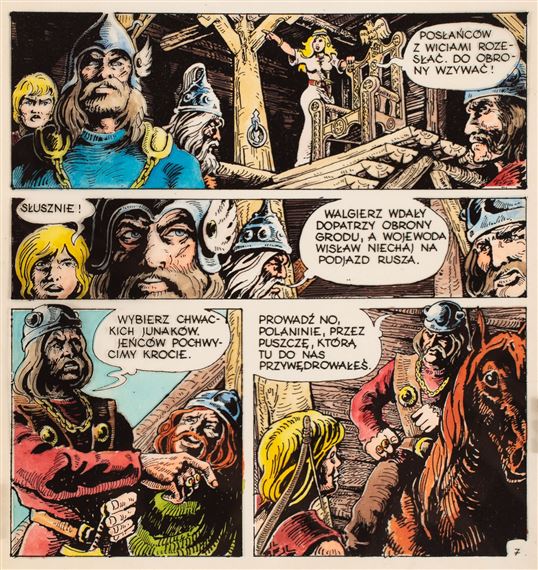
Doman: Grzechy Ardana (Doman: Sins of Ardan) is something of a Golden Axe clone based on a Polish sword-and-sorcery comic drawn by Andrzej Nowakowski.
The player controls one of two characters, Doman himself or his sidekick Baurus, that I assume are the heroes of the comic (it's hard to find information about Doman in English...) and you simply walk down a path slaying everyone dumb enough to get in your way.
The moves are heavily inspired, if not outright swiped from the classic Barbarian, and the controls are similar in how you hold the fire button and then push a direction to perform a specific move. Holding the button and pulling away from an enemy will execute the famous twirling decapitation attack from Barbarian, for instance, and it will decapitate the enemy if their health bar is low enough.
The game was created by World Software, which caused a brief mid-90s stir in Eastern Europe through games that were crudely made but hilariously over the top in their gore and general subject matter. The year before releasing Doman, they made a beat-'em-up called Franko: The Crazy Revenge!, which involved a couple of heroes cleaning up the streets by splattering the blood of street punks all over the place. Not a particularly well-made game, but memorable and funny in a time when simply being edgy and gross was enough to ensure a certain amount of attention. Doman is a bit more advanced than Franko, but only just so. The graphics are little more refined and the controls are a bit easier to use, although it's still very difficult and, like Franko, the levels do go on for a bit. There are some between-level cutscenes and you get the occasional image of Doman reclining on a throne just like Conan did in the movie. The game could have used something like at least one layer of parallax scrolling, but you get the sense that these guys were just having fun cranking out games they wanted to see and were lucky enough to get paid for doing so.
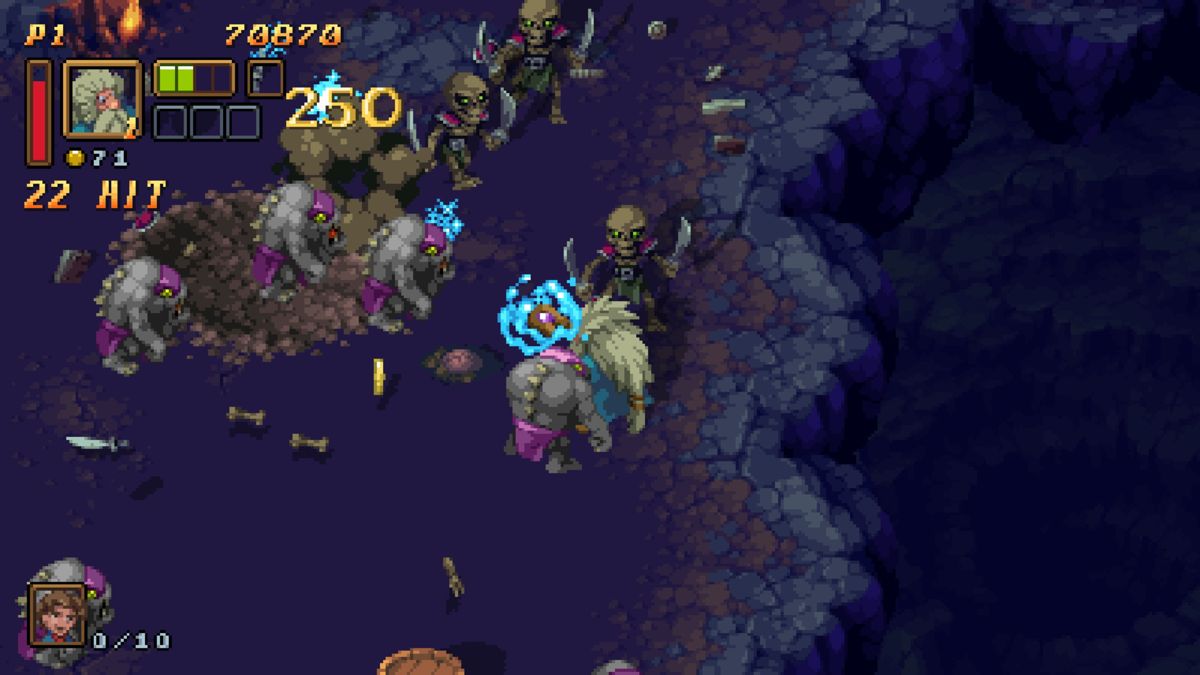
Battle Axe is the Kickstarted brainchild of Henk Nieborg, who wanted to create a game inspired by Gauntlet, Golden Axe, Knights of the Round, and Capcom's Dungeons & Dragons games. The game itself doesn't explain much of a story (not a big deal), but the Kickstarter campaign outlines a Seven Samurai-like scenario in which an evil sorceress sends her orks out from their northern wastelands every seven years to round up new slaves. The player chooses from a selection of three heroes who have answered the pleas for help from the populace: a red-haired pirate who lugs a cannon on his shoulder, a dark elf woman who wields twin blades, and an old wizard.
Nieborg got his start in the early 90s, coming out of the German demoscene and doing graphics for Thalion, working on Ghost Battle, Lionheart, and Ambermoon. After Thalion dissolved, Nieborg's art showed up most prominently in The Misadventures of Flink and the Lemmings spin-off, The Adventures of Lomax. His pixel art stands out especially for its verdant colors and details. He's hung around the industry and has worked in 3D, but with the resurrection of pixel art in indie games, there's now an opening for him to be appreciated for his art in ways that weren't there before. Lots of games feature pixel art, much of it well-done, but there's a repetitiveness to a lot of it, as if the creators were all imitating or taking their lessons from the same sources. Nieborg is an original with his own style. He's one of those sources that the newer developers are aping, much like how many fantasy artists take cues from Frazetta but rarely get the sense of color and mood that Frazetta was so great at.
So Battle Axe is a very nice-looking game. It's on the cartoony side but only just so. It's not meant to be really heavy in terms of mood. A recurring aspect of the four levels is that the action mostly happens on a floating plane, so a bit of parallax scrolling can happen in the background despite the overhead view. Nieborg chose to base the game's resolution on the Sega Megadrive, but it looks more advanced than what a real 16-bit console could do, more like something that would have been released for the Neo Geo. It really does feel like a long-lost Neo Geo game, albeit one with music by Manami Matsumae, who worked on Capcom games like Magic Sword.
In terms of how it plays, Battle Axe does play a bit like Gauntlet in the way it involves monster generators that have to be wrecked, but what it most reminds me of is a fantasy take on Shocktroopers (see? Just like a Neo Geo game). It's fast-moving and quite challenging even on the easy setting. It's easy to get tripped up on traps, especially since the view is a bit more zoomed in than in Gauntlet. The screen can get a little busy at times, somewhat obscuring the gameplay, but it's doesn't cross the line into feeling unfair (contrast with Xeno Crisis, a game Nieborg didn't design but contributed graphics to. A decent but often frustrating experience). Each character has melee or ranged attacks and a rechargeable special move. The game has attracted some criticism for its short length (only about 30 minutes to complete), but that ignores that the game's difficulty will require most players to spend some hours learning the stage design and monster placement and figuring out which characters are most agreeable to their style. There are no continues - you have to finish it in one shot, die and you have to restart. The game is relatively expensive for an indie production, though, and it's advisable to wait for a sale on it.