A bit of an odd choice this time but an interesting contrast in how games are marketed in different regions. Kid Niki the game is a cute action-platformer with a goofy sense of humor. For the North American cover, the company went with this more realistic and fiece image of the hero facing down his enemies with his sword already running with blood, with the damsel in distress at the center looking like a swipe from Frazetta's Egyptian Queen. Not an uncommon occurence in the marketing of 8-bit video games, as we saw with Deadly Towers.
Similar to the Conan game released by Datasoft, Mindscape's Conan for the NES was actually a different game to which they made some modest changes before they slapped the Conan branding on it. At least Datasoft's game was just a game they picked up before completion and publication, whereas Mindscape's was published under a different title on other platforms: Myth: History in the Making.
Myth is another minor classic of old school PC gaming, mainly for the C64 and ZX Spectrum, although the Amiga version has a solid following as well. The 8-bit versions of Myth have some modest differences, but the gist is that a bored high school kid is suddenly called by the gods to battle evil in several time periods, facing enemies drawn from various mythologies such as the Greek, Egyptian, and Norse. The Amiga version altered the concept slightly so the hero is instead a more traditionally muscular, long-haired warrior. The NES version...uses Conan as the protagonist.
The gameplay is a mixture of action and puzzle-solving. You run and jump like in a regular platforming game, fending off attacks from randomly spawning monsters (like many old European games, the emphasis is more on managing your health as you absorb numerous unavoidable attacks from all sides, rather than avoiding hits entirely as tends to be the case in American and Japanese games). In the opening level, for instance, you have use magical attacks to slay monsters (those sword-wielding skeletons again) in the underworld until one drops a sword you can pick up, then you carry the sword to a particular place where a body is suspended from the ceiling by chains. You breaks the chains with the sword, causing the body to fall next to a sea of fire. After slaying this new enemy and causing its head to fall into the fire, a trident-wielding demon rises from the fire. After dispatching this demon, you pick up its trident, carry it until you meet a fire-breathing griffon, which you kill with a throw of the trident. This opens the way to the exit, and you're whisked off toe ancient Greece. It's a bit obtuse, but since your gameplay options are fairly limited you can persevere by simply blundering around until you accidentally hit on the right sequence of actions to take.
Conan of course makes no sense at all as a hero in these kinds of situations. Yeah, he's a man of action, but he doesn't throw magic missiles around, he doesn't time travel, he isn't a pawn of gods. Even so, games can still be fun even if there's something weird about the concept, but the NES version isn't at all fun. The original computer versions have quirky gameplay (e.g., floaty jumping) but it's something that can be quickly acclimated to, but the NES version has horrific controls that make simply picking up the items you need more of a chore than it needs to be. You'd think pressing down on the controller would work well enough, but pushing down actually causes you to jump (pushing up also causes you to jump), so you have to hold down one of the attack buttons and then push down. The collision detection is lousy, so it's hard to get a sense of how close you need to be to enemies to fight them and the sword somehow seems to do even less damage to enemies than punching or kicking them. The imps that release health pick-ups, so crucial since you're under constant assault, are frustratingly elusive. That's just the first level, too. The graphics are poor, too, with the NES version looking even rougher than the Spectrum's despite the Spectrum's limited color palette. About the only positive is that there's music that could be worse. It's a port that shows many signs of laziness and sloppiness. Kind of like how Conan was treated in general in the media around that time.
It's hard not to figure that an action-packed battle to slay a vampire or some other monster isn't a classic S&S premise. For instance, Conan versus Akivasha in The Hour of the Dragon. Karl Edward Wagner's Kane fought werewolves in Reflections on the Winter of My Soul. Much like how Konami's Contra is basically "Rambo and Commando vs. Aliens," Castlevania can be boiled down to being about a Conan-like hero using a whip to fight his way through the entire Universal Horror pantheon, albeit with some tweaks for legal purposes and some other monsters from western culture thrown in to pad out the rogue's gallery.
The original Japanese title is Akumajo Dracula, for which the closest translation appears to be Demon Castle Dracula. The Japanese title was considered a bit too satanic and therefore religious to get past Nintendo's strict "no religion" censorship policy, so it was retitled Castlevania in the West. The hero is named Simon Belmont, who travels to Dracula's castle to eliminate him, armed with a magical whip called the Vampire Killer. The oddness of a vampire hunter using a whip is often remarked on but the reason is simply that the creators of the game were big Indiana Jones fans and thought the whip would be cool.
Director Hitoshi Akamatsu grew up a fan of the Universal horror movies and he wanted to create a game that was very cinematic. The title screen scrolls in sprocket holes at the edges of the screen and there's a moody cinematic showing Simon approaching the gates. Upon finishing the game, the player is rewarded with fake end credits that list names inspired by classic horror icons Terence Fisher, Christopher Lee, Boris Karloff, and...Jean-Paul Belmondo?
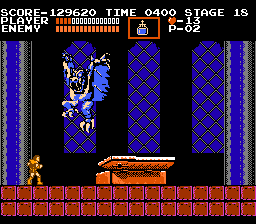
By the time Castlevania came along, video games had evolved from single-screen concepts that demanded quick reflexes and pattern recognition skills for success toward broadly scrolling games that emphasized memorization of level layouts and placement of enemies and traps. Although it's a challenging game, it can be overcome by simply learning where everything is and working out the correct sequence of actions to navigate a section, almost like a puzzle. Simon can't walk and attack simultaneously and the arc of his jump is fixed, so restraint is helpful in determining when to strike and when to move. Success can be made much easier if the player picks up the right alternate weapons depending on which level boss is being faced. The axe works well for the giant vampire bat, while the watch that stops time is deadly to Medusa. The holy water is generally best because it can freeze many enemies while doing constant damage.
Graphically, the game is especially nice-looking for an NES game. Although the system wasn't much for shadows, especially at that period, the game features moody colors with lots of deep reds and blues and well-proportioned, naturalistic figures. The best part of any Dracula adaptation is the beginning in his crumbling, cobweb-ridden castle and the game wisely is based entirely around that. Simon begins outside the moat, makes his way over the drawbridge into an entrance hall lined with ragged drapes, and eventually will pass through bone-strewn dungeons and the water-logged foundations crawling with fish-people, ascend a clocktower, and then finally penetrate Dracula's tower. It's an internally consistent pattern that worked so well that most of the game's sequels adhere relatively faithfully to it. There are various embellishments but the general map doesn't change much. Lastly, all the Castlevania games are renowned for their soundtracks and this one got the series off to a great start.
Akamatsu apparently wanted to set the game up for sequels, much like horror films often do. An idea that doesn't come across clearly in the game is that Dracula doesn't become a demon or reveal a second form after his health bar is depleted, but his head flying off and his body exploding were supposed to be his actual body scattering across the earth, leaving open the possibility of his resurrection (which indeed became the basis of the second game as Simon returned to track down Dracula's body parts). The demon the player fights afterward is supposed to be an embodiment of sin or "an incarnation of the curse of man," insinuating that Dracula's persistence is tied to the darker side of human nature. Akamatsu also clarified that the clock tower, a fixture of the series, is supposed to represent Dracula's heart.
It's a classic game that holds up well and kicked off a series that remained relatively consistent in high quality despite some significant evolutions in gameplay, even if the expansions of the backstory became confusing and somewhat watered down the gut-level appeal of simply battling Dracula, the Mummy, and Frankenstein's Monster.
Deadly Towers, published by Broderbund for the NES. Artist is unidentified? Classic example of the cover promising something the game wouldn't deliver.