
Witchaven's sequel brought back Ken Kelly as cover artist, this time using his Field of Fury as the source.

Witchaven's sequel brought back Ken Kelly as cover artist, this time using his Field of Fury as the source.


Heretic is the fourth game released by Raven Software, a studio founded by Brian and Steve Raffel. With their debut game, an Amiga Dungeon Master clone called Black Crypt, John Romero of id took notice of them and the studios formed a partnership in which Raven would develop games based on game engines id created - ShadowCaster was built on the Wolfenstein 3D engine; Heretic and its sequel, Hexen, were made on the Doom engine; Hexen II on the Quake engine; and onward. Eventually Raven was bought out by Activision and sent to the slave mines to spend eternity working on Call of Duty sequels, but that's not important here.
Heretic's story is mostly conveyed in the manual, which tells us of the Sidhe, "an ancient elf race adept at arcane sorcery and keepers of the Tomes of Power." The Sidhe are attacked by three Serpent Riders from Hell, who begin forcibly converting everyone to a cult called the Order of the Sign, but the Sidhe are immune to the Serpent Riders' mind control, leading the Serpent Riders to brand them...HERETICS! The two more powerful Serpent Riders depart, leaving one behind the manage the situation on Earth and slaughter the Sidhe, but one Sidhe remains to continue the fight and that's you.
Upon starting the game, it immediately becomes clear that Heretic is effectively Doom with the knob cranked all the way to the Fantasy side of the meter. You run and fight monsters, find color-coded keys, and find the exit. Brian Raffel said the studio planned on Heretic being more of an RPG, as they were all D&D fans, but John Carmack advised them to just "do it like Doom, and add the fantasy flavor and other stuff." (This process of starting with something relatively complex and then stripping it down to make a simpler, action-heavy experience sounds a bit like how Wolfenstein 3D and Quake were made. Perhaps it was one of id's advantages in that their games didn't suffer from feature creep like many others but instead emphasized accessible, impactful gameplay.)
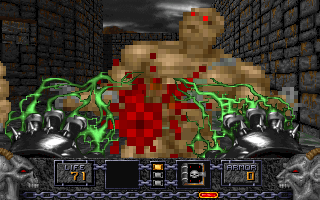
So Heretic became a Doom-like game, but with some expansions on the game engine. You could look and up and down (although the game still auto-aims for you if enemies are above or below), you got a modest item inventory, you could cast a flight spell, and by using a Tome of Power item you could gain powered up alternative-fire versions of the weapons. Most amusing is the morph ovum, a magic egg that turns monsters into chickens.
The weapons are all fantasy-based variations on Doom's arsenal. You start with a simple staff for melee attacks (instead of your fists) and a weak magic wand for a pistol. The crossbow is the shotgun equivalent, the Dragon Claw is the chain gun equivalent, etc. One of the more memorable weapons is the game's version of the chainsaw, a pair of magical gauntlets that send lightning into enemies at a touch.
The monsters, however, aren't precisely 1:1 Doom variations. There are flying gargoyles, golems, undead warriors, snakemen, flying wizards, etc. Some come in intangible "ghost" variations that can only be killed with particular weapons.
The game is often called a Doom clone in a somewhat pejorative way, like people recognize that it's fun but lament that it wasn't more unique, but the thing is that "D&D Doom" or "medieval Doom" or "fantasy Doom" is still Doom and therefore is still pretty good. Raven developed a reputation for making excellent action games, especially FPSs, and Heretic shows they had those talents from early on. Heretic has creative level design and the gameplay additions are interesting without overcomplicating the experience. The art design and audio are very good. It's maybe not quite as "heavy" as Doom in the sense of having a thrash metal edginess about it, but it set the stage for fantasy FPSs carrying more of the sword-and-sorcery feel going forward in its sequels and other games like Witchaven. When a fantasy FPS is made even today, people often compare it to Heretic and Hexen before anything else.

Are they fighting the monster or saluting it?

It seems like there are a couple of particularly strong cinematic influences that keep coming up in sword-and-sorcery games. Conan the Barbarian is the obvious one, and the other is Ray Harryhausen's fantasy movies, mainly his Sinbad movies and Jason and the Argonauts (those reanimated skeletons keep turning up...). Jordan Mechner's Prince of Persia in many ways feels like a Sinbad movie adapted to video game form.
Mechner broke onto the scene in 1984 with Karateka for the Apple II. Karateka, about a Japanese martial artist battling through a forbidding castle to rescue his princess, stood out for its high quality animation and innovative cinematic touches, such as cutting back and forth between the hero and his next enemy as they advanced toward each other and between-level cutscenes that showed the villain scheming. Mechner, never a very prolific game creator, returned a few years later with Prince of Persia, which looks and plays like a refinement of the concepts he was working with in Karateka. The rotoscoped animation is even smoother, the combat is more engaging, and the game is just bigger and more ambitiously designed with its maze-like levels compared to Karateka's strictly horizontal castle layout.
Prince of Persia begins with the sultan's daughter being approached by the grand vizier, Jaffar (it's always Jaffar, why the fixation on Jaffar?), who gives her an ultimatum to concede to marry him within one hour or die. "All the princess's hopes now rest on the brave youth she loves. Little does she know that he is already a prisoner in Jaffar's dungeons...." The player then takes control of the hero, who has just been locked within a...weirdly spacious, multi-tiered cell. Fortunately, a part of the floor collapses under his feet, revealing a tunnel into which he escapes. From here, the player can find a sword that he uses to out-fence guards barring his path and make his way through 12 levels, from the dungeon to the upper reaches of the palace. Along the way, he has to overcome many more guards of increasingly deadly swordsmanship, reanimated skeletons, boobytraps such as spikes that rise up from the floors, and some situations that involve magic, most notably a mirror that creates an evil doppelganger of the hero, before confronting Jaffar in a climactic swordfight.
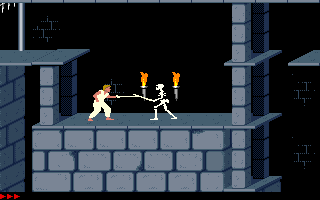
True to Jaffar's word, the player has one hour of real time to get all the way through the game, although the game does allow a save to be made after level 2 is passed. A good strategy to conserve time is to save at the start of a level, explore until the most efficient route to the exit is found, and then reload and make a serious run to the exit. Most of the non-combat gameplay involves running across platforms, triggering doors to open with pressure plates in the floors (a nod to the death traps in the Indiana Jones movies), and then making difficult jumps across wide gaps before the gates can close. Secrets can be found by probing the ceilings for loose plates. Potions are scattered about that can refresh health or poison the player, and there are some with unique effects, such as one that allows the prince to fall like a feather. Combat is simple - the player can lash out with his sword, or perform a parry, and timing and positioning determine if a hit is scored. The combat was designed so that when the hero and an enemy are going full speed, it would resemble the fencing in swashbuckling films like The Adventures of Robin Hood.
Prince of Persia effectively established a new subgenre of games that people took to calling "cinematic platformers" because of the way they often use rotoscoped animation and relatively realistic characters, emphasize cinematic storytelling, and stress a more measured, careful style of play compared to standard platforming games like Super Mario Bros. Games that followed Prince of Persia include the French-made Flashback and Another World (aka Out of This World), Blackthorne, Nosferatu, and The Way, among others. It could be argued that the original Tomb Raider games adapted the genre to work in 3D, as they also emphasize platforming challenges with a frail, somewhat realistic character. The way Lara Croft has to carefully get in position to make leaps is very much akin to how cinematic platformers work.
The game has excellent art direction. The smoothness of the animation - the rotoscoping was based on films of Mechner's brother - was really striking at the time, and the graphics effectively bring across the Middle Eastern atmosphere without requiring a lot of clutter on the screen. The game looks only as detailed as it needs to be. Once you know the controls and move around a couple of screens, you just get how you need to play the rest of the game. Some welcome touches include that the enemies are just as vulnerable as you are - if you harry them backward off a ledge or into a trap, they'll die as surely as you would - and spike traps can be passed if you walk carefully through them instead of the instant-kill-on-touch quality seen in most games. The music, composed by Mechner's father, is sparse but also memorable. There's a rare sense of elegance and restraint in every aspect of the game's design that also extends to how the game handles the sorcerous elements. The game might involve sword-swinging skeletons and mystical doppelgangers, but it still feels like a relatively naturalistic world compared to the crazed delirium the afflicts most games in historical settings (and movies that are inspired by such games). You're just a man trying to rescue his lady from a sorcerer and his minions in a castle. There's no need for the whole planet to be in jeopardy from armies of flame-puking demons rampaging everywhere (not that that can't be fun in the right hands...).
Supplemental reading: Desert of Souls, by Howard Andrew Jones

Blackthorne isn't a sword-and-sorcery game so much as it's shotgun-and-sorcery. The introduction explains that on the world of Tuul, a faction of orcs (or at least creatures close enough to the traditional image of orcs) lead by Lord Sarlac are completing their conquest of the planet. The human king Vlaros, making his last doomed stand at "Stonefist, South of the Borderlands," has his wizard transport his son, Kyle, to Earth to grow up in relative peace and safety. Twenty years later, Kyle, aka Blackthorne, has grown up to be a decorated soldier turned drifting mercenary before he's unexpectedly whisked back to Tuul to have his vengeance on Sarlac and liberate the men of his kingdom through the use of his trusty pump-action shotgun. There's also some gobbledygook involving a Light Stone and a Dark Stone both sides are fighting over that isn't very important. The setting is a mixture of fantasy and sci-fi, mostly blended according to Rule of Cool and hearkening back to days when storytellers were daring enough to mix peanut butter with their chocolate.
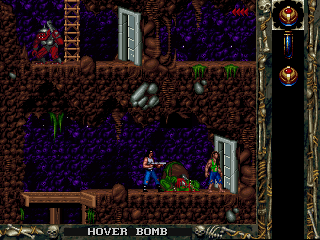
Blackthorne was created by Blizzard back when they were a scrappy independent studio and in many ways it's a classic Blizzard creation in that there's virtually nothing original about it, but what it does have is a lot of coolness and sheer playability. It's a cinematic platforming game in the mold of Prince of Persia or Flashback, but classics as those are most people would likely reckon that Blackthorne is just cooler than those games. Blackthorne himself is a gritty, Snake Pliskin-like figure with his long black hair; white tank top, jeans, and boots; and a pair of sunglasses that he never, ever removes. The heroes of Prince of Persia and Flashback are relatively humble in appearance - the prince having to traverse dungeons in what appear to be baggy white pajamas, and Flashback's Conrad Hart running around in his sneakers - while Blackthorne is jacked up like an 80s action hero. Everyone who's played Blackthorne remembers that the coolest move in the game is having Blackthorne extend his gun backwards to do a no-look blast. It's a move that has almost no practical use, but the fact that you can do it and it looks totally badass is enough. Blackthorne is also the only original game that features cover art by comics artist Jim Lee, back during his mid-90s commercial peak no less. Say what you will about how Lee stacks up to great cover artists, his red-hued image of Blackthorne against a black background really leapt off store shelves at the time and probably earned Blizzard a number of extra sales. The soundtrack alternates between moody horror and propulsive action to great effect.
Otherwise, Blackthorne plays like a typical example of its genre, albeit a well-polished one. Blackthorne himself is smoothly rotoscoped and must climb ledges and carefully make leaps across broad chasms. He can talk to imprisoned slaves to get hints and items. Special items such as keys, bombs, and portable elevators must be used to overcome obstacles. The gunplay centers around the characters leaning into the background and then popping out of cover to nail a shot before the opponent can duck back again. The enemies get increasingly smart about how they fight as the game progresses and mastering the timing needed to bring them down can get tricky and unfortunately somewhat tedious. There's a bit of tension between the game's hard rockin' imagery and the genre's insistence on patience and careful, measured play. One has to wonder, had Blizzard waited just a bit longer to develop it, if the game would have been more fast-paced to compete with the mid-90s explosion of the first person shooter.

Keith Schuler designed Realms of Chaos and released it through Apogee as a DOS shareware title in 1995. Schuler would go on to contribute to Duke Nukem 3D, Shadow Warrior, and Borderlands.
The game's premise is that the brother and sister team of Endrick and Elandra must rid the land of evil in a side-scrolling action game that broadly resembles Rastan. Endrick is a swordsman with a strong melee attack, while Elandra is a sorceress who can attack at range as long as she has gems for ammunition and she can jump farther than her brother. The player must switch between them depending on circumstances, but if either one dies the player must restore a saved game to continue.
There's a loose story to the game that develops in text after each episode, and that story is tongue in cheek, particularly the revelation that the game is a distant sequel to Schuler's previous puzzle-solving game, Paganitzu. Profile pages on the characters inform us that Endrick likes chocolate and Elandra loves strawberries and poodles. But in terms of how the game looks and plays, it carries the sword-and-sorcery aesthetic as well as any game. The heroes battle their way through lushly VGA-rendered forests, swamps, dungeons, and caverns that are inhabited by creatures such as giant frogs, rock men, goblins, and minotaurs. Endrick could almost pass for a descendant of Conan and Elandra is a hot chick who throws fireballs in a scant outfit.
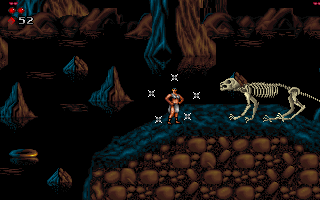
Schuler demonstrates a strong and varied grasp of level design. Some levels are mostly horizontal, some emphasize verticality. There are various types of traps and gadgets such as elevators and swamp rafts. Some levels are mazelike. There's a forced-scrolling type that forces the player to move quickly. Another requires that you ride a snake-like platform upward. The need to switch between characters is well-distributed; you never go too long before switching or get the sense that one character is better than the other.
Although the game uses a lot of the sampled sound effects common to shareware games of the era, the animation is particularly good, with touches such as a Endrick sheathing his sword when it's not in use. It can be completed well within a day, although it's not lacking in challenge. The difficulty increases at a smooth rate through the first, free episode, but the second episode has a significant difficulty spike and it's not impossible to get stuck in a position where it's exceptionally hard to defeat the final boss monster, a questionably designed stone giant that involves random elements in addition to the creature's regular attack pattern. Episode 3 is more in line with the first but there are sections that will almost certainly require that the player save and restore a lot because certain fatal traps can only be found through trial-and-error.
A modest game but good for a dull afternoon.
SKALD: Against the Black Priory is a Kickstarted RPG by Anders Laurindsen that hearkens back to classic PC RPGs, particularly those for t...


