Showing posts with label Capcom. Show all posts

Thursday, April 27, 2023

Magic Sword (1990)


A little while after doing Black Tiger, Capcom took another crack at "Heroic Fantasy" with Magic Sword. Up to two players can take control of a hero who must ascend 51 floors of the Dragon's Tower, defeat the wizard, Drokmar, and destroy the Black Orb that gives him his power. Wizards and their towers...

Unlike Black Tiger's leaping and climbing gameplay, Magic Sword places more emphasis on plain hacking and slashing through mobs of enemies, although some areas do require the player to leap across deadly pits. Magic Sword's primary gimmick is that the player can collect keys that unlock prison cells throughout the tower, freeing their inhabitants (who call out to you with poorly translated lines like "Get rid of me!") so they can fight alongside you. The other party members - Amazon, Big Man, Ninja, Thief, Wizard, Priest, Knight - have particular strengths and weaknesses. Collecting a magic ring will allow you to recruit a Lizardman, arguably the best companion, to your side. The player can also collect various power-up items that have effects such as raising attack or defense or revealing locations of hidden chests. Altogether, the game has a lot of options to test out so the player can settle on what they like best.

At first the number of floors to go through will seem daunting, but as it turns out most of the floors can be cleared very quickly, especially if you just want to move along instead of trying to clear out every single chest on every floor. Every few levels a boss enemy will be revealed, usually a variation of a dragon or chimera. The pacing and user-friendly controls and gameplay help offset the game's running time, making it easy to jump in and start cutting through the enemies, who respawn quickly, freeing prisoners, breaking open treasure chests, and charging for the doors to the next floor.

The graphics are of Capcom's usual high quality, colorful and with well-defined characters. The main hero, shirtless with his long braided blonde hair, is reminiscent of John Jakes's Brak the Barbarian. Manami Matsumae contributes a dramatic musical score. A relatively uncommon feature for arcade games but something that had been appearing in some PC and console games at the time was giving the player a choice between a good or bad ending after defeating the wizard. You could either destroy the Black Orb as directed, or allow yourself to be corrupted by taking it for yourself.


Tuesday, November 29, 2022

Black Tiger (1987)


Black Tiger (aka Black Dragon) was created by Capcom under the supervision of Yoshiki Okamoto. Okamoto got his start at Konami, where he created Time Pilot and Gyruss, and at Capcom he had his hands in a whole bunch more classic games, such as Gun.Smoke, 1943, Willow, Magic Sword, and Armored Warriors, not to mention mainstay franchises like Street Fighter, Final Fight, and Resident Evil.

In Black Tiger you control a classic Frazetta-esque warrior as he fights to free the land from the clutches of three dragons that have descended on it. This takes the form of you running and jumping among platforms while blitzing your way through any creatures that oppose you. You wield a long flail while simultaneously hurling a spread of three daggers, which sounds impressive except that many enemies can take a good amount of punishment before going down. The levels scroll in all directions and have maze-like qualities, making it easy to take wrong turns and run down your time limit while your health gets chipped away. It's a pretty tough game and success is best achieved by memorizing the most efficient routes and enemy placements while keeping on your toes for any random attacks that spring up in your path. The likelihood of managing this is low, however, and the game is very much eager to eat your quarters for continues. It's also a long game that could take up to an hour to complete.

There's a modest RPG influence on the game in that you collect money (zenny) from fallen enemies, chests, and vases and you can find shops to spend that money on power-ups. Be careful of trapped chests, though. You have to find keys to unlock chests, and can gather hints by restoring to life wise men that have been turned to stone.

Black Tiger has a striking graphical look. Not overly lush or fancy, but cleanly designed and the hero and the monsters have solid, relatively realistic proportions that would be more eye-catching to a traditional western fantasy audience, rather than super-deformed styles that are common in Japanese games. The hero himself, clad in his horned helmet and scant armor, looks like he leapt right off of a classic paperback cover. It's rarely hard to track what's happening on-screen. However, there is a sameness to the levels that grows wearisome in their length. There's some recycling going on with the boss enemies - even the dragons are basically just the same enemy repeated three times. Combined with the relatively long clearance time required, Black Tiger comes across similar to games like Gauntlet or Rampage, where a little bit of the game goes a long way and it's often easier to just play a credit or two before moving on. If you do persevere, you get a congratulatory message on your strength and prowess and the credits roll over an image of the hero resting on a throne (got to get that classic throne pose in there), but at least this hero gets to have an attractive lady on his knee instead of just glowering in his loneliness like Rastan or Grandoval. 


Monday, September 12, 2022

Trojan (1986)


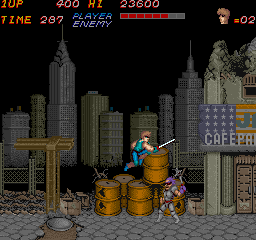
When sword and sorcery started fading from prominence in the 80s, one of the genres that arguably picked up the standard and gave audiences some of the same feeling was post-apocalyptic sci-fi/action. Generally (though not always...) lacking in sorcery or fantasy elements, but stories about hardened warriors wandering a bleak landscape, often having to revert to melee weapons because of scarcity of firearms, coming into conflict with local warlords, and then moving on the next adventure. Trojan (Tatakai no Banka - Battle Song?) takes place in one of these scenarios. 

The player controls a man armed with a sword and shield as he hacks his way through the demon army of a tyrant named Achilles. The game begins in a ruined city, then proceeds through wilderness, dilapidated factories, and ends up at Achilles's classically styled palace. Many of your foes are just armored men with maces and crossbows, but some appear to be flame-spitting mutants and others have bionic attachments like a metal arm with an extendable claw. Some especially annoying guys will use gyro-packs to attack you from the skies. Some enemies can knock your weapons away from you, forcing you to fight with your hands and feet until you can retrieve a fresh set, which makes the hero look like a total badass in his ability to adapt. 


It's the fourth game designed by Takashi Nishiyama, who broke in at Irem and created Moon Patrol, and then went on to design Kung Fu Master/Spartan-X (inspired by Jackie Chan's Wheels on Meals) before leaving for Capcom. Trojan feels like a spiritual successor to Kung Fu Master in that both games are strictly horizontally-scrolling brawlers in which you often have to determine if it's better to move forward or to turn around and take care of the goons breathing down your back while also minding the knife-throwers and other threats still coming from the front. Trojan is a lot more hectic than Kung Fu Master, and Capcom's influence shows in how the game, much like Ghosts 'n Goblins, requires you to beat it twice before it's considered properly completed. The "true ending" for Trojan, though, only amounts to some insignificant changes in the ending text and most players should feel satisfied if they only complete the first loop - that's an accomplishment in itself.

Visually the game is exceptionally dark, mostly taking place at night, with lots of muted gray and brown backgrounds, while the somewhat more colorful characters look very manga-influenced. Although the game has a lot of the popular hallmarks of the genre, with the crumbling buildings and goons in big shoulder pads, it's hard to imagine that the game wasn't heavily inspired by Fist of the North Star, particularly considering its Japanese origins. Fist of the North Star was a very hot series at the time and had a bigger impact on video games than many westerners realize. For instance, it was also a primary influence on Double Dragon, despite popular assumptions that Double Dragon was some kind of campy take off of The Warriors or martial arts B-movies. 


SKALD: Against the Black Priory (2024)

  SKALD: Against the Black Priory is a Kickstarted RPG by Anders Laurindsen that hearkens back to classic PC RPGs, particularly those for t...