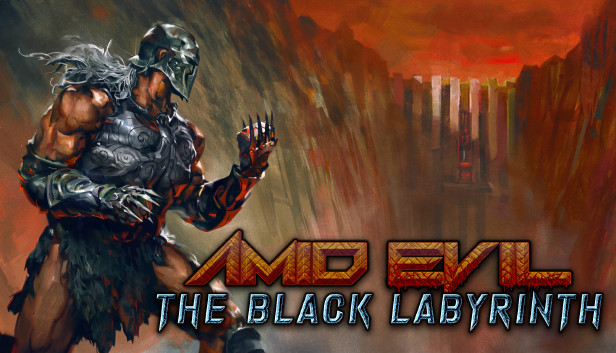
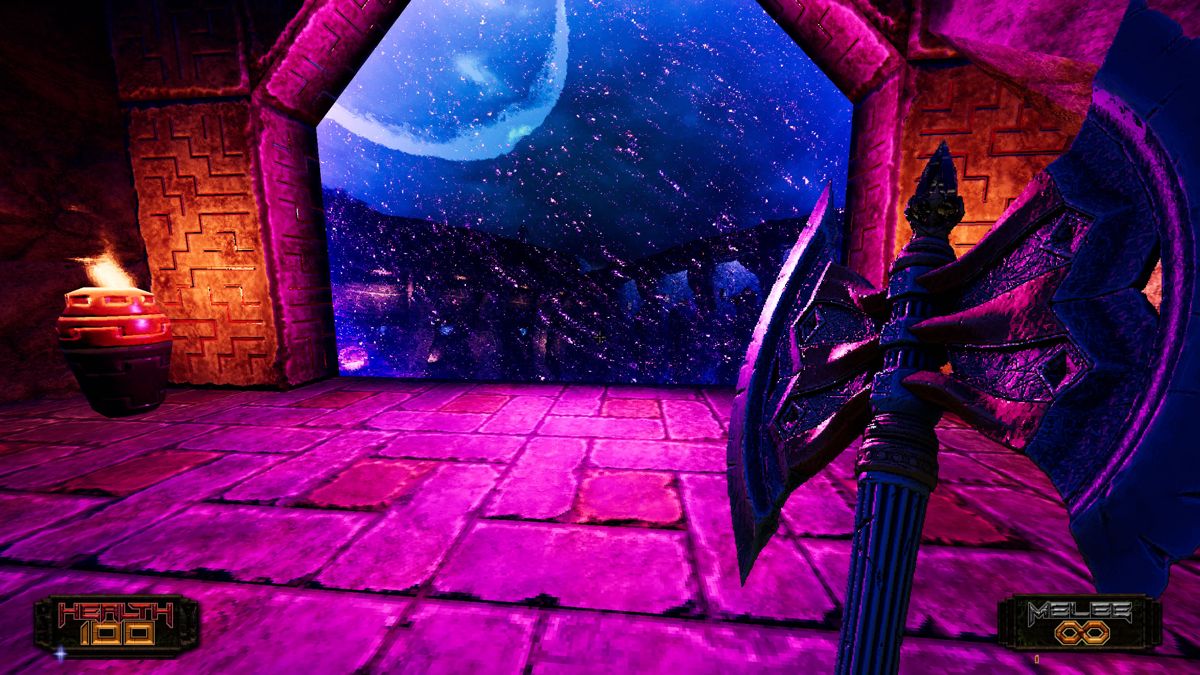
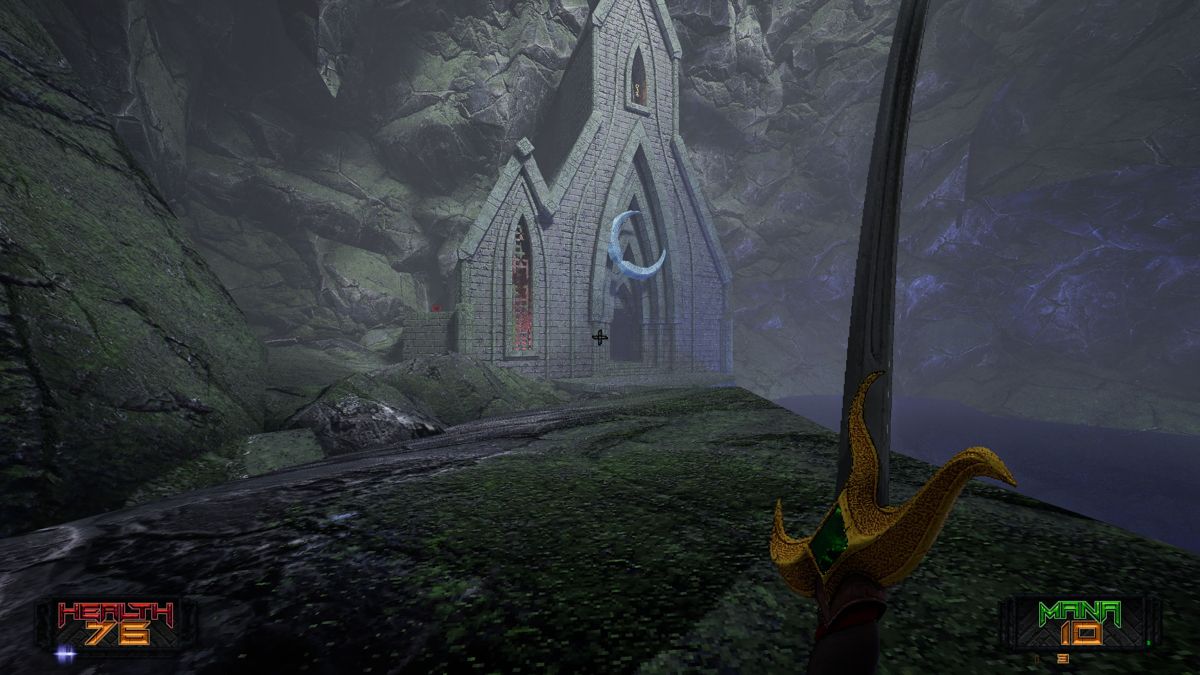
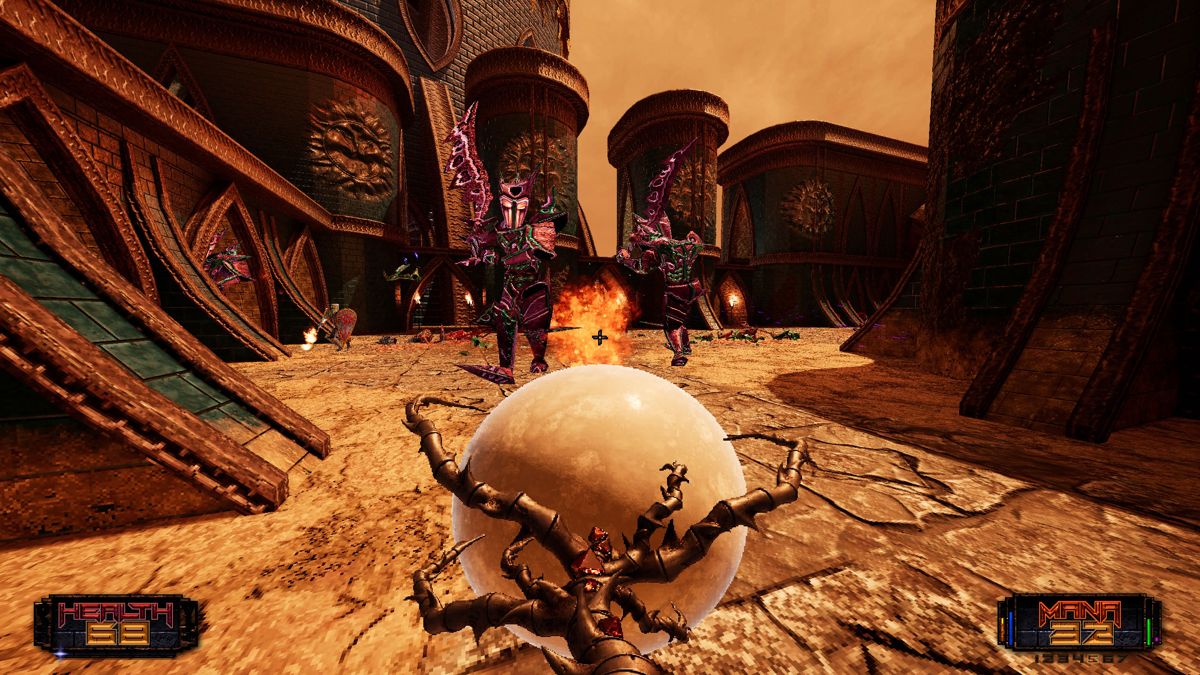
When Amid Evil begins, it establishes that you're the champion of the gods because you conquered the Black Labyrinth and seized the mystical axe at its end for yourself. So when Indefatigable wanted to do an expansion of the game, it only made sense to do a prequel in which you get to see what the Black Labyrinth is like for yourself.
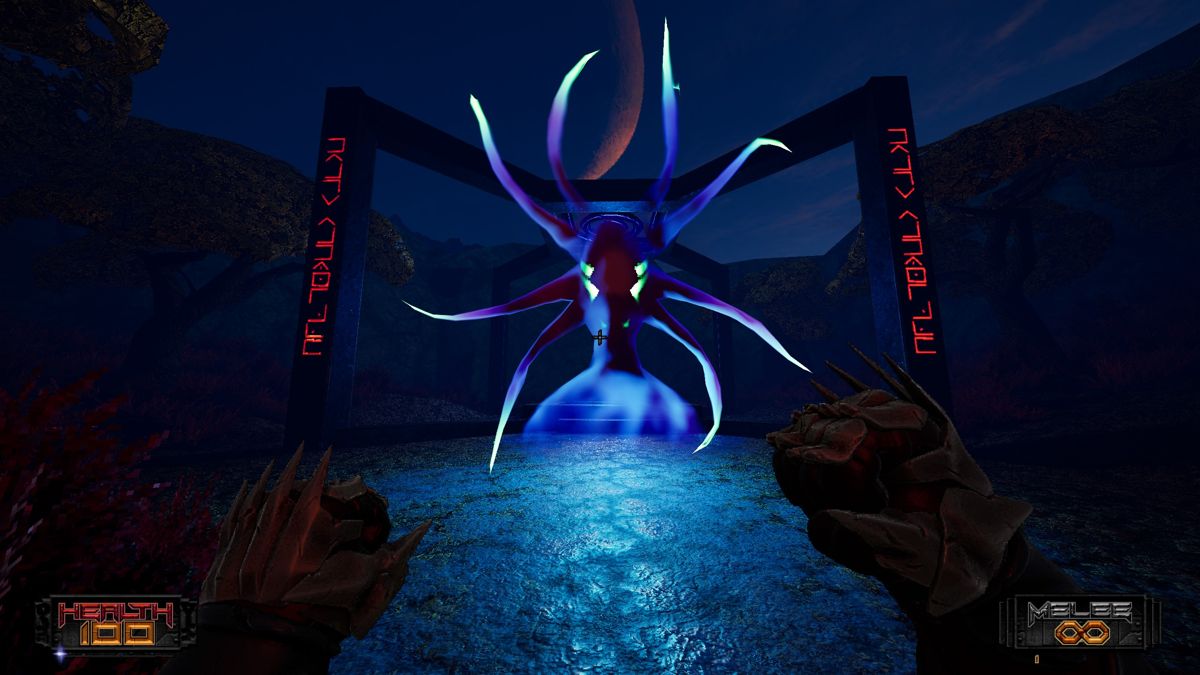
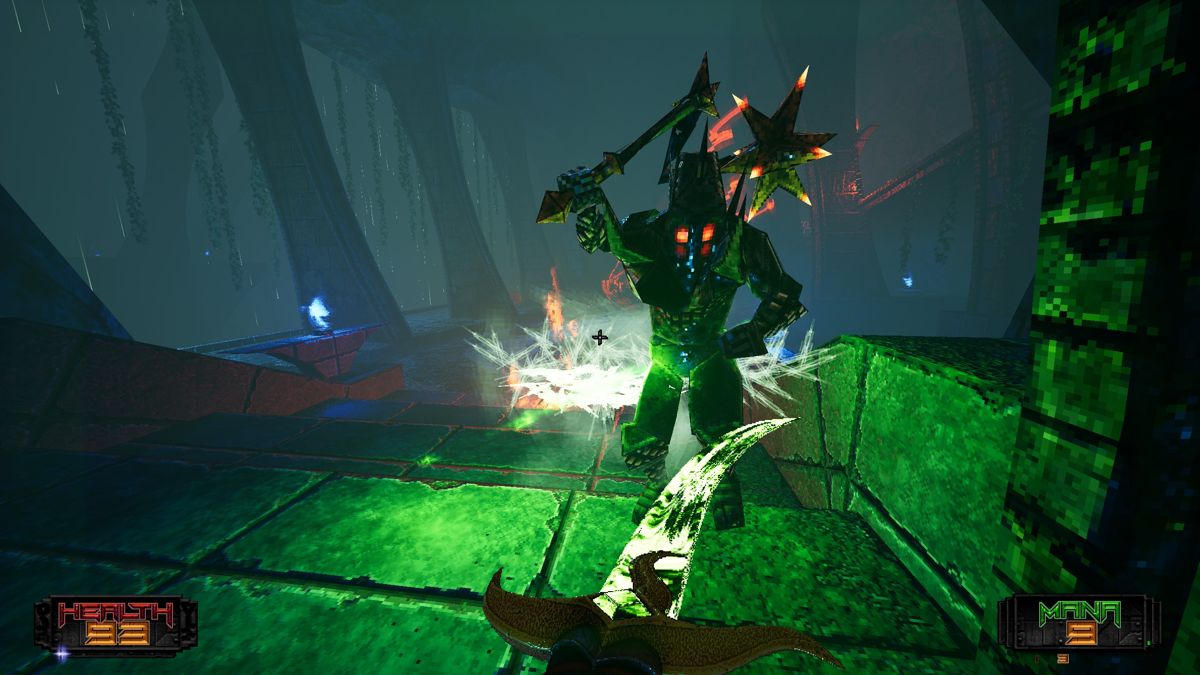
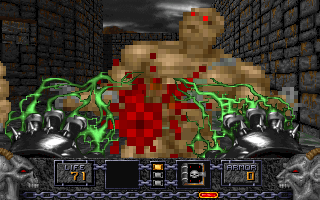
Since you obviously don't have the axe yet, the game replaces the no-ammo melee option with a pair of spiked gauntlets that are actually pretty fun to use. Punching enemies into mush just doesn't get old, especially when you activate the alt-fire mode and the punches turn from mere flurries into such a hyperactive torrent that it becomes hard to see what you're attacking. The other new weapon addition is the Voidsplitter, a scythe that fills in for the Aeturnum of the base game. If you complete the expansion, the game gives the option of going forward with the main campaign with the new weapons, in addition to the main campaign's array.
Beyond the weapons, the expansion is more of the same, which is good because the game is good. In keeping with how the original game was designed, the expansion has its own set of new enemies, such as archers, flail-wielding armored men, and elemental spirits.
The final boss is quite a challenge, perhaps more than any from the base game. Otherwise, the Black Labyrinth maintains the same sense of rich color. Despite the concept of being caught in a labyrinth, which might suggest tight corridors, the expansion instead goes for massively spacious rooms, some of which can shift similar to old Build engine games, and even some outdoor spaces in which you could get punished for trying to escape by making a break for the horizon. It's not a very long set of levels and is definitely worth a play for those who enjoyed the original.
Northern Journey opens with you controlling a guy in a rowboat, apparently having gotten lost among the Norwegian fjords. You turn and notice an operating lighthouse on a nearby island and a moment later some strange energy comes from near the lighthouse and pokes holes in your boat, forcing you to hurriedly row to the shore, arriving just before the boat sinks. You take a path up a hill and meet a strange man wearing a wolf's head, playing a flute, who tells you some things were stolen from him and he needs you to find them. A short way further in, you find a tiny village, but everything is strange. The constable is keeping some kind of demon or elf woman in his cell, there are tiny humanoid creatures scampering about who burrow into the earth when they see you coming closer, a little boy is torturing a thief locked in some stocks, something big is locked in a cellar under the church, and a there's a pair of witches keeping two black goats and boiling some strange green stuff in a cauldron. The whole place has a sense of wrongness similar to the atmosphere in Lovecraft's Innsmouth. With nothing else to do, you push forward on your mission to help the flute player get his stuff back.
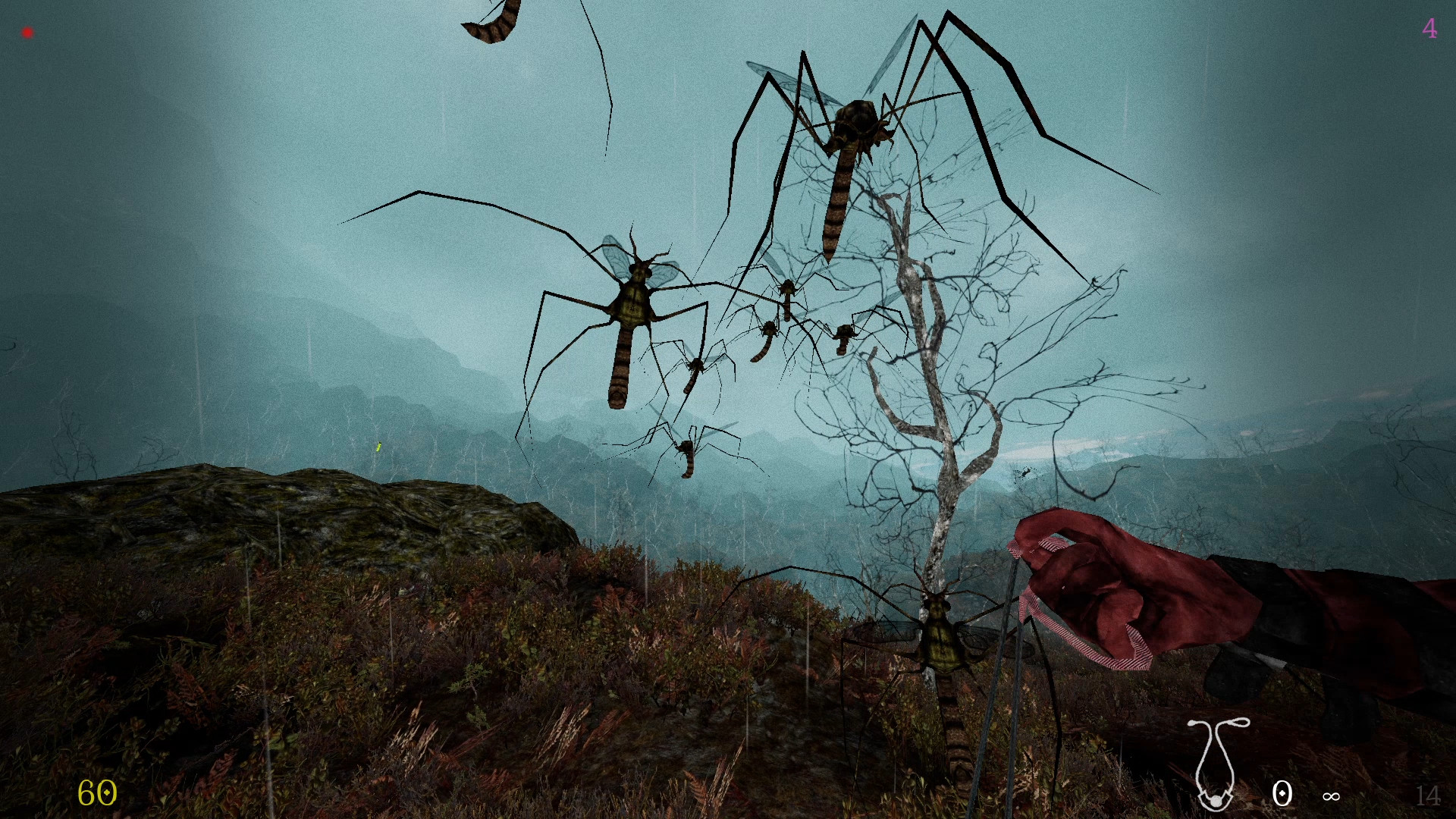
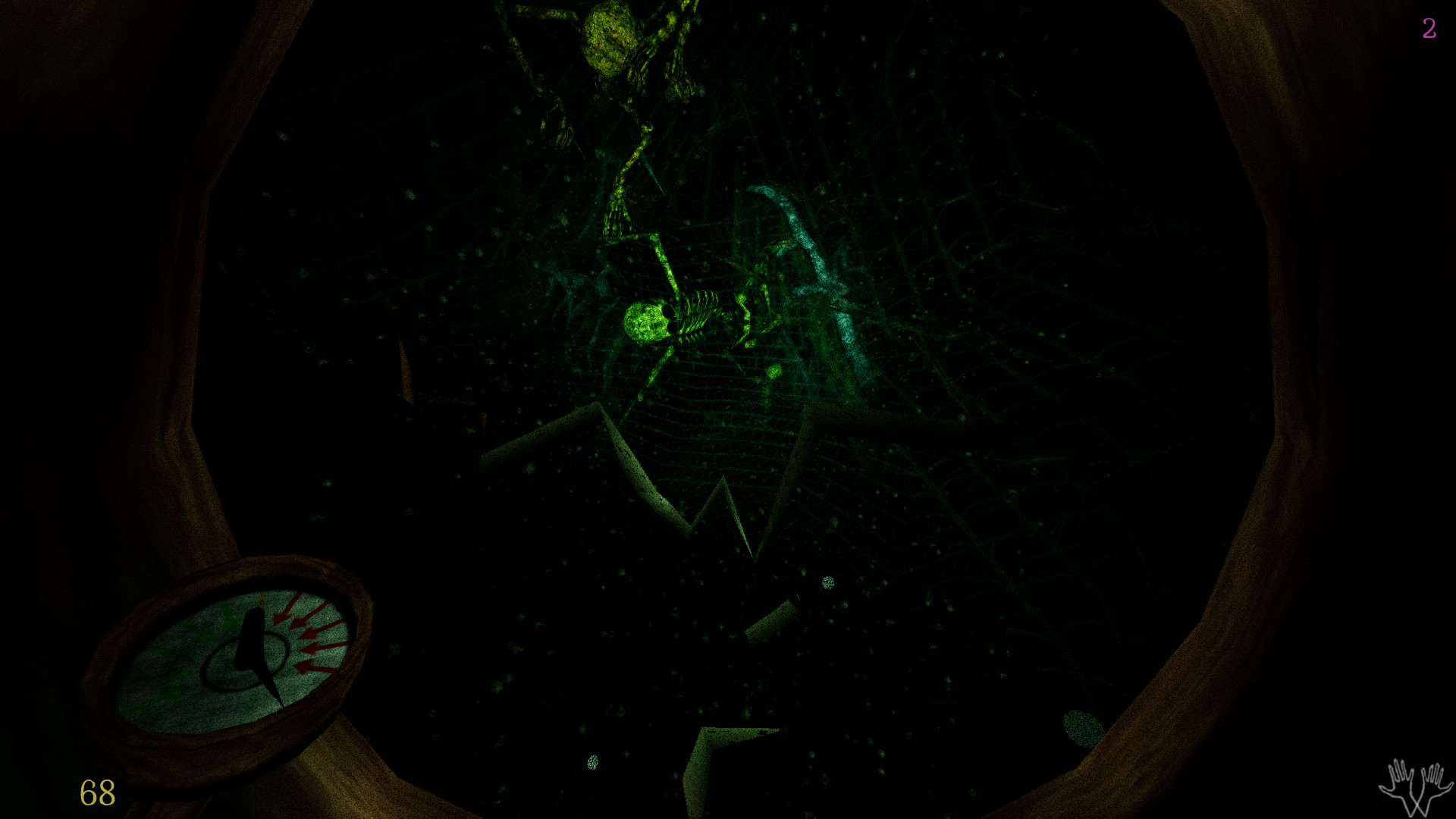
In short order, you start accumulating weapons, starting with a sling, and you find yourself using them against the island's hostile wildlife, which is mostly represented by giant bugs. There's a variety of spiders who attack you, giant mosquitos, and trilobytes, among others. Northern Journey isn't a game that should be played by people with bug phobias. One particularly harrowing sequence has you creeping through a crevasse with a high tree canopy above, with giant ticks raining down on you. Unlike your average video game enemies, these creatures generally don't announce their presence with audio cues, but like real world predators and parasites they stay silent and they use camouflage to ambush you. Many jumpscares await, not with a trite musical sting but simply because you'll be shocked to see long arachnid legs noiselessly creeping up on you right as you thought you'd cleaned an area out.
There are some non-bug enemies. You'll face a few moose and bears, and there are some sheep that have gone mad because of the ticks hanging off of their bodies. And you eventually start encountering more overtly supernatural foes, many of which are drawn from Norwegian folklore. If you know your mythology, it won't take long to realize that the mysterious flute player, with his helpful wolves and ravens, is probably Odin and the cause of the rot in the land and the outburst of supernatural creatures is probably the handiwork of Loki. As often happens in the stories, Odin is using you as his instrument to clean up a mess whether you want to or not.
The game as a whole is a tribute to the Norwegian countryside. The creator, Øystein Pedersen (Slid Studio is just him), wanted to make a game that reflected his love of hiking through the places he knows in Norway. Despite the relatively modest graphics, the game looks real in a way many far more expensive games don't approach. There are steep hills and towering cliffs, grasses and weeds that sway in the breeze, heavy waterfalls and violent rapids (deep water is your worst enemy of all in this game), and sprawling bogs. Many of the textures used to create the vivid foliage were based on photos he took while hiking, and the game also incorporates his interest in scuba diving by including a couple of underwater levels. These levels are as scary as anything in the game but there's also a great sense of authenticity in how they depict the lack of light deep underwater and the lay of the depths. Same with the subterranean spaces - many of them are tight and claustrophobic as you'd find while doing actual spelunking. When you finally meet some undead skeletons, they don't stand upright like the usual Harryhausen skeletons but crawl at you on their bellies because they just came straight out of their graves and there isn't much room to stand in their cramped burial mounds.
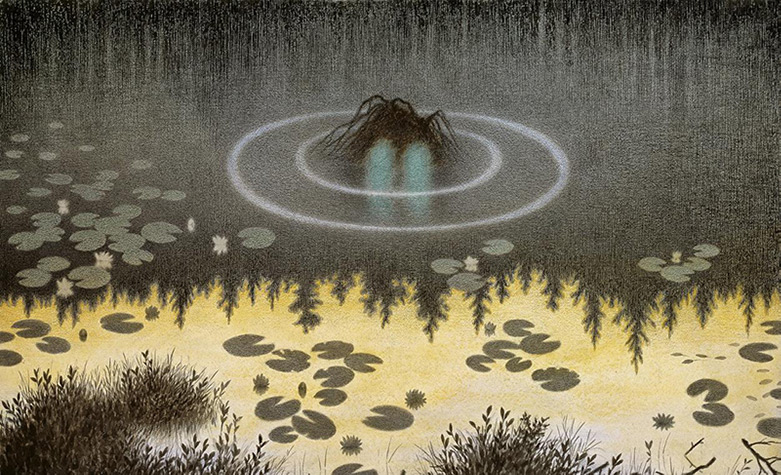
Whatever nature didn't provide in inspiration was complemented by Norwegian artist Theodor Kittelsen. The game's poster is directly based on Kittelsen's Nokken painting from 1904, and when gazing on the misty landscapes in the game it can be hard to tell what was maybe taken from life and what was inspired by Kittelsen's work.
Pedersen also cited games like Skyrim as influences, mostly the sense of walking and exploring, although Northern Journey is not a walking simulator. In terms of how it plays, it's mostly a traditional and simple FPS. There are health and ammo pickups scattered around the levels and you're supposed to find newer and more interesting weapons. The weapons are quite uncommon, though. There are no guns in the game despite the presence of certain types of advanced technology (e.g., the diving sphere you use to explore the Nokkpond). The sling you obtain first is a viable weapon through the entire game, and beyond that you get a bow, throwing axes, multiple types of fast-loading crossbows, and spears. You do get some swords, but as there is no melee combat in the game, you throw the swords like everything else. Weapons also tend to be slow and require careful aiming that accounts for drops over distance while also leading targets, which gets tough when you're being swarmed by skittering bugs. Pedersen is experienced in the use of slings and archery in the real world, so he wanted to draw on that for his game. If nothing else, Northern Journey has the most well-implemented sling ever done in a video game.
Although there's some backtracking around the game's map, it's mostly a linear experience that's well-paced and is quick to make sure you're constantly seeing and doing new things. The only major gameplay issue is that it's easy to get hung up on parts of the environment, or to be a bit screwed over by the physics and end up slipping over a cliff because the character didn't have his footing. There's a lot of ground-level foliage, which is meant to hide enemies but has the downside of making the ground somewhat fuzzy and hard to read when engaged in combat or making difficult jumps. It's nothing insurmountable but it does lead to some frustration.
Leave it to a Norwegian to show how "the Northern Thing" is done. Pedersen has created a beautiful and scary as well as funny and melancholic game. "Happysad" as he describes it. It captures the flavor of folklore and it's weird. Not quirky modern weird but in the way people used to speak of weird tales. If Poul Anderson had lived to see it, I think he would have appreciated this game.
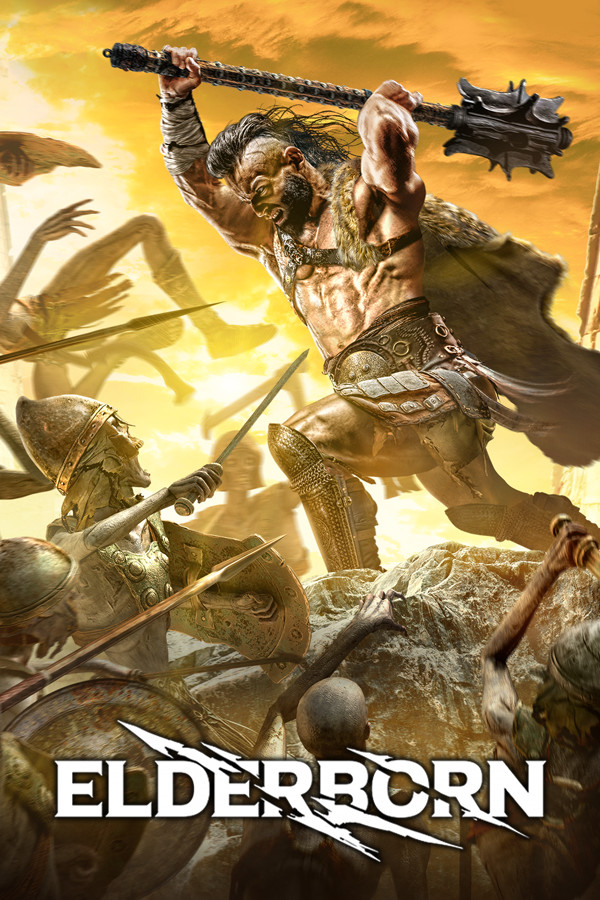
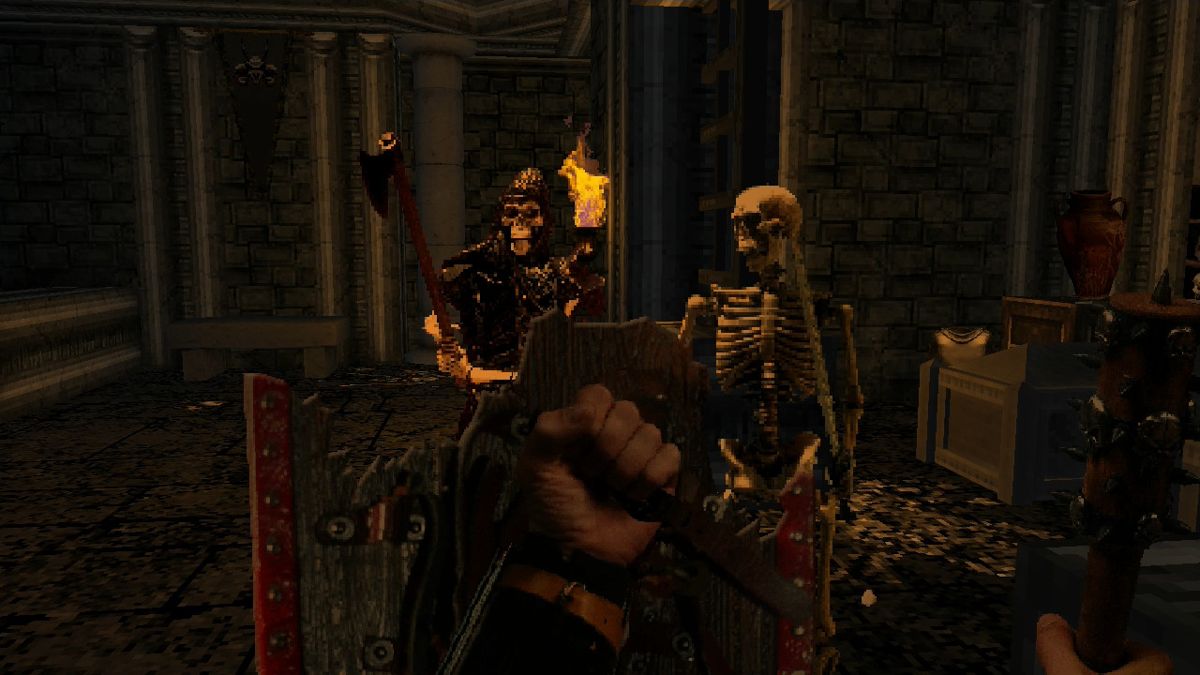
Elderborn is described by its Polish creators, Hyperstrange (Jupiter Hell, Crossbow: Bloodnight, Blood West), as "a Metal AF* Slasher with brutal FPP melee combat and souls-like/RPG character progression. In the times of legend, barbarian tribes need a new dark messiah. Be that merciless slayer. Uncover ancient secrets in the city of doom. Forge your own destiny! *Action Fantasy." The terms "souls-like" and "dark messiah" are particularly notable because the game takes heavily after Dark Messiah of Might and Magic and Dark Souls.
As with Dark Messiah, the game is a first-person melee combat game in which you break through enemy shields by kicking them, although Elderborn lacks Dark Messiah's complicated physics and magic systems. You can at least kick weaker enemies off high ledges to kill them. And like Dark Souls, enemies leave behind experience that can be picked up and cashed in for skill increases at special respawning locations (mostly fountains instead of bonfires). If you're killed, you'll have to trudge back to where you were snuffed to gather up all the experience your previous life had accumulated, but you lose it entirely if you're killed again.
The premise of the game is suitably Howardian. As a member of a barbaric tribe, you're tasked with making a pilgrimage to the golden city of Jurmum, which has fallen into decadence under the "guidance" of its corrupt priesthood and the exploitation of strange technology that powers the city, and by pilgrimage it means you're supposed to kill everything you see there, but few have ever returned from the city. You're given a choice between a male or female warrior (no real difference between them) and in the game's opening you have to slay the other option in an arena before setting out on your quest. You begin in the catacombs beneath the city, then move into the city itself. Along the way you'll battle various types of undead warriors, homicidal lepers, giant scorpions, and Lovecraftian fishmen. Note that many of these enemies aren't friendly with each other and it's often easy to get them to fight each other. There's some unintentional comedy in sometimes walking close enough to trigger an enemy into moving only to see him turn around, run the opposite direction, and start attacking another group of enemies.
Getting good at the combat mostly involves unceasing movement (often utilizing the game's quick-dash ability) and mastering the game's parrying system. A successfully timed parry will stun the enemy and leave them vulnerable to an extra-high damage counterattack. You can also fully heal yourself with a special injection up to three times before needing to kill more enemies to refill the injections. Unlike Dark Souls, there is no stamina meter that forces you to be conservative in dodging, blocking, or attacking, so the game is quite a bit faster than current-day "souls-like" games. Instead, you'll be contending with potentially large mobs of enemies at particular points in the game, racing from one opponent to the next, whittling down their numbers as you go. There are also some minor puzzle-solving aspects, mostly to do with operating some of the peculiar machines in the city.
For a "Metal AF" game, the soundtrack is adequate. It's suitably hard-driving and enhances the mood in parts but it's also not especially memorable, especially with several games today being accompanied by heavy soundtracks, such as Mick Gordon's work on the new Doom games. The graphics are quite good, but there's a certain lack of color to them. The catacombs are heavy on the blue while the city is a lot of brown (see the game's title card/poster above). It's tough to equal masters like Frazetta in nailing a sense of foreboding and violence while still being very colorful.
The weapon selection is varied enough to cover just about any playstyle (I settled on the spears), and there aren't too many games that allow you to unlock the ability to rip a corpse's head off and use it as a projectile.
The most unfortunate thing about the game is simply how short it is. There are essentially two levels, albeit long ones, and then a relatively brief epilogue. The game seems to end right as it's getting going, leaving a sense that you just completed the opening episode of a shareware game only to realize there's no more of it left. Hopefully a more substantial sequel will come some soon.
Despite its title, Arthurian Legends doesn't really have a huge amount to do with Arthurian legend, but it does include a little bit of backstory that refers to Uther Pendragon, Merlin, and Igraine but backstory is all it is. You start the game and are greeted with men breaking into your house to kill you, so off you go. You don't meet Uther, or Merlin, or anyone else associated with the legends. Just a bunch of armored men, wizards, and hell creatures, all of whom need killing. Essentially, the story is that you're a one-man army fending off an invasion by devil-worshipping Saxons.
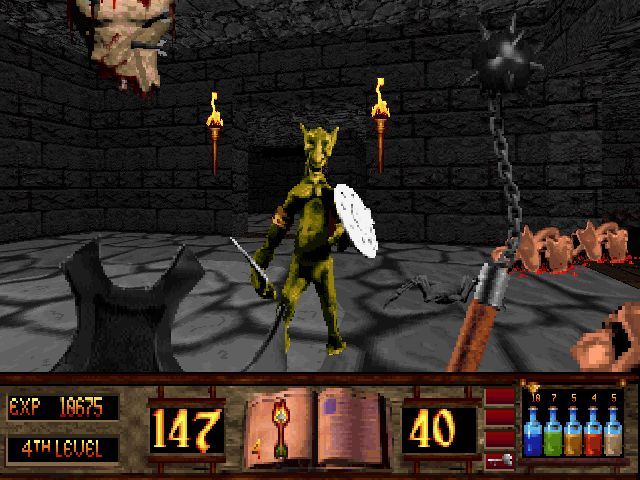
The game is an FPS that greatly takes after Witchaven in that it emphasizes melee combat while including the use of magical runes and potions. Despite being created by a one-man studio, Scolaro Games (Keith Scolaro), it's actually a general improvement on Witchaven. The combat is more complex and provides more of a sense of feedback than most melee FPSs. You can actively block with a shield, perform a shield bash to stun enemies, or use an extra weapon in your left hand if you prefer, and there's a better sense of attacks connecting through enemy reactions, sound effects, and blood spraying everywhere. It's an amusingly gross game - even using the crossbow, enemies will literally explode upon death, leaving behind a pool of gore and a a decapitated head that you can kick around a bit.
The setting is dark and grim, but there is a sense of humor running through the game that takes after classic FPSs, particularly the Build engine classics, and Monty Python and the Holy Grail. Visually, it resembles Build engine games in its sense of verticality but it lacks that engine's capability for reshaping the environment mid-level. Scolaro made the game using a program called 001 Game Creator, one of those "game design for rookies" programs, which makes the completed game even more impressive because it certainly appears that Scolaro pushed the engine as far as it could possibly go. The graphics are clear, easy to parse at a glance, and about on par with mid-90s 2D FPSs. The soundscape is somewhat inconsistent, which is common with indie games. Some enemies will speak up but it's not unusual for them to sneak up on you completely silent. Unfortunately, the low-budget indie nature of the game becomes apparent with the kinds of bugs that occur, particularly in corrupted saved games that get more common in the game's later stages.
Basic enemies include various types of enemy soldiers who gradually give way to giant spiders, undead skeletons (these guys again...), two-headed wolves, and flying imps. At the end of each episode, you have to face a boss enemy that is an evil witch or wizard, and there are occasional mid-episode bosses who are mostly optional, such as the Green Knight, the Questing Beast, and...the Killer Rabbit (make sure you save one of your holy hand grenades for that one).
Much like Witchaven, weapons and armor degrade through use, and the game encourages you to switch among them often because of "ammo" shortages; e.g., the spiked club is great for stunning magic users and the grenades are great for when you're being mobbed, but you really should save them for such occasions.
Supplemental reading: The Dragon Lord, by David Drake
Heretic is the fourth game released by Raven Software, a studio founded by Brian and Steve Raffel. With their debut game, an Amiga Dungeon Master clone called Black Crypt, John Romero of id took notice of them and the studios formed a partnership in which Raven would develop games based on game engines id created - ShadowCaster was built on the Wolfenstein 3D engine; Heretic and its sequel, Hexen, were made on the Doom engine; Hexen II on the Quake engine; and onward. Eventually Raven was bought out by Activision and sent to the slave mines to spend eternity working on Call of Duty sequels, but that's not important here.
Heretic's story is mostly conveyed in the manual, which tells us of the Sidhe, "an ancient elf race adept at arcane sorcery and keepers of the Tomes of Power." The Sidhe are attacked by three Serpent Riders from Hell, who begin forcibly converting everyone to a cult called the Order of the Sign, but the Sidhe are immune to the Serpent Riders' mind control, leading the Serpent Riders to brand them...HERETICS! The two more powerful Serpent Riders depart, leaving one behind the manage the situation on Earth and slaughter the Sidhe, but one Sidhe remains to continue the fight and that's you.
Upon starting the game, it immediately becomes clear that Heretic is effectively Doom with the knob cranked all the way to the Fantasy side of the meter. You run and fight monsters, find color-coded keys, and find the exit. Brian Raffel said the studio planned on Heretic being more of an RPG, as they were all D&D fans, but John Carmack advised them to just "do it like Doom, and add the fantasy flavor and other stuff." (This process of starting with something relatively complex and then stripping it down to make a simpler, action-heavy experience sounds a bit like how Wolfenstein 3D and Quake were made. Perhaps it was one of id's advantages in that their games didn't suffer from feature creep like many others but instead emphasized accessible, impactful gameplay.)
So Heretic became a Doom-like game, but with some expansions on the game engine. You could look and up and down (although the game still auto-aims for you if enemies are above or below), you got a modest item inventory, you could cast a flight spell, and by using a Tome of Power item you could gain powered up alternative-fire versions of the weapons. Most amusing is the morph ovum, a magic egg that turns monsters into chickens.
The weapons are all fantasy-based variations on Doom's arsenal. You start with a simple staff for melee attacks (instead of your fists) and a weak magic wand for a pistol. The crossbow is the shotgun equivalent, the Dragon Claw is the chain gun equivalent, etc. One of the more memorable weapons is the game's version of the chainsaw, a pair of magical gauntlets that send lightning into enemies at a touch.
The monsters, however, aren't precisely 1:1 Doom variations. There are flying gargoyles, golems, undead warriors, snakemen, flying wizards, etc. Some come in intangible "ghost" variations that can only be killed with particular weapons.
The game is often called a Doom clone in a somewhat pejorative way, like people recognize that it's fun but lament that it wasn't more unique, but the thing is that "D&D Doom" or "medieval Doom" or "fantasy Doom" is still Doom and therefore is still pretty good. Raven developed a reputation for making excellent action games, especially FPSs, and Heretic shows they had those talents from early on. Heretic has creative level design and the gameplay additions are interesting without overcomplicating the experience. The art design and audio are very good. It's maybe not quite as "heavy" as Doom in the sense of having a thrash metal edginess about it, but it set the stage for fantasy FPSs carrying more of the sword-and-sorcery feel going forward in its sequels and other games like Witchaven. When a fantasy FPS is made even today, people often compare it to Heretic and Hexen before anything else.
Witchaven, developed by Capstone in 1995, is an early attempt at doing a melee-focused FPS. There had certainly been first-person games with fantasy themes, but Ultima Underworld and Elder Scrolls: Arena were more focused on creating a real-time RPG experience, and Heretic was essentially Doom but more heavily tilted toward a fantasy theme. Witchaven is more about the speed of the FPS genre but with melee weapons and modest RPG elements included.
The premise is that the player controls a knight named Grondoval who has traveled to an island under the control of a witch named Illwhyrin. Illwhyrin is performing grotesque rituals so she can call forth demons to unleash on the world. By killing her, you can make the whole problem go away.
The weapons you use to do the job include a dagger, a short sword, a flail, a broadsword, a bow, throwing axes, a battle axe, a halberd, and a magic sword. The weapons degrade with use (effectively equivalent to the ammo needed in regular FPSs) and need to be replaced when damaged, although you can always resort to your fists if necessary. There are different suits of armor that can be picked up, and a shield can further reduce damage, but if the shield is destroyed the player can dual wield his weapons. The player can also use magical scrolls to do things such as illuminate dark areas, force open doors, cast magic missiles, or even fly. Scroll use is restricted by the player's experience level, which goes up by killing enemies. Finally, there are potions that can be accumulated and used for health refills, curing poison, resisting fire, or getting certain kinds of boosts for combat.
Among the monsters are goblins, undead skeletons, magic-slinging hags, fire demons, ogres, and even occasional dragons. Illwhyrin herself will appear in a few levels during the game, teasing the player on the way to the final confrontation. Many of the monsters are claymation models, while Illwhyrin is played in digitized form by Capstone's product manager Judy Melby.
Advancement through the levels is the classic FPS method of picking up colored keys for corresponding doors, although to use the exit the player needs to also find a magical pentagram and bring it to the exit to be teleported to the next level.
Witchaven, apparently based on a tabletop RPG, is the first game officially made with Ken Silverman's Build engine, being released just ahead of Capstone's game based on William Shatner's TekWar novels. It uses certain Build engine tricks such as levels with more verticality than you'd see in Doom, halls twisting above other halls, and large chunks of scenery shifting when triggered.
The game is a classic case of being more interesting than good. One of the reasons why there are relatively few first-person melee-fighting games is because it's hard to create a sense of weight or impact from that perspective and Witchaven isn't one of the games to transcend this problem. You do get used to the attack system (and the game gets almost comically easy when you do) and how to time strikes so the weapon is falling down on the enemy at the right moment, but it doesn't feel good. You watch the weapon come down and maybe it registers a hit and maybe it doesn't. The art direction is nothing special and the game looks ugly and jagged compared to the more popular entries in the genre. The character actually strafes faster than he walks forward, even when in water. Some levels are outright bugged - I was stumped on one level only to look up the problem online and discover that the level suffers from a button that doesn't work, requiring that the player use the open door spell to proceed. One wonders if the whole reason for spells like open door or flight was as much to work around bugs as proper level design. Attempts at atmospheric lighting don't seem to work quite right and even using the light spell doesn't help much. The soundtrack is mediocre and buggy as it often seems to revert to a single track. The dragons look goofy and barely move, content to just breathe fire on the player, and if you've taken the resist fire potion they're completely helpless while the potion is active.
With all that said, the game has just enough to keep you playing if you're feeling indulgent and have maybe played through all the more notable FPSs. The game earned a certain amount of notoriety in its time thanks to its amounts of gore, and there simply aren't very many fantasy FPSs out there even now. The game closes with the usual Conan movie homage, with Grondoval reclining on a throne, promising further adventures on his way to a throne of his own, and Capstone cranked out a sequel the following year.
A happy effect of the rise of digital distribution and the return of a sort of video game midlist is that it made genres that had been decreed dead and buried by blockbuster-minded publishers viable again. Turn-based RPGs, 8- and 16-bit-style pixel art games, point-and-click adventures...and mid-90s-style FPSs that prioritize labyrinthine level design and pure frenetic gameplay over linear cinematic experiences. Amid Evil is among the leaders of a retro FPS movement that also includes games such as Dusk and Ion Fury. It's the product of Indefatigable, a studio formed by two guys that previously contributed to the 2013 remake of Rise of the Triad, and it takes heavily after Quake and the Heretic/Hexen series.
There is a story underpinning the game, but it's so basic that it would almost be better if it wasn't included at all. The player controls the Champion, who claimed the axe of the Black Labyrinth that allows him to travel among dimensions. The Champion is directed by a pantheon of fallen gods to exterminate the "Evil Force" that is corrupting reality. And mercifully that's about it. The Champion begins in a hub world and travels to several different worlds, arriving with only his axe to begin but accumulating six other magical weapons with which to cleanse the worlds before challenging the Evil Force in a final Lovecraftian dimension. So it takes after the more cosmic, dimension-hopping side of the genre, as in Moorcock's Eternal Champion works, or perhaps Zelazny's Amber books or Adrian Cole's Voidal stories, among others.
As with the classic games it emulates, the only things to worry about are slaughtering everything in your path and finding keys that unlock doors. Despite the comparisons to Heretic, it lacks the inventory management aspects of that game, and the barebones style and 3D visuals better evoke Quake. On the other hand, it's much more colorful than Quake's notorious brown and grey aesthetic.
The weapons generally fall into the traditional FPS pattern but each has a particular twist. The first ranged weapon acquired is a water magic staff that spews homing projectiles at enemies. The "shotgun" is a jeweled sword that when swung sends out a broad green wave that can hit multiple enemies at once. The "rocket launcher", known as the Celestial Claw, is a gnarled staff that literally yanks planets out of orbit and hurls them at enemies. Killing enemies causes them to drop their souls, and when the player collects enough, the player can temporarily activate a more powerful, alternate fire mode for each weapon; e.g., the Celestial Claw now grabs stars instead of planets.
FPSs in this style are often looked down upon because of their simplicity, but there are arguments that the first person perspective and their terse presentation can be more evocative than games that work harder at conjuring an atmosphere. Many RPGs, for instance, include reams of text and even extensive, fully voiced dialogue among massive casts of characters in trying to develop their settings. Some succeed more than others, but the vast majority can't overcome a tedious flatness. Amid Evil has almost no dialogue or story and yet probably succeeds better than most more complicated games in providing a sense of a desperate struggle in strange lands that sprawl vertically as much as horizontally. Some of the worlds, such as the worlds of the moon or sun worshippers are merely beautiful to look at, with clear skies above high towers that might not be too out of place in the real world. Others get weird with colossal structures that serve no discernible purpose but which need traversal regardless. The Forges are a world of constantly chugging machines of giant gears and levers, occupied by living machine creatures. The final level, the Void, is as aggressively Lovecraftian in its depiction of non-Euclidean geometry as a game can reasonably get while still remaining navigable. Some parts can be genuinely unnerving to look at, never mind the strange creatures constantly attacking.
Speaking of the creatures, each world has its own unique set. The game's sound design is top level and once you know what to listen for, you can reliably tell when a monster has been roused (and if you hear it, you know it's coming for you at top speed), when you've scored a hit, and when you've defeated it. The graphics are beautiful in their odd combination of looking fine at a distance but revealing chunky pixellation up close.
Cover for the definitive first person shooter, Doom, by Don Ivan Punchatz. Punchatz's son, Gregor, contributed to the game as a model designer for creatures such as the Arch-Vile and the Spider Mastermind. Obviously, this isn't a sword-and-sorcery game, but Punchatz's art evokes works by artists like Frazetta with its pyramidal structure depicting the desperate hero on a rise fending off hordes of enemies. Replace the guns with swords or axes and you'd have a pretty good cover for a hard-hitting fantasy novel.
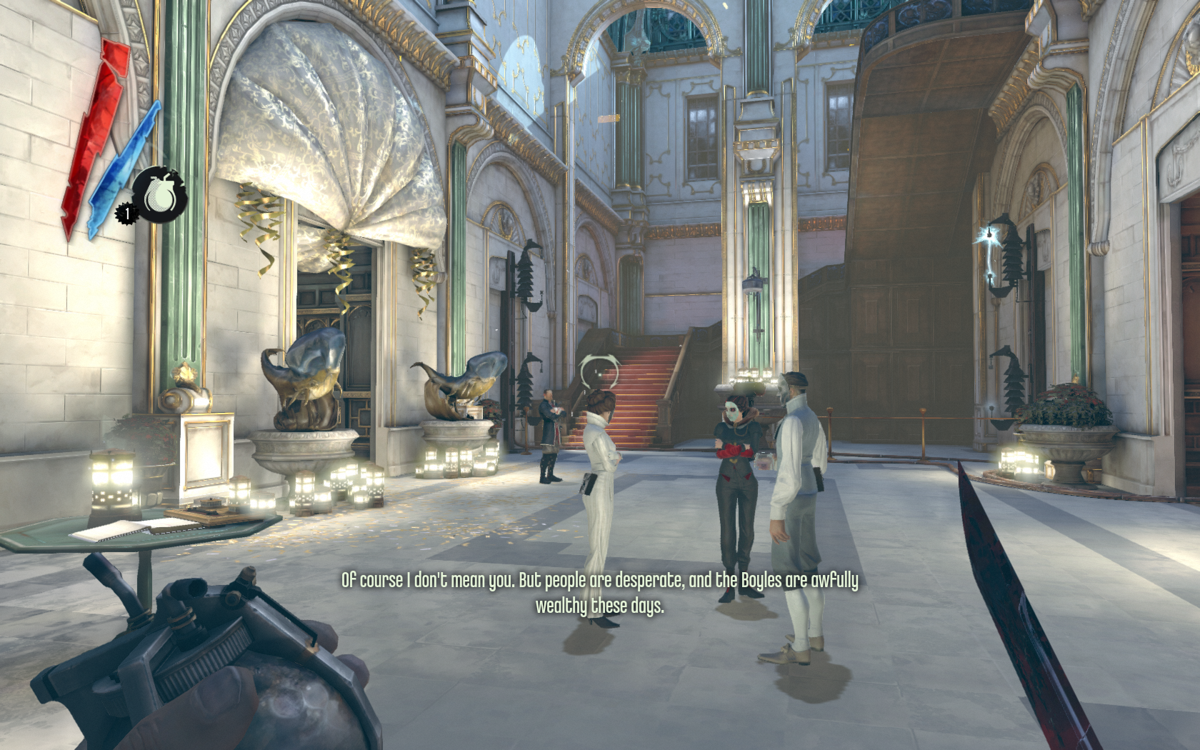
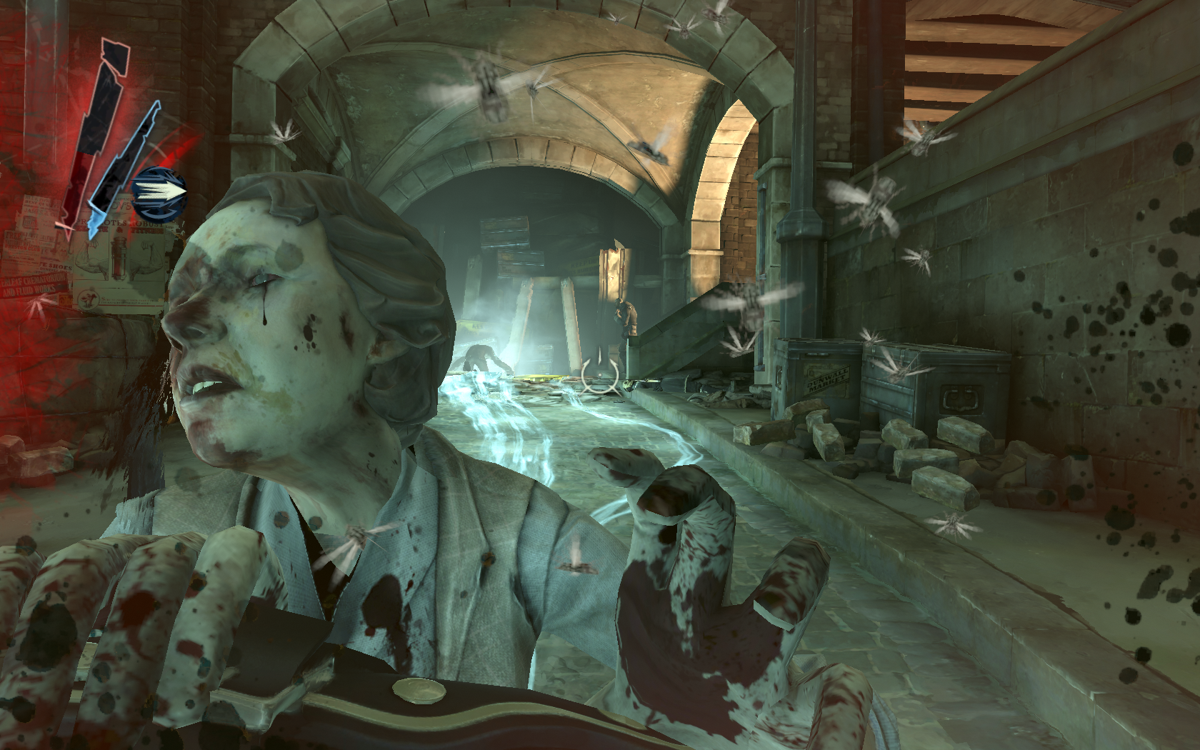
Dishonored, released by Arkane Studios, probably isn't most people's idea of a traditional sword-and-sorcery work. The player controls a royal bodyguard, Corvo, to the empress of a secondary world modeled on Victorian London. It's technically not a steampunk world, but rather a world in which fantasy technology is entirely powered by whale oil. The empress is assassinated, her daughter is kidnapped, and Corvo is framed for the crime and sent to prison. Months later, a group of conspirators loyal to the empress helps spring Corvo from the joint and immediately afterward Corvo is approached by a mysterious cosmic entity called the Outsider, who provides Corvo with supernatural powers that Corvo may use to gain his revenge. The Outsider's relationship with Corvo and other mortals is broadly reminiscent of how Elric's magic is supported by Arioch and other supernatural beings.
Unlike the other games covered so far, in which story served more as flavor and as something to simply put various aspects of the games in context, Dishonored is a big-budget modern game that attempts to tell a full story of Corvo's fall and rise and insists that players watch lengthy cutscenes, interact with fully voiced supporting characters, read books full of background information on the world and its people, and listen to audio logs. It's a far cry from the hard-hitting, get-right-to-it manner of Rastan or Golden Axe. But Dishonored in many ways takes after the Thief series and Thief is absolutely thick with Fritz Leiber-esque atmosphere.
Dishonored is designed to offer as much freedom as possible to the player in achieving goals. The game can be completed without directly harming a single person by sneaking about like a ghost, or Corvo can charge in and capably hack his way through multiple opponents with his sword and pistol, setting off alarms and causing complete chaos. Corvo's powers potentially include teleportation, possession, stopping time, or calling forth hordes of plague rats to overwhelm foes. Corvo is also armed with several types of gadgets such as traps, grenades, and hacking devices. It doesn't take long for Corvo to seem quite overpowered compared to all the enemies around him.
The game was initially intended to simply be an assassination game, as Corvo would eliminate important characters that were part of the conspiracy against him and the empress, but co-director Harvey Smith (Deus Ex, Thief: Deadly Shadows) proposed that missions have alternate non-violent solutions, although in some cases it could be debatable whether the non-fatal method is more humane; e.g., in one mission your solution leads to a female target being kidnapped by an admirer who will forever have the woman at his mercy without anyone realizing her circumstances. The game judges the player through a simple morality system based on how much chaos the player causes. More death and explosions lead to more negative consequences and the bad ending, while keeping body counts low leads to a happier outcome.
The fantasy elements are relatively restrained in that enemies are all essentially human. Even the "zombies" present in the game are actually people reduced to that state because of an unexplained plague afflicting the city. There are no hints of elves, orcs, or dwarves anywhere.
Visually, the game uses a painterly effect that is effective in providing a sense of realism, but stylized just enough that the game's seams don't show. The artists, such as Viktor Antonov, cited as inspiration works by Gustave Doré and illustrations for Rafael Sabatini's novels such as Captain Blood, among others.
As with so many big budget games, the production values are very impressive, although I can't help thinking that the big name voice cast the studio hired was somewhat wasted. Aside from Michael Madsen as the villain/DLC protagonist Daud, I failed to recognize most of the voices and was surprised to see names like Brad Dourif and Carrie Fisher listed in the cast. It's enjoyable enough to play but the story is predictable and I never felt invested in the fates of any of the characters. The game is almost too effective at evoking a sense of squalor - the overwhelming brownness of it and the trash- and carcass-strewn streets and houses become wearisome after a while, reminding me of how many recent fantasy works seem weirdly preoccupied with excrement and garbage. But at least the game is of a modest length and doesn't overstay its welcome, either.