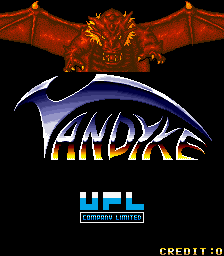
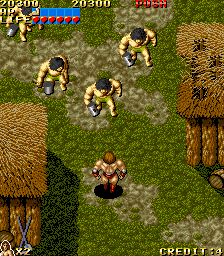
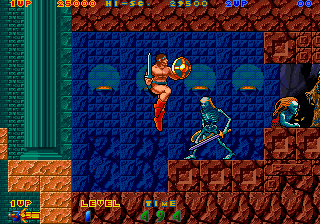
Vandyke is an overhead, vertically scrolling arcade game released by Japanese studio UPL (Universal Play Land). You control the typical muscular barbarian-type hero as he slices through hordes of monstrous enemies. You start out swinging a sword but can power-up by picking up alternate weapons such as a very long flail, bombs, or boomerang-like throwing stars. The game is very accessible, with easy to pick up controls (attack and jump), appealing graphics and music, and a fast pace.
You start out fighting enemies like giant scorpions, toads, and cavemen. The first boss is a mutant elephant with a snake-like man for a trunk. Level 2 introduces the undead skeletons and giant bats, with a medusa-like boss. So far, so normal.
Level 3 is when things start getting a little offbeat. Immediately after starting, the player is beset by what appear to be sashaying, giggling leather daddies with clawed gauntlets on their right hands. Combined with other odd enemies like the men trapped inside rolling disks and the way the hero (it's not clear if his name is truly Vandyke or why the game is called Vandyke at all) strikes bodybuilder poses whenever he grabs a health power-up, it becomes apparent that the game is something of a send-up. It doesn't go into all-out parody, but it's clearly not taking itself very seriously, either.
Beyond that, there's not much to say about Vandyke. It's a fun play but gets quite challenging by the end, and the reward for completing it is a simple screen of the hero looking content, not much more than a simple "Thanks for playing!" message. UPL and the particular creators' output was eclectic, but they didn't do any similarly themed games before or after Vandyke.
Konami got in on the Gauntlet craze with its own 3-player take-off (its first 3-player game) called Dark Adventure, but they gave their game a different slant by favoring a pulpy, Indiana Jones theme instead of Dungeons & Dragons.
Dark Adventure's attract mode informs us that our three heroes, Condor (i.e., Indiana Jones), a pretty blonde reporter named Labryna, and Zorlock, another archeologist who seems inspired by Belloq from Raiders of the Lost Ark, are holding a press conference to announce the discovery of a strange sarcophagus. Condor slides open the lid, the box explodes with light, and the three characters vanish as a voice declares, "Those who tamper with the sacred ark...are DOOMED!" On starting the game, the heroes appear in a strange land of demons and the only way out is to fight their way through to the demon king and slay him.
Condor of course has a whip, Labryna a sword, and Zorlock a spear, and each can also fling sticks of dynamite around. As with Gauntlet, the characters' health steadily (and quickly) declines and can only be restored by picking up soda cans that occasionally appear. The monsters mostly appear from stone generators and exits must be unlocked by finding keys. Complicating things, however, is that levels often feature multiple exits and taking the wrong one can cause the players to loop back to levels they've already played. More powerful weapons, such as laser guns or bazookas can also be found occasionally, or power-ups that can speed up the characters or extend their melee range.
Dark Adventure makes a strong first impression. The graphics are quite nice, with an appropriately dark color scheme and characters that are taller and more detailed than Gauntlet's. The first level features you battling hordes of minotaurs and then suddenly the music picks up as a giant sword-wielding slime monster starts chasing after you, booming with each footstep. Killing this creature will cause it to collapse back into the muck, but if you linger too long the monster will reappear, so there's a sense of urgency created. Unfortunately, the game isn't consistent in keeping up this atmosphere and it feels like it played its best hand right away. There are some cool monsters and sights still to be seen - e.g., demonic trees that try to ensnare you, bat-winged men similar to those Solomon Kane fought in Wings of the Night, and lava-based levels with their own giants - but not much with the impact of that muck giant chasing you on the very first level. Among other creatures the come against you are rats, giant spiders, bats, and the undead skeletons do finally arrive relatively late in the game.
Konami also produced an alternate version for two-player cabinets called Devil World.
Devil World deletes the Zorlock character as an option, and includes some significant changes such as ditching the non-linear progression and starting the characters out with ranged weapons that can be upgraded with a Gradius-style system in which you pick up orbs that can be saved up and traded in when you have enough for whichever weapon you want. On the downside, the game is stripped down a bit in its rogues gallery and its audio presentation.
It never got a home port. Perhaps it just didn't make much money in arcades but it seems like the concept would have been good for an NES adaptation that could have shifted the design more toward something like a more horror-tinged The Legend of Zelda, similar to what Blood Omen did years later.
Venture can probably lay claim to being the very first instance of dungeon-crawling in an arcade game. At a distance, it might appear to be a fantasy-themed variation of Berzerk, with its overhead view of combat and happy-faced character, but it's slightly different.
The player takes control of the crossbow-armed Winky, the aforementioned happy-face character, sort of a heroic version of Berzerk's Evil Otto. You start out in a dungeon, the halls of which are patrolled by fearsome and invincible monsters. Avoiding the monsters, you duck into individual rooms, at which point the game zooms into a more detailed view of the room. Each room includes a certain type of monster - such as our old friends the skeletons, snakes, spiders, etc. - and a treasure to be claimed. Unlike the monsters in the halls, Winky can use his crossbow to vanquish the denizens of the treasure rooms, but he has to be quick because if he takes too long the monsters from outside will invade the room and chase after Winky. If you can claim the treasure and escape the room, the game will fill its outline in the broader view, marking it as complete, and the process repeats until the entire floor has been cleared, all the treasures collected, and then Winky descends to the next, more difficult, level of the dungeon. Not unlike Gauntlet - you're killing monsters, taking their stuff, and exploring deeper and deeper - but without the multiplayer aspect.
The game was designed by Exidy co-founder Howell Ivy, not a household name today but his list of credits is nothing to sneeze at. Among his other games were Death Race, an unofficial Death Race 2000 adaptation that was the first game to ignite a moral panic, Circus, Mouse Trap, and Pepper II. The graphics in Venture are a bit Space Invaders-like in how they balance abstraction, menace, and an odd cuteness, and the game has well-rendered, high-tempo music that wasn't yet a common feature in 1981 games. Winky might be a far cry from Conan and his various clones and offshoots, but he was probably about as good as 1981 gaming could manage.
The game is exceptionally difficult because of the combination of its controls and enemy AI. Instead of being a smoothly maneuvering, agile character, the controls for Winky are unusually sticky in that pushing the joystick in a direction will cause him to first aim his crossbow and then move a moment later, but the enemies aren't bound similarly. They flit about rapidly like water bugs and will deliberately evade shots from the crossbow, and in the event they can be pinned down for a killing shot, their corpses will remain deadly until they decompose and vanish after a couple of valuable seconds. Not only do you have to kill them, you have to make sure they don't die in a spot where they'll block your path and slow you down. Despite its level of challenge, the game is addictive because of its pacing and the dopamine hit that washes over you after you've cleared a room and maybe even an entire floor, and the discovery of new types of treasure.
A little while after doing Black Tiger, Capcom took another crack at "Heroic Fantasy" with Magic Sword. Up to two players can take control of a hero who must ascend 51 floors of the Dragon's Tower, defeat the wizard, Drokmar, and destroy the Black Orb that gives him his power. Wizards and their towers...
Unlike Black Tiger's leaping and climbing gameplay, Magic Sword places more emphasis on plain hacking and slashing through mobs of enemies, although some areas do require the player to leap across deadly pits. Magic Sword's primary gimmick is that the player can collect keys that unlock prison cells throughout the tower, freeing their inhabitants (who call out to you with poorly translated lines like "Get rid of me!") so they can fight alongside you. The other party members - Amazon, Big Man, Ninja, Thief, Wizard, Priest, Knight - have particular strengths and weaknesses. Collecting a magic ring will allow you to recruit a Lizardman, arguably the best companion, to your side. The player can also collect various power-up items that have effects such as raising attack or defense or revealing locations of hidden chests. Altogether, the game has a lot of options to test out so the player can settle on what they like best.
At first the number of floors to go through will seem daunting, but as it turns out most of the floors can be cleared very quickly, especially if you just want to move along instead of trying to clear out every single chest on every floor. Every few levels a boss enemy will be revealed, usually a variation of a dragon or chimera. The pacing and user-friendly controls and gameplay help offset the game's running time, making it easy to jump in and start cutting through the enemies, who respawn quickly, freeing prisoners, breaking open treasure chests, and charging for the doors to the next floor.
The graphics are of Capcom's usual high quality, colorful and with well-defined characters. The main hero, shirtless with his long braided blonde hair, is reminiscent of John Jakes's Brak the Barbarian. Manami Matsumae contributes a dramatic musical score. A relatively uncommon feature for arcade games but something that had been appearing in some PC and console games at the time was giving the player a choice between a good or bad ending after defeating the wizard. You could either destroy the Black Orb as directed, or allow yourself to be corrupted by taking it for yourself.
Gauntlet II, once again designed by Ed Logg, is so similar to the original that it feels more like an expansion to the original game than a true sequel. In fact, it was sold as a conversion kit for the original arcade cabinets. It looks and sounds largely the same, but it adds a lot of gimmicks, mostly involving the environment.
Players are now free to choose the same class if they want, with their characters distinguished by their color. Players can push certain blocks around, there are more environmental traps like pools of acid that shift about, teleporters, and force fields that drain health. One of the most entertaining additions is the addition of a Tag mode in which a character can become "it," causing every monster to seek them out until the player can tag a partner and make them "it" (becoming "it" in single player mode makes no difference since the monsters all want to kill you regardless). It's possible to pick up items allowing extra abilities to the player, such as ricocheting shots off walls.
There are a handful of new monsters to fight, the most noteworthy being a giant fire-breathing dragon that takes an enormous amount of punishment before going down.
Although it has a lot of the same flaws as the original, the additional gameplay elements lend it a little more longevity and liveliness as the game can keep the surprises coming for a while.
After the dud that was Nastar, Taito concluded its Rastan arcade trilogy with a more respectable effort. In Warrior Blade: Rastan Saga Episode III, we pick back up with old Rastan on his throne, telling more stories of his adventurous past. This time around, he and his friends Dewey the ninja(?) and Sofia, a whip-wielding former princess turned thief, battle foul creatures as they try to claim the jewels of Depon. But of course the story isn't the reason anyone plays a game like this. It's about evoking a certain mood, which is also for the best because the English text translation is lousy, even if no one outside Japan saw it on initial release because the game wasn't released abroad.
The game doesn't appear to share much talent with the previous two games in the series, aside from Masahiro Takaki on music, and it seems that the big plan for the game and getting the series back on track was to largely ape Golden Axe. Instead of a purely horizontally scrolling experience, characters have a bit more room to maneuver up and down and it plays like a traditional brawling game as cooperative players try to take down groups of enemies without being surrounded and struck down from behind. Instead of simply swinging his sword, Rastan has a set of moves he can use, such as charging attacks and even grabbing enemies so he can bash their faces with the pommel of his sword or fling them at their partners. It's mostly standard stuff for the genre, only distinguished by the fact that few games besides this and Golden Axe use a S&S theme.
The graphics look great. The characters are large and well-detailed. Rastan in particular looks very much the Conan clone he was always intended to be, like he stepped out of a John Buscema or Neal Adams drawing. Enemies include classic sword-and-sorcery types like serpent men, rival tribesmen, armored knights, living skeletons (of course), fishmen, and cloaked wizards. Some of the boss enemies are quite befitting of the genre, such as the skeleton of a dead king on his throne that moans "help me" as demons fly out of his carcass, or a giant tentacled sea monster. The stages, most of which can be selected in any order, have names like The Enchanted Castle of Zananstaff, Mahadidekaradi Spiral Tower, or The Palace of Black Demon Religion. There are also interlude stages in which the heroes engage in battles on horseback or while rising into the clouds on the backs of dragons. The heroes themselves don't use a lot of magic, but amusingly you can occasionally summon a wizard and can force him to cast screen-clearing spells on your behalf by booting him in the ass until his meter is spent.
In its own time, the most eye-popping thing about the game was that it used a gimmick Taito had previously busted out for its Darius and Ninja Warriors games, which was to place two monitors side-by-side in one cabinet to create a widescreen image. Not a big deal now, but it really made games standout in arcades back then.
At the game's conclusion, Rastan, mercenary as ever, divvies up the winnings with his friends and parts ways with them, frustrated that he hadn't found what he was looking for and continuing to seek a kingdom for himself. And that was the end of Rastan's adventures in video games, not counting a half-assed attempt years later to throw him in a different barbarian-themed console fighting game.
A couple of years after releasing Rastan, Taito and designer Hiroshi Tsujino unleashed Cadash, which might serve as an indication of how the tides had shifted in fantasy since the decade had begun. Cadash broadly resembles Rastan in that both games were side-scrolling hack-and-slash types (there was no crossover between the teams behind each game), but while Rastan was a pure sword-and-sorcery experience that was made to be a sort of unofficial Conan game, Cadash is a multiplayer, party-based game that tilts more toward the sort of high fantasy that had come to dominate the genre by 1990.
Up to four players can play Cadash simultaneously, each person choosing from a fighter (the closest to the older Conan/Rastan type), a magician, a priestess, or a ninja, each of course with particular strengths and shortcomings. Perhaps following Gauntlet's example a bit, or simply riding the RPG mania that gripped Japan after Dragon Warrior and Final Fantasy blew up, each character has a set of hit points, upgradable equipment, and experience levels, and before getting to the monster fighting players can wander a town speaking to NPCs to get hints about what to do; e.g., when in the gnome village, you need to find a magical item that will shrink you down to their level so you can enter their homes and shops and teleport to the next continent over. Instead of simply going in one direction, the dungeons are somewhat nonlinear and exploration could lead to finding chests with extra power-ups, although a time limit meant the players needed to stay focused on the goal.
By the time Cadash was released, people were starting to perceive Dungeons & Dragons as less of the classic sword-and-sorcery experience it was at the start, where adventures were often just about taking care of localized issues or simply raiding dungeons while picking up a lot of cash, and more like epic adventures where parties were akin to Tolkien's Fellowship of the Ring and the fate of the world, if not all creation, was at stake. The story in Cadash is that demons are rising up to conquer the surface world behind their leader, Baalogue, whose name is a mistranslation of Balrog. Baalogue kidnaps the king's daughter, so the king hires the heroes to get her back and end the menace.
It's a reasonably entertaining game, especially with more than one player, and it being not terribly long offsets how the level design can be a bit dull. It's not nearly as visually or musically inspired as Rastan, but it's not bad in those aspects, either.
Gauntlet, designed by Ed Logg (Asteroids, Super Breakout), brought the party-based dungeon-crawling concept of Dungeons & Dragons to arcades. It's easy to say roleplaying games are about complex, evolving, consensual narrative experiences, but for many, particularly less imaginative players, it really comes down to killing monsters and taking their money while exploring a maze. Gauntlet fulfills this. Up to four simultaneous players could choose a distinct character: Thor the Warrior, Thyra the Valkyrie, Merlin the Wizard, and Questor the Elf, each of whom had a particular strength. Thor was an axe-wielding barbarian type who was especially good at hand-to-hand combat, the Valkyrie had a bit more resistance because she wore (some) armor, the Wizard was obviously the most powerful at using the screen-clearing magic potions, and the Elf was the fastest. Regardless of how many people are playing, the action always involves running around a level, picking up treasure, keys, and life-restoring food, and slaying monsters and the generators that spawn them on the way to finding the level's exit.
The original seed of the game was actually an Atari computer game called Dandy (i.e., D-and-D) created by John Howard Palevich in 1983. In Dandy, players control a bow-and-arrow-wielding hero who wanders through a maze, picking up money, keys, and food, and defeating monsters. An odd quirk of Dandy is that attacking monsters will cause them to transform into different, weaker monsters until the weakest form is defeated and they die. In desperate times, the player can use a screen-clearing bomb similar to the smart bombs in Defender. Logg acknowledges having played Dandy in 1983, but there's no mention of it in the original pitch document for Gauntlet (under the name, Dungeons) and when Gauntlet was released Palevich threatened to sue Atari for stealing his game design, which earned Palevich a settlement.
Gauntlet takes the concept of Dandy and with the power of a state of the art arcade system massively improves the presentation. The graphics are clean and attractive, instantly conveying the dungeon-crawling concept. If you were already a D&D fan back then, the hulking 4-joystick cabinet stood out like a monument among other machines. Gauntlet also has one of the most memorable soundscapes of any game ever made, particularly thanks to its use of voice synthesis. To this day, all you have to do is utter "Elf needs food, badly" and people will know exactly what you're talking about.
As a gaming experience, though, Gauntlet is a classic example of how a little bit goes a long way. Once you've put about 15 to 20 minutes into it there isn't much left to discover as you've probably seen the whole variety of monster and maze types. Although the game has its own particular strategies like any arcade game, it's especially voracious about coin-eating, keeping a constant pressure on the player by ticking their hit points down at a steady rate (on top of the monster attacks), which can only be stymied by eating food or pumping in more quarters. After a while, the game starts feeling like drudgery and after more than 100 levels it simply flips back to level 1. Pity any player who spent a ton of money to see what would happen after persevering through every level only to get no reward or congratulations at all. But even so, it's still fun to go back to it and play just a little bit every now and then.
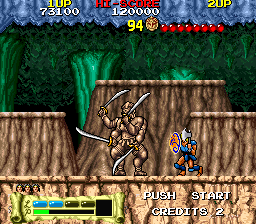
Black Tiger (aka Black Dragon) was created by Capcom under the supervision of Yoshiki Okamoto. Okamoto got his start at Konami, where he created Time Pilot and Gyruss, and at Capcom he had his hands in a whole bunch more classic games, such as Gun.Smoke, 1943, Willow, Magic Sword, and Armored Warriors, not to mention mainstay franchises like Street Fighter, Final Fight, and Resident Evil.
In Black Tiger you control a classic Frazetta-esque warrior as he fights to free the land from the clutches of three dragons that have descended on it. This takes the form of you running and jumping among platforms while blitzing your way through any creatures that oppose you. You wield a long flail while simultaneously hurling a spread of three daggers, which sounds impressive except that many enemies can take a good amount of punishment before going down. The levels scroll in all directions and have maze-like qualities, making it easy to take wrong turns and run down your time limit while your health gets chipped away. It's a pretty tough game and success is best achieved by memorizing the most efficient routes and enemy placements while keeping on your toes for any random attacks that spring up in your path. The likelihood of managing this is low, however, and the game is very much eager to eat your quarters for continues. It's also a long game that could take up to an hour to complete.
There's a modest RPG influence on the game in that you collect money (zenny) from fallen enemies, chests, and vases and you can find shops to spend that money on power-ups. Be careful of trapped chests, though. You have to find keys to unlock chests, and can gather hints by restoring to life wise men that have been turned to stone.
Black Tiger has a striking graphical look. Not overly lush or fancy, but cleanly designed and the hero and the monsters have solid, relatively realistic proportions that would be more eye-catching to a traditional western fantasy audience, rather than super-deformed styles that are common in Japanese games. The hero himself, clad in his horned helmet and scant armor, looks like he leapt right off of a classic paperback cover. It's rarely hard to track what's happening on-screen. However, there is a sameness to the levels that grows wearisome in their length. There's some recycling going on with the boss enemies - even the dragons are basically just the same enemy repeated three times. Combined with the relatively long clearance time required, Black Tiger comes across similar to games like Gauntlet or Rampage, where a little bit of the game goes a long way and it's often easier to just play a credit or two before moving on. If you do persevere, you get a congratulatory message on your strength and prowess and the credits roll over an image of the hero resting on a throne (got to get that classic throne pose in there), but at least this hero gets to have an attractive lady on his knee instead of just glowering in his loneliness like Rastan or Grandoval.
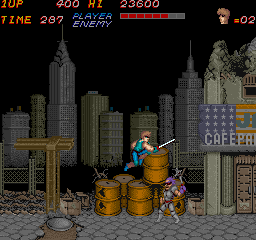
When sword and sorcery started fading from prominence in the 80s, one of the genres that arguably picked up the standard and gave audiences some of the same feeling was post-apocalyptic sci-fi/action. Generally (though not always...) lacking in sorcery or fantasy elements, but stories about hardened warriors wandering a bleak landscape, often having to revert to melee weapons because of scarcity of firearms, coming into conflict with local warlords, and then moving on the next adventure. Trojan (Tatakai no Banka - Battle Song?) takes place in one of these scenarios.
The player controls a man armed with a sword and shield as he hacks his way through the demon army of a tyrant named Achilles. The game begins in a ruined city, then proceeds through wilderness, dilapidated factories, and ends up at Achilles's classically styled palace. Many of your foes are just armored men with maces and crossbows, but some appear to be flame-spitting mutants and others have bionic attachments like a metal arm with an extendable claw. Some especially annoying guys will use gyro-packs to attack you from the skies. Some enemies can knock your weapons away from you, forcing you to fight with your hands and feet until you can retrieve a fresh set, which makes the hero look like a total badass in his ability to adapt.
It's the fourth game designed by Takashi Nishiyama, who broke in at Irem and created Moon Patrol, and then went on to design Kung Fu Master/Spartan-X (inspired by Jackie Chan's Wheels on Meals) before leaving for Capcom. Trojan feels like a spiritual successor to Kung Fu Master in that both games are strictly horizontally-scrolling brawlers in which you often have to determine if it's better to move forward or to turn around and take care of the goons breathing down your back while also minding the knife-throwers and other threats still coming from the front. Trojan is a lot more hectic than Kung Fu Master, and Capcom's influence shows in how the game, much like Ghosts 'n Goblins, requires you to beat it twice before it's considered properly completed. The "true ending" for Trojan, though, only amounts to some insignificant changes in the ending text and most players should feel satisfied if they only complete the first loop - that's an accomplishment in itself.
Visually the game is exceptionally dark, mostly taking place at night, with lots of muted gray and brown backgrounds, while the somewhat more colorful characters look very manga-influenced. Although the game has a lot of the popular hallmarks of the genre, with the crumbling buildings and goons in big shoulder pads, it's hard to imagine that the game wasn't heavily inspired by Fist of the North Star, particularly considering its Japanese origins. Fist of the North Star was a very hot series at the time and had a bigger impact on video games than many westerners realize. For instance, it was also a primary influence on Double Dragon, despite popular assumptions that Double Dragon was some kind of campy take off of The Warriors or martial arts B-movies.
Jousting by itself is as good a concept as any for a video game. In 1982 John Newcomer added flight to it when he designed Joust for Williams.
Joust is known as much for the fact that the player rides on the back of a flying ostrich as it is for its gameplay. It comes across as the kind of weirdness that is often associated with classic fantasy, although when it's picked apart there is a logic behind it. Newcomer was going for an arcade game that didn't involve shooting like so many others, and when he settled on the idea of riding birds for their emotional connection to players (as well as inspired by numerous bits of sci-fi and fantasy fiction such as the hawkmen in Flash Gordon), he found after researching that as beautiful as eagles were in flight, he didn't care for how they looked when they ran and running does factor a bit into gameplay. Ostriches do look great when they're running (since that's kind of what they do), so he went with the fantasy that these ostriches can fly, too. Some of the promotional art for the game also indicates that the birds have some kind of cybernetic enhancement. Newcomer also said the ostriches were good precisely because of how unique a choice they were - everyone going to the arcade would remember that game with the flying ostriches.
With the flying bird concept settled, he decided to go with a two-way joystick - similar to Defender's but horizontal instead of vertical - and a single button to control flapping. The faster you hit the button, the faster you ascend, so the core of the game is mastering the sense of the characters' weight. It's also an early example of a two-player cooperative game, with player 2's character riding the back of a stork to make for a visually distinct sprite.
The game is essentially a deathmatch scenario. The player controls a golden knight riding his ostrich. He has to defeat every other enemy on the screen. The bad guys all ride buzzards and come in three flavors: Bounders (red) are fairly stupid; Hunters (gray) are more aggressive and will even attempt to hover over the player in some circumstances; and Shadow Lords (blue) are very fast and powerful and tend to zoom into the air and bounce off the "ceiling" downward just as fast, making them very dangerous. Defeating an enemy simply requires that the player's lance makes contact with them on a higher plane (being perfectly level with an enemy results in a draw of course). When an enemy is beaten, his bird drops an egg and the player must scoop it up before it hatches. If it hatches, it reveals an enemy of the next level higher level, but the player still has a few seconds to run him over before he mounts a fresh buzzard.
The field is peppered with floating platforms, so the characters all have to try to kill each other while quickly slipping through the gaps in the platforms. As the game progresses, platforms will vanish - open space tends to favor the computer since the player is outnumbered and can't hide as much above or beneath the platforms. There's also a lava pit surrounding the lowest level and early on a "lava troll" will start trying to grab fliers who drop too low over the pit. The troll doesn't discriminate and will grab enemies, too. If grabbed, the player needs to hammer the flap button rapidly to ascend out of the troll's grip while hoping an opportunistic enemy doesn't kill them while they're immobilized (and the player can benefit from this in the opposite circumstance).
To prevent rounds from dragging, before long an ear-splitting cry will announce the coming of the "Unbeatable?" Pterodactyl, an invincible creature that homes in on the player until the round is finished. The reason for the question mark, though, is that a last-minute programming change resulted in the pterodactyl being vulnerable in a tiny spot, allowing the player to temporarily vanquish it through a pixel-perfect strike into its mouth.
Joust is as perfect an arcade game as has ever been created, especially if one is grading based on how a game feels to play. Unlike Defender, which was deliberately designed to frighten players with the complexity of its controls (you have to push a button just to switch direction), Joust's controls are approachable. The physics are extremely finely tuned and easy to get to grips with in terms of gravity and the rhythm of hitting the flap button, as well as understanding the bird's sense of speed. When the game is really up to speed, the sense of soaring through the air is unparalleled in a game of its time. You actually feel graceful while playing it. As a contrast, Nintendo released a Joust clone called Balloon Fight a couple of years later, and while it's a very good game, it's still inferior to Joust in terms of how it feels to play.
Joust has a fair difficulty curve. It looks and sounds great, too. Williams's games tended to have instantly memorable soundscapes, and the animation by Bill Pfutzenreuter is smooth and conveys a sense of character, particularly touches like the how the ostrich will do a Looney Tunes-style foot-braking when it has to stop after running.
Despite the title, Astyanax isn't about the son of Hector of Troy. The player controls a hero who must, as ever, hike across the land and battle monsters until he defeats a dark lord. The game, distributed by Jaleco and known in Japan as The Lord of King, was designed by Rastan's Toshiyuki Nishimura and Tokuhiro Takemori, with Takemori listed as director.
For a core game mechanic, Takemori brought a concept around which he'd based one of his previous games, The Legendary Axe, namely that the hero's axe has a power meter that charges up between attacks. The idea being that you have a choice between attacking a lot at low power, or saving up to unleash a much stronger blow. As it is, Astyanax is such a frantic game that most players will probably just hack away as fast as possible at the litany of foes coming from all sides. The player also can make limited use of a screen-clearing magical attack. Among the bosses are another instance of a multi-armed statue likely influenced by the Kali statue in The Golden Voyage of Sinbad, and a two-headed dragon.
Unlike some other games, Astyanax does follow a relatively consistent path in settings. The attract mode displays a huge tower rising on an island in the middle of a lake that is connected to the surrounding land by a long, narrow bridge. Indeed, the player starts out in a forested area, then moves through cave, then onto the bridge, then penetrating the castle/tower to meet the evil wizard. Because it was the 80s, the final level has the hero bust into a Giger-esque biomechanical hellhole and face skittering monsters that rear up to display mouths that look like vagina dentata, culminating in a battle against a final boss that attacks with an arm that extends across the screen, presumably because having its mouth shoot outward would have been a bit too much for the lawyers. With the job done, the tower and its island crumble and sink and the world is made safe again.
It's not a bad game, but it does overall feel inferior to the console games it's related to, both Legendary Axe for the PC Engine and the NES console port of Astyanax, which keeps the axe-charging mechanic and hack-and-slash gameplay but otherwise reworks the game quite a bit. The graphics in this arcade game are reasonably good, but it feels a bit rote in its side-scrolling design and it's so hyperactive that it renders the charge attack almost pointless.
Rastan was a classic late 80s arcade hit for Taito. Somehow this sequel didn't turn out so well. Possibly the only thing saving it from a worse reputation than it already has is that it isn't well-known at all. The game's design is credited to Hisaya Yabusaki, whose only other design credit is for Taito's animal conservation-themed brawler Growl.
The game's attract mode lays out the story in classic Engrish: The "Rastania" was a sacred place, in which the sacred temple, "Skycraper", soared into the sky. It is said that whoever conquer the "Skyscraper" would rule the "Rastania". A wicked group has invaded the "Skyscraper" and has tried to make it their own. If the situation is left as it is, the place would eventually be controlled by the wicked group.
The player controls a headstrong warrior who seeks to defeat the "wicked group" occupying the tower, although the settings for the five levels don't bother with internal consistency very much. You'll go from looking over tree tops, to a cavern, to a forest, etc. The characters are bigger than the sprites in Rastan, but the game is slower and feels much clumsier to control. Actions like the downward stab that were easy to execute in Rastan now require precise timing - if you do the downward attack too soon the warrior will revert back to his regular stance before coming down on the enemy and will take damage. Even grabbing and leaping off Taito's classic swinging ropes can be oddly finicky. Even worse, the game takes advantage of this and will force the player to deal with incredibly difficult jumps or fall to his death in bottomless pits. One particular trap involves having to do a weird mid-air crouch while falling to squeeze into a tiny space - moves like this have to literally be pixel-perfect in execution. It feels cheap instead of challenging.
Probably the most noteworthy difference from Rastan in gameplay is that the player can block attacks when not attacking. The hero starts with a short sword and shield and can also obtain a long two-handed sword or a pair of iron clawed gauntlets that have shorter range but more power.
Between levels, the game treats the player to scenes of the hero commenting on the action; e.g., clearing level 2 gives a closeup of him with the claw weapon, declaring, "You wicked people! How did you like my assault? Oh, here come tough enemies!" One can imagine how this would sound appropriately badass with a proper translation - maybe something like "You bastards! You like the taste of my steel? Come and get some more!" - but good Japanese-to-English translations even today can't always be taken for granted. At least the music is still pretty good, although not as immediately memorable as the original's.
There's not a lot of information available on Blade Master, but it was released by Irem in 1991, and was known as Cross Blades! in Japan.
It's a beat-em-up game in which players can control either the dual-sword-wielding Roy or the spear-and-flail-wielding Arnold as they battle their way from left to right in pursuit of Roy's girlfriend, Princess Emina, who's been kidnapped by the demon lord because she possesses a spell that can seal him away. Roy has a headband that with his long brown hair kind of makes him resemble Miles O'Keefe in Ator, while the hulking Arnold is kind of obvious, although in both cases the portraits in the upper corners of the screen simply look like a couple of Asian heroes.
Unlike a lot of beat-em-ups, Blade Master's gameplay doesn't involve a lot of combos, but instead it's a countering/parrying system that demands timing during attacks. There are also some simple moves like a downward strike that come in handy. Many of the bosses can be knocked down and then leaped on to start hammering into their chests. Beating people when they're down is always such a satisfying element of this genre. Enemy AI isn't very impressive as enemies will sometimes become immobile depending on the player's approach.
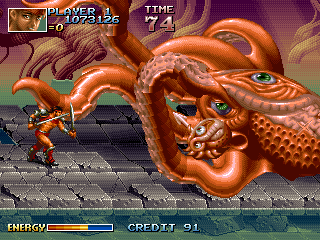
Irem's games around this time were known for lush graphics and this one makes a good first impression. The heroes and the assorted humanoids they fight look good for their relatively modest heights. Bosses are imposingly huge, including a kraken with gorgeously animated tentacles and a biomechanical, Giger-esque giant with a retractable neck.
The backgrounds feature attractively rendered sights such as cities rising above clouds, a distant sunset, and rocky valleys, but it doesn't take long to notice that there's a lot of repetition, like seeing the backgrounds cycle in old Hanna-Barbera cartoons. The final two of the seven stages disappointingly recycle the same endless bridge graphics, and it's a long game by beat-em-up standards so seeing the same imagery for minutes at a time gets wearisome. There's a section in which the heroes ride on the backs of giant flying bugs, but it's all too brief. The game could have used one or two more imaginative setpieces like that. The game also resorts to recycling the humanoid bosses as it continues - one becomes two or three later in the game.
Not a bad game but one that feels like it could have used some extra care to become a must-play.
Rastan (aka Rastan Saga) was released by Taito, design credited to Toshiyuki Nishimura under the direction of Yoshinori Kobayashi. Nishimura also is credited as designing The Astyanax, a game that will likely get some coverage here down the line.
Along with Golden Axe, Rastan is probably the purest example of sword and sorcery in an arcade game and yet another game very clearly influenced by the Conan the Barbarian movie. The international version of the game doesn't have much to show for a story aside from the image of an aged Rastan on a throne, similar to the movie's final image of Conan as a king. The Japanese version, however, includes a screen explaining that Rastan has made a business arrangement with the princess of a kingdom: Rastan will slay a dragon and upon dropping its head before the princess, she will give him all of the money.
Rastan is one of the standout games of its time in terms of presentation. The character designs are instantly memorable, with Rastan being an agreeably drawn loin-clothed barbarian taking on various enemies that tend to have a mythological slant. Centaurs, amazons, chimeras, and harpies, among others. There isn't a lot of parallax scrolling, but the lush, richly colored environments are imbued with memorable effects such as changes in time of day or weather, and interesting features such as colossal statues far in the distance that any Tolkien fan would recognize as the Argonath. Best of all, Rastan has an absolutely great Basil Pouledoris-influenced soundtrack by Naoto Yagishita and Masahiko Tagaki that would probably make a fine transition to a full orchestral performance.
Whereas Golden Axe was modeled on brawlers like Double Dragon, Rastan is purely horizontal and enemies generally are vanquished with a single stroke. Levels are divided between an outdoor section, such as mountains or murky forests, and fortresses that Rastan must navigate until meeting an end-boss in a throne room. Rastan's basic weapon is a sword, but he can find axes, morning stars, or (best of all) a magical sword that shoots fireballs, along with items that carry effects such as replenishing his health or making him more resistant to damage. Rastan has a health bar that runs down to a heart that beats harder as his life runs down, another classy visual touch. An important distinguishing feature of the game's design is that Rastan need not stop before attacking or leaping. A big part of developing a successful strategy for the game is balancing the urge to rush ahead while cleaving through enemies with the need to occasionally slow down or even stop and wait for an opening.
An amusing touch is that Rastan will sometimes have to jump out and grab a swinging vine, calling back to Taito's Tarzan game, Jungle King, which was reworked as Jungle Hunt after the Burroughs estate rattled its saber at the company (not a lot of Tarzan or ERB-based games out there...).
Rastan is unusually difficult even by the standards of coin-munching arcade games. Enemies are numerous and never stop charging at you from both sides. Moreover, the stages are full of hazards such as pits and lakes that will kill you instantly if you fail to make a leap. On top of that, the game pulls a bit of a tough trick on players when it reveals that there are no continues for the final level. To actually overcome the game, one has to learn it very well instead of just purchasing credits all the way through. I confess I've never beaten the game. I'm not good enough.
If one is good enough to win, the game reveals Rastan moving on before concluding with the shot of his older self on the throne, stating that this was only one of his adventures on the way to earning his kingship, and that he might have other stories to tell. Taito did create more games featuring the character, but those are stories for another time...
I had a few thoughts on where to start, something more recent or something very old, but Golden Axe kept coming to mind. Why not?
It is an arcade game released by Sega, designed by Makoto Uchida, who previously worked on Altered Beast and would go on to design the Die Hard Arcade/Dynamite Cop games. Strongly influenced by Double Dragon, it plays like a horizontally scrolling beat-em-up game, but instead of picking up weapons (because the characters are already armed), for powering up the player can either accumulate potions for magical attacks or mount one of three creatures that attack in their own ways. One of the creatures is a squat, tail-whipping and bird-like creature referred to as a cockatrice (which also previously appeared as an enemy in Altered Beast), the other two are dragons that breathe fire in different ways.
The player can choose one of three characters to control, differentiated in a typical way for beat-em-up games: physically strong but with weak magic, physically weak but with strong magic, and an intermediate character. They're each on a quest to defeat Death Adder, a hulking, ax-wielding brute who's taken over the kingdom and is keeping the king and princess hostage. Ax Battler, the barbarian, wants revenge for his mother's murder. Tyris Flare, the amazon, wants revenge for her parents' murder. Gilius Thunderhead, the dwarf, wants revenge for his brother's murder. The motives are about as simple as you can get.
The game is fun, intuitive to control, and relatively easy for a coin-muncher. Some of the collision detection can be tricky, but even having not played the game for a good while, I was able to complete it in around 20 minutes and using no more than what would have been $1.50 per character. The graphics are good and the music does an adequate job of evoking works by Basil Pouledoris. My friends and I used to love hearing the death cries of the game's characters that were sampled from "First Blood."
Stylistically, the game aims straight down the middle in how it goes for a sword-and-sorcery flavor and it's probably more reminiscent of mid-list books that were written in the 70s as cash-ins than the major classics of the genre. Uchida is said to have studied the "Conan the Barbarian" movie quite a bit for inspiration, and the presentation of the characters follows the classic post-Frazetta veneration of the human physique. Ax Battler is a muscular swordsman in a blue speedo. Tyris Flare is a swordswoman in a red bikini. Gilius is a bit irregular since the genre doesn't often depict dwarf heroes, but it's not like there's a rule that you can't have non-human heroes. Death Adder is also very muscular and wears relatively little clothing. Not practical, but for better or worse modern visual depictions of the genre largely favor this style of hairless bodybuilders facing down their enemies.
One of the most striking enemies in the game is the skeleton warrior who rises out of the earth with a sword and his brow angled down in a permanent glare, straight out of the climax of Ray Harryhausen's "Jason and the Argonauts." Most of the others are an assortment of club and sword-swinging goons, male and female.
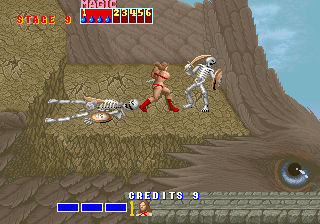
For setting, the heroes travel through the wilderness, arriving at a village on the back of a giant turtle that swims across the sea. They pass through a town but, finding the way to the villain's castle blocked with enemies, they ride and fight on the back of a giant eagle to the castle's ramparts and proceed to the throne room for the final confrontation.
After besting Death Adder, he collapses on back as he flings his axe skyward, only for it to twirl down and embed itself in his chest, causing blood to explode out of the wound. The heroes release the king and his daughter and the game abruptly cuts to an arcade in which kids are playing the Golden Axe arcade game, at which point the game's cast of characters jump out of the screen and chase the kids through the streets of what is presumably Tokyo. It was common in games of the era to not take themselves very seriously, but overall this is about as pure a S&S game as has ever been made. I suspect most won't fit the genre so cleanly.
Supplemental viewing - Conan the Barbarian (1982); Jason and the Argonauts (1963)
Supplemental reading - Kyrik: Warlock Warrior, by Gardner Fox