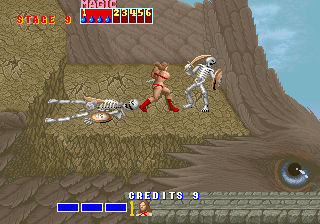
Sega didn't waste much time porting Golden Axe to its new Mega Drive/Genesis console, getting it out just in time for Christmas the same year it debuted in the arcades.
They did a pretty good job on it. It's a slight downgrade in audio and video, lacking the great First Blood voice samples and the parallax scrolling of the arcade, but for audiences accustomed to NES games, it would have looked spectacular having something so close to the arcade version at home. More importantly, it plays just about right, too. Techniques that work well in the arcade version still work well in the home version as it moves at a very similar speed and the collision detection seems pretty close as well.
The best home ports usually do something extra with the game and in this case Sega added an extra, final level to the game. It plays out just like the arcade version, with the heroes travelling to Death Adder's castle on the backs of the giant turtle and eagle, but after facing the villain in the throne room and saving the king and princess, instead of the farcical, Blazing Saddles-like ending of the cast breaking out of the arcade, the king informs you that you only faced an underling and the master is somewhere behind the door from which Death Adder appeared. So you head through the door and tackle the final stage.
The last stage is slightly disappointing in its look. Instead of something wild and creative, like maybe dragging the heroes into another dimension or something, it's just a dungeon with some tougher enemies within, many of whom can be cheaply defeated by knocking them into bottomless pits. Before long, you face the true villain, Death Bringer, who's just like Death Adder except getting hit by him is extremely costly because in addition to taking damage from his giant axe, a hit also triggers a magical explosion similar to what the players can do with their fully charged magic attacks. It's a good challenge. Overcoming him leads to the heroes emerging back into the throne room and receiving some thanks from the king and a congratulatory message from the game before some credits roll.
I had a few thoughts on where to start, something more recent or something very old, but Golden Axe kept coming to mind. Why not?
It is an arcade game released by Sega, designed by Makoto Uchida, who previously worked on Altered Beast and would go on to design the Die Hard Arcade/Dynamite Cop games. Strongly influenced by Double Dragon, it plays like a horizontally scrolling beat-em-up game, but instead of picking up weapons (because the characters are already armed), for powering up the player can either accumulate potions for magical attacks or mount one of three creatures that attack in their own ways. One of the creatures is a squat, tail-whipping and bird-like creature referred to as a cockatrice (which also previously appeared as an enemy in Altered Beast), the other two are dragons that breathe fire in different ways.
The player can choose one of three characters to control, differentiated in a typical way for beat-em-up games: physically strong but with weak magic, physically weak but with strong magic, and an intermediate character. They're each on a quest to defeat Death Adder, a hulking, ax-wielding brute who's taken over the kingdom and is keeping the king and princess hostage. Ax Battler, the barbarian, wants revenge for his mother's murder. Tyris Flare, the amazon, wants revenge for her parents' murder. Gilius Thunderhead, the dwarf, wants revenge for his brother's murder. The motives are about as simple as you can get.
The game is fun, intuitive to control, and relatively easy for a coin-muncher. Some of the collision detection can be tricky, but even having not played the game for a good while, I was able to complete it in around 20 minutes and using no more than what would have been $1.50 per character. The graphics are good and the music does an adequate job of evoking works by Basil Pouledoris. My friends and I used to love hearing the death cries of the game's characters that were sampled from "First Blood."
Stylistically, the game aims straight down the middle in how it goes for a sword-and-sorcery flavor and it's probably more reminiscent of mid-list books that were written in the 70s as cash-ins than the major classics of the genre. Uchida is said to have studied the "Conan the Barbarian" movie quite a bit for inspiration, and the presentation of the characters follows the classic post-Frazetta veneration of the human physique. Ax Battler is a muscular swordsman in a blue speedo. Tyris Flare is a swordswoman in a red bikini. Gilius is a bit irregular since the genre doesn't often depict dwarf heroes, but it's not like there's a rule that you can't have non-human heroes. Death Adder is also very muscular and wears relatively little clothing. Not practical, but for better or worse modern visual depictions of the genre largely favor this style of hairless bodybuilders facing down their enemies.
One of the most striking enemies in the game is the skeleton warrior who rises out of the earth with a sword and his brow angled down in a permanent glare, straight out of the climax of Ray Harryhausen's "Jason and the Argonauts." Most of the others are an assortment of club and sword-swinging goons, male and female.
For setting, the heroes travel through the wilderness, arriving at a village on the back of a giant turtle that swims across the sea. They pass through a town but, finding the way to the villain's castle blocked with enemies, they ride and fight on the back of a giant eagle to the castle's ramparts and proceed to the throne room for the final confrontation.
After besting Death Adder, he collapses on back as he flings his axe skyward, only for it to twirl down and embed itself in his chest, causing blood to explode out of the wound. The heroes release the king and his daughter and the game abruptly cuts to an arcade in which kids are playing the Golden Axe arcade game, at which point the game's cast of characters jump out of the screen and chase the kids through the streets of what is presumably Tokyo. It was common in games of the era to not take themselves very seriously, but overall this is about as pure a S&S game as has ever been made. I suspect most won't fit the genre so cleanly.
Supplemental viewing - Conan the Barbarian (1982); Jason and the Argonauts (1963)
Supplemental reading - Kyrik: Warlock Warrior, by Gardner Fox