Showing posts with label Revenge!. Show all posts

Monday, August 29, 2022

Torvak the Warrior (1990)


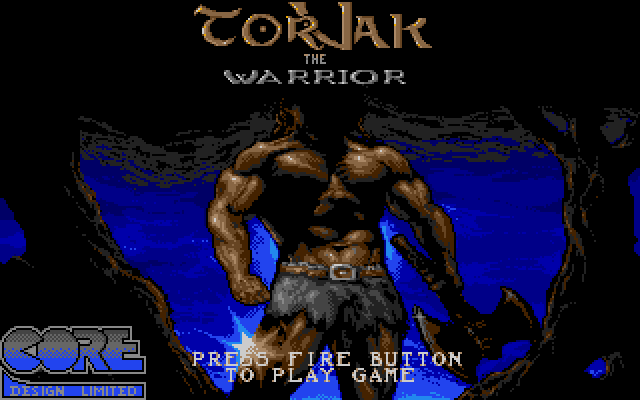
Torvak the Warrior is a relatively early game from Core Design, which of course would go on to fame for creating the Tomb Raider series. Torvak is yet another poor barbarian warrior who comes home from the war to find the whole place burned down and all villagers slain by the forces of a necromancer. With no rest for the weary, Torvak picks up his axe and heads off to make the sumbitches pay.

This takes the form of a side-scrolling hack-and-slash game in which Torvak has to generally go from left to right over five levels, but those levels can get a bit mazelike and feature long vertical shafts and hidden secrets that offer extra points and power-up items. Torvak will face human berserkers, green-skinned orcs, rat-men, oozing swamp creatures, and rock-men, among several others.

Torvak begins with his axe but he can pick up a broadsword, a warhammer (leave this one alone, it's terrible), or a ball-and-chain. He can find shields for protection, and he can find potions that allow him to unleash a limited number of magical attacks, handy for facing level bosses.

The game superficially resembles stuff like Rastan, but it's a slow, plodding experience. Torvak, with his top-heavy upper body and relatively stumpy legs, moseys along his way, stops moving while attacking, and since bigger enemies often take multiple hits to kill, he frequently has to take a shot, then leap backwards to create enough space for a second attack. Although he has an explosive jumping ability, he's definitely more akin to Arnold's lumbering portrayal of Conan than Robert E. Howard's quick, pantherish original.
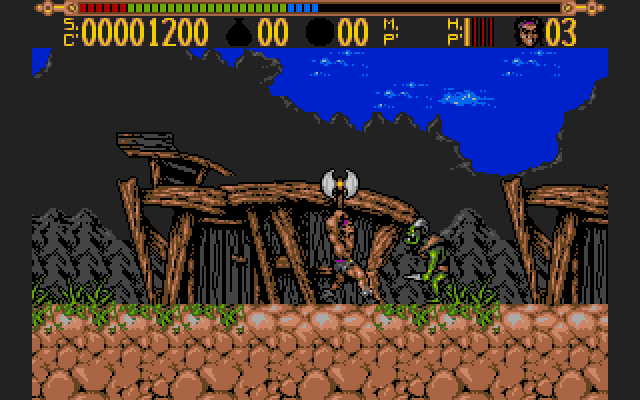

Torvak the Warrior seems to have been initially designed for the Atari ST, then ported to the Amiga, a phrase that probably triggers old Amiga fans' PTSD. The Amiga version got a modest upgrade to Matt Furniss's soundtrack, but nothing else. The relatively limited colors and lack of parallax scrolling betray the game's ST origins, and even the improved soundtrack comes at the cost of forcing the player to choose between music or sound effects, but not both simultaneously, a common issue with Commodore machines because of their limited audio channels.

To its credit, though, the game plays fairly, controls well, and it looks okay even if it's not a technical marvel. Core had some good artists (Lee Pullen and Terry Lloyd in this case), so their games often had a clean, attractive look and distinctive characters. The levels have the standard swamp/mountains/jungle themes, but there are evocative background details like giant skulls and rotting carcasses of huge creatures littering the ground.

Torvak the Barbarian is better than many games, but there are also many games better than it.

Supplemental reading: Legend, by David Gemmell


Thursday, June 2, 2022

Age of Barbarian Extended Cut (2016)


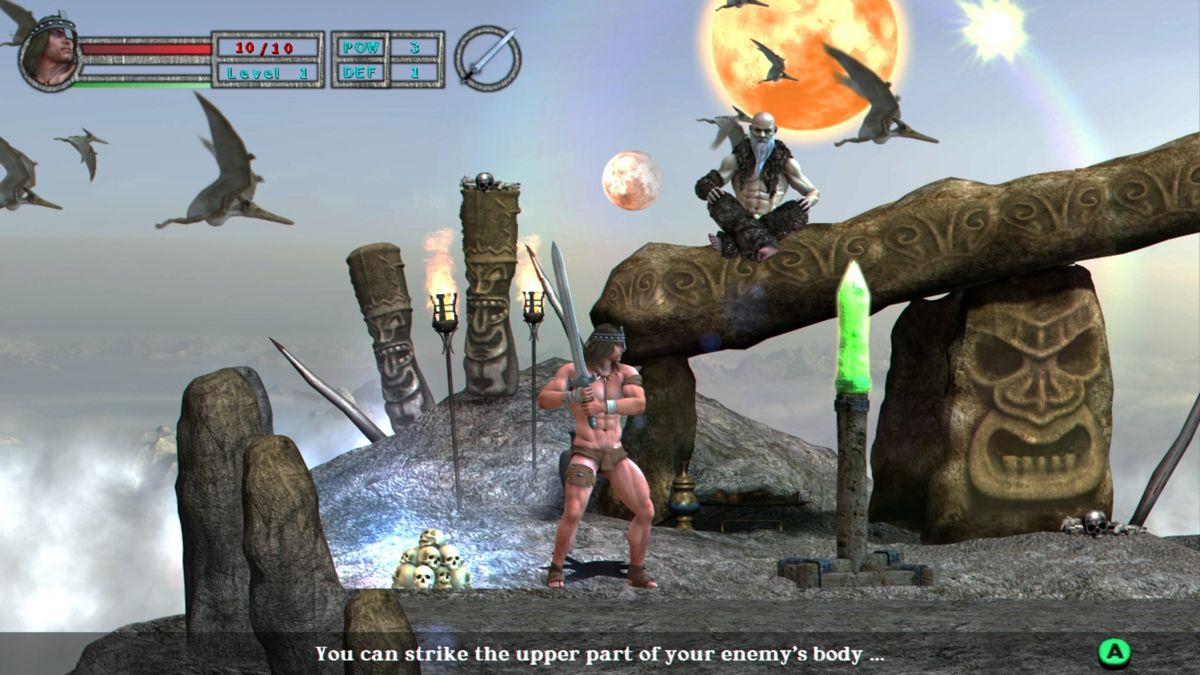
Age of Barbarian - created by Italian studio Crian Soft, headed by Christian Fanucci and Catherine Thalman - is about as pure a representation of sword and sorcery in games as can be found. It pays homage to the entire genre, both the best (Robert E. Howard) and the more questionable parts (80s B-movies like Deathstalker). It apologizes for nothing.

The player can choose between a male or female character. The man, Rahaan, is a thinly veiled Conan stand-in (even including a gap in his teeth like Schwarzenegger) whose village is destroyed and who survives being crucified by the dark lord Necron, while the woman, Sheyna, is a warrior princess who escapes Necron's slavers. Depending on which character is chosen, the game will change somewhat beyond their particular stats (Rahaan: stronger, Sheyna: faster), with distinct opening levels and cutscenes. Each character wears as little clothing as possible and they are as physically idealized as the creators could imagine.


The player must choose a level from a world map, and those levels scroll strictly horizontally, similar to Rastan but with occasion rooms to enter and multiple exits to different sections, which become particularly important when uncovering secrets. The characters are exceptionally large compared to most such games (closer to something like Gladiator) and the combat system is relatively simple but still complex enough to demand the player's attention. The player can choose among high and low attacks, combos, a kick to separate from enemies too close to hit, blocking, rolling, or simply switching direction. The kick and roll moves and some of the special techniques such as the spinning decapitation move are straight out of Barbarian for the C64, so the game isn't just a tribute to books and movies but to other games as well. The deliberate platforming elements, including climbing, leaping over pits, and avoiding lethal spike traps, are from Jordan Mechner's Prince of Persia, for instance. There are mild RPG elements, including inventory to manage and experience points/leveling.

Every aspect of the game is hellbent on creating a true S&S experience. The bestiary almost entirely eschews Tolkien/high fantasy influences. There are masked slavers, lizardmen, apemen, giant spiders, crocodiles, zombies, etc. There are no elves, orcs, or dwarves present, and when something like a basilisk appears as a level boss, it's presented as something that is disturbingly singular, alien, and deadly. Wizards are similarly rare and dark-natured. Necron of course is basically swiped from Ralph Bakshi and Frank Frazetta's Fire and Ice, and one of his chief henchmen is Frazetta's Death Dealer. Some levels include hostages, particularly scantily clad maidens, that need to be rescued and, in a unique touch, escorted to safety (thankfully, the escorting part isn't especially difficult or tedious). The player will traverse mountains, forests, swamps, spider-haunted temples, and Roger Dean's floating rocks in the skies. Combat is gory, full of disembowelments, decapitations, dismemberments, and harsh executions, and the game is uncommonly frank about nudity (although there is a censor option). The player can activate a filter to get some extra grindhouse movie flavor in the visuals. The game is also quite funny, but it's a humor that comes from love and knowledge of the genre rather than mockery from afar. Rahaan's crazed death glare in response to enemy taunts is always a highlight.

Graphically, the designers went for a very particular mid-90s look like something created on an old Video Toaster. The characters are lifelike but embellished rather than using straight digitizations of actors and it's quite an effective job. The backgrounds are reasonably well-rendered, with garishly colored skies and moons. The soundtrack is appropriately epic, and the voice acting certainly does evoke 1980s B-movies.

It's certainly not perfect. The game is a low-budget indie effort (maybe that's only fitting) and bugs are common. The spider cult DLC is particularly prone to crashing at odd times. The controls have a knack for becoming unresponsive, extra frustrating when the player is faced with an instant-kill trap that requires precision to pass. The animations sometimes jerk about. The English translation is rough. The menus and user interface are awkward and feel perfunctory in some ways. 

But like the Millennium Falcon, it's got it where it counts. 

Tuesday, April 26, 2022

Odallus: The Dark Call (2015)


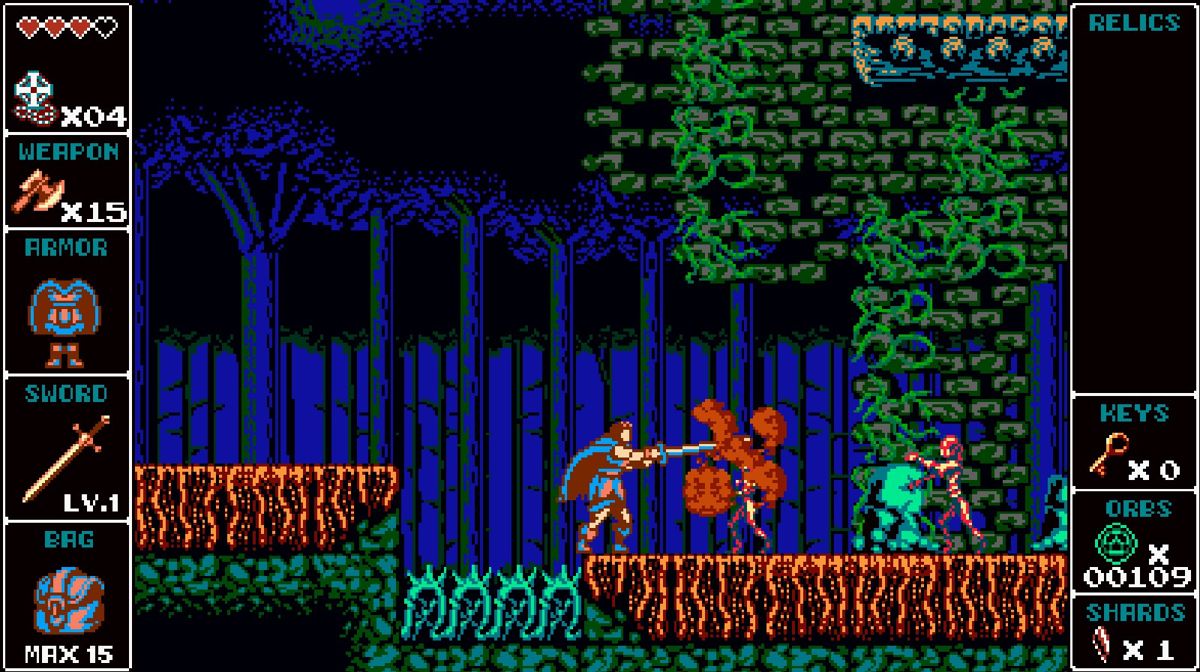
Odallus is the creation of JoyMasher, a Brazilian studio headed by Danilo Dias and Thais Weiller. It's their second game, following 2012's Oniken, with both games being united by a relatively strict adherence to the limitations of the original NES (the studio's next game, Blazing Chrome, moved beyond the NES to more of a Sega Mega Drive feel). Although the 8-bit aesthetic has been very popular among indie developers over the last decade, most such games settle on something that looks NES from a distance but on closer inspection has effects that are beyond what an NES could really do, such as mixed resolutions, going beyond the 4-color limitation, and rotation and scaling effects that were a big selling point of the Super NES. Oniken was very dedicated to being a game that wouldn't look out of place among real NES games. Odallus is much the same, although they've colored slightly outside the lines in certain ways, such as dedicating the screen space beyond the 4:3 gameplay window to character information. 


In Odallus, the player controls the somewhat unfortunately named Haggis, who returns home from a hunt to find his village burning and his only son missing. The only thing to do is to head out for revenge and to rescue his boy from the demons that took him. The dark and downbeat story is mostly conveyed through short dialogue segments when facing level bosses. JoyMasher's games so far have all featured a style that is very reminiscent of 1980s and early 90s anime, with a lot of influence from western action and horror movies. Instead of the cute, nonthreatening protagonists popular in modern anime and games, JoyMasher's stern-faced, muscular characters look like they walked out of something like Fist of the North Star, and Odallus in particular feels like a combination of Highlander and Berserk. In terms of how it compares to other games, there's a strong Castlevania and Demon's Crest influence but the dark blue-green colors and grungier feel recall the NES games published by Natsume. Natsume is mostly known today as the company that publishes Harvest Moon, but among their earlier output were games like Shadow of the Ninja, Shatterhand, and Power Blade II - games that come across like moodier takes on the sort of platforming action Konami and Capcom thrived on at the time.

Although Odallus is often described as a Metroidvania, it doesn't have the completely open world of that particular type of game. Instead, the game is broken into distinct levels with multiple exits and the player is encouraged to explore as much as possible, move to the next level, and after obtaining particular items they can then return to previous levels and unlock previously impassible exits to follow a different track for a while. It's more like the structure of Demon's Crest or Demon's Souls. Also like Castlevania, the use of limited secondary weapons is required, although Haggis has the ability to grab ledges and pull himself up, an ability that would have come in handy in many old platforming games. 

It's a very well-crafted game. Hard enough to put up a solid challenge without leaving the player too frustrated. JoyMasher has been a consistently good studio that works in a style that isn't being covered by many other modern game developers. While many other small developers have been trying to work in a childlike, super-deformed style that has become somewhat standardized, these guys produce games that not only look and sound like late 80s work but also replicate the same kind of easygoing coolness.


Thursday, April 7, 2022

Blood Omen: Legacy of Kain (1996)


Blood Omen opens with a somewhat baffling scene of a rat-headed vampire storming into a castle and slaughtering several wizards, a guard being resurrected as a living suit of armor, and a series of nine tall white pillars erected in a forest staining and cracking. The game then transitions to gameplay, in which the player assumes control of a nobleman as he's being turned out of a tavern, and is then immediately confronted outside by a mob of assassins who yell "THAT'S HIM!" before killing him. If you're skillful, you can actually fend off a number of the killers, but to progress the game you have to accept that the man will die. Then another cutscene plays in which the man, named Kain, is resurrected as a vampire by another wizard and promised that he can have his revenge. The game properly begins with the vampire Kain awakening in a crypt and wandering out into the world.

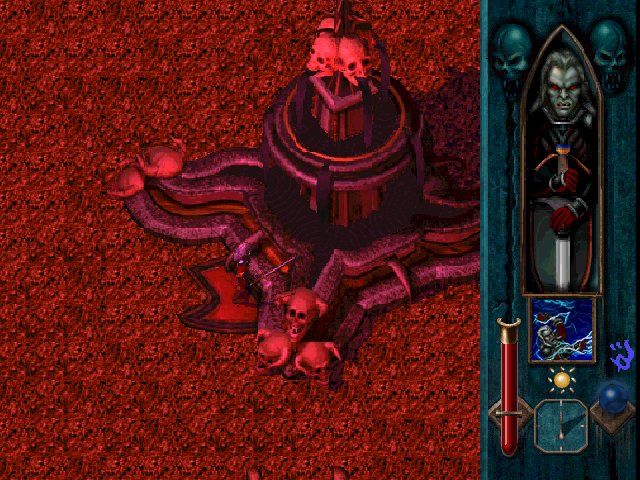
The way the game actually plays is as a ponderous, adult-oriented take on The Legend of Zelda, with a top-down view of the action as Kain wanders through forests, towns, snowy fields, swamps, and castles, battling men and monsters. Kain accumulates new abilities that allow him to reach previously unreachable areas, such as the power to transform into a wolf, mist, or even a normal human, which opens the possibility of interacting with people who would normally flee from or attack a vampire. As a vampire, Kain maintains his energy by drinking blood from enemies, or occasionally from helpless victims. Having to clutch and suck blood from a neck like in traditional stories would likely have become tedious, so the game's solution is to allow Kain to raise his hand and simply yank all the blood from a victim out of their mouth, across space, and down his own throat. Sort of an inversion of the projectile vomiting from John Carpenter's Prince of Darkness.

The game is fairly easy to complete, with most of the difficulty coming from enemies that can cast homing projectiles at you. The ability to cast a shield spell trivializes most of the challenge in the latter part of the game as you can simply plow through attacks, chop down enemies, and then recharge your mana before casting the shield again.

In terms of art direction, the game is very classical gothic horror, down to the Germanic towns you visit, and it's full of colored lighting effects. If a person was ever curious as to what Mario Bava's interpretation of Zelda might look like, this game probably comes as close as any to fulfilling that.


Blood Omen is uncommonly good in terms of how it tells a complex story through a video game. Although there are some crudely rendered, poorly aged CGI cutscenes, a lot of the game's story and lore is imparted to the player simply through narration that occurs during gameplay. Whereas many games fall to the temptation to inflict many minutes if not hours of non-interactive cutscenes on the player, Blood Omen is admirably restrained and adheres to brevity. It doesn't hurt that the cast, with actors like Simon Templeman and Tony Jay, give very good voice performances. Characters are quickly established, there are a couple of interesting plot twists, and the next goal on the map and in the plot is always clearly explained. The story itself involves Kain being manipulated by greater forces of his world to perform a mission of assassinating the wizards appointed as the guardians of the Pillars of Nosgoth. For reasons explained throughout the game, the guardians have fallen into paranoia and infighting and must be eliminated so that the magical pillars they represent can be cleansed and forces of chaos expunged from the world.

It's hard not to look at Kain with his white mane of hair and chalky complexion and not think of Elric, although their personalities are rather different, and of course Elric merely wielded a vampiric sword while Kain is the vampire himself. There are also some similarities in terms of their stories' concerns with free will. For his part, director Denis Dyack said the storyline was influenced by Robert Jordan's Wheel of Time series and the Necroscope books by Tarra Khash writer Brian Lumley, with the idea of the Pillars of Nosgoth coming from his seeing a copy of Ken Follett's Pillars of the Earth and thinking the title sounded evocative.


Supplemental reading: Bloodstone, by Karl Edward Wagner

Wednesday, March 9, 2022

Dishonored (2012)


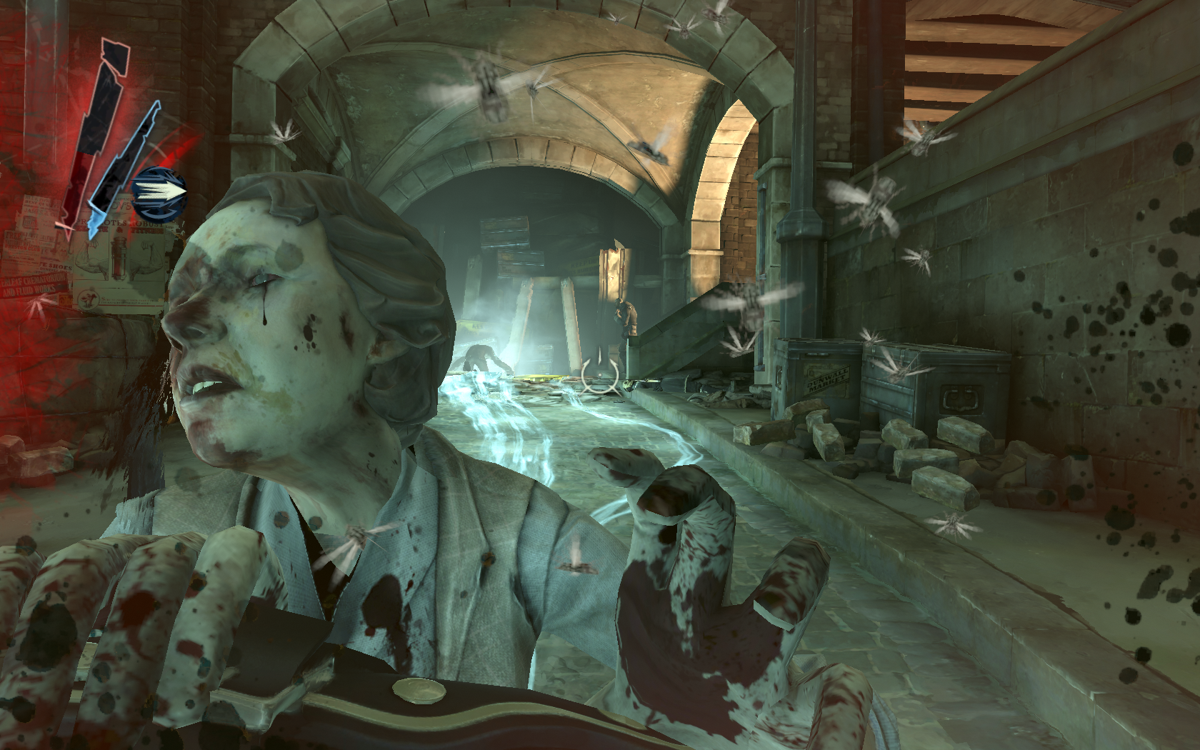
Dishonored, released by Arkane Studios, probably isn't most people's idea of a traditional sword-and-sorcery work. The player controls a royal bodyguard, Corvo, to the empress of a secondary world modeled on Victorian London. It's technically not a steampunk world, but rather a world in which fantasy technology is entirely powered by whale oil. The empress is assassinated, her daughter is kidnapped, and Corvo is framed for the crime and sent to prison. Months later, a group of conspirators loyal to the empress helps spring Corvo from the joint and immediately afterward Corvo is approached by a mysterious cosmic entity called the Outsider, who provides Corvo with supernatural powers that Corvo may use to gain his revenge. The Outsider's relationship with Corvo and other mortals is broadly reminiscent of how Elric's magic is supported by Arioch and other supernatural beings.

Unlike the other games covered so far, in which story served more as flavor and as something to simply put various aspects of the games in context, Dishonored is a big-budget modern game that attempts to tell a full story of Corvo's fall and rise and insists that players watch lengthy cutscenes, interact with fully voiced supporting characters, read books full of background information on the world and its people, and listen to audio logs. It's a far cry from the hard-hitting, get-right-to-it manner of Rastan or Golden Axe. But Dishonored in many ways takes after the Thief series and Thief is absolutely thick with Fritz Leiber-esque atmosphere.

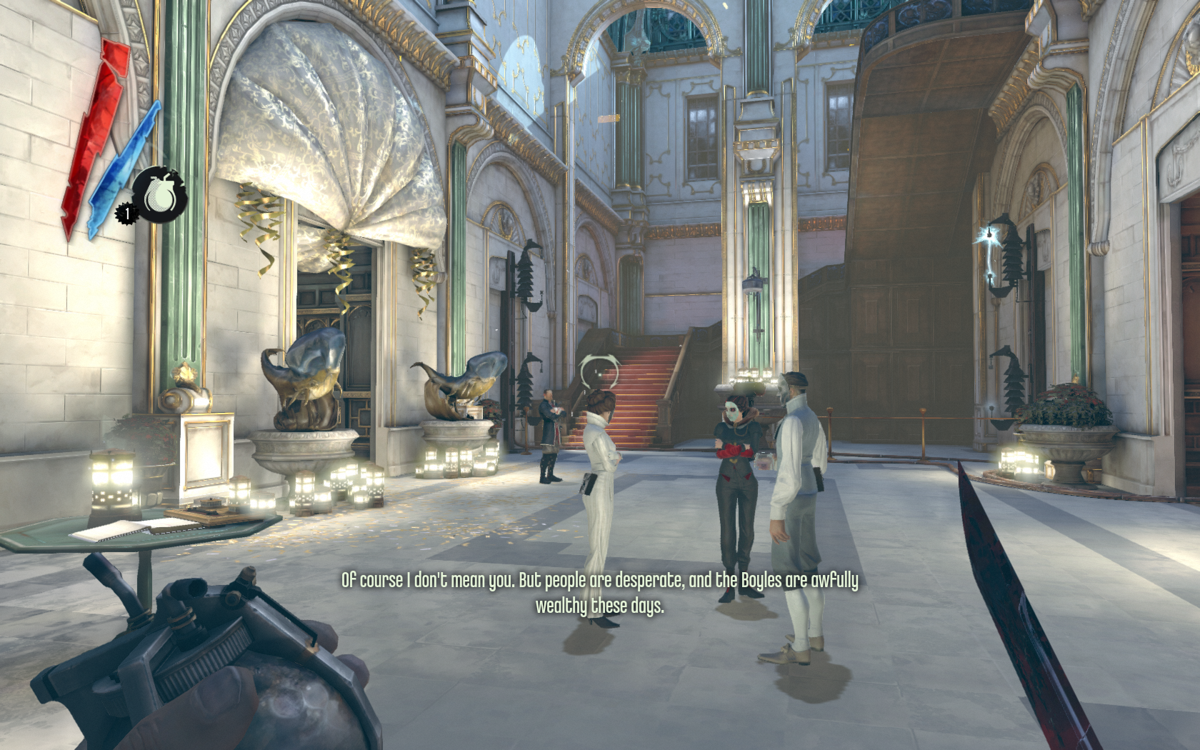
Dishonored is designed to offer as much freedom as possible to the player in achieving goals. The game can be completed without directly harming a single person by sneaking about like a ghost, or Corvo can charge in and capably hack his way through multiple opponents with his sword and pistol, setting off alarms and causing complete chaos. Corvo's powers potentially include teleportation, possession, stopping time, or calling forth hordes of plague rats to overwhelm foes. Corvo is also armed with several types of gadgets such as traps, grenades, and hacking devices. It doesn't take long for Corvo to seem quite overpowered compared to all the enemies around him. 

The game was initially intended to simply be an assassination game, as Corvo would eliminate important characters that were part of the conspiracy against him and the empress, but co-director Harvey Smith (Deus Ex, Thief: Deadly Shadows) proposed that missions have alternate non-violent solutions, although in some cases it could be debatable whether the non-fatal method is more humane; e.g., in one mission your solution leads to a female target being kidnapped by an admirer who will forever have the woman at his mercy without anyone realizing her circumstances. The game judges the player through a simple morality system based on how much chaos the player causes. More death and explosions lead to more negative consequences and the bad ending, while keeping body counts low leads to a happier outcome.

The fantasy elements are relatively restrained in that enemies are all essentially human. Even the "zombies" present in the game are actually people reduced to that state because of an unexplained plague afflicting the city. There are no hints of elves, orcs, or dwarves anywhere. 

Visually, the game uses a painterly effect that is effective in providing a sense of realism, but stylized just enough that the game's seams don't show. The artists, such as Viktor Antonov, cited as inspiration works by Gustave DorĂ© and illustrations for Rafael Sabatini's novels such as Captain Blood, among others. 


As with so many big budget games, the production values are very impressive, although I can't help thinking that the big name voice cast the studio hired was somewhat wasted. Aside from Michael Madsen as the villain/DLC protagonist Daud, I failed to recognize most of the voices and was surprised to see names like Brad Dourif and Carrie Fisher listed in the cast. It's enjoyable enough to play but the story is predictable and I never felt invested in the fates of any of the characters. The game is almost too effective at evoking a sense of squalor - the overwhelming brownness of it and the trash- and carcass-strewn streets and houses become wearisome after a while, reminding me of how many recent fantasy works seem weirdly preoccupied with excrement and garbage. But at least the game is of a modest length and doesn't overstay its welcome, either.


Wednesday, January 5, 2022

Golden Axe (1989)

I had a few thoughts on where to start, something more recent or something very old, but Golden Axe kept coming to mind. Why not?


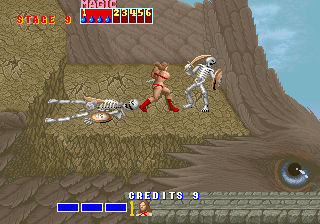
It is an arcade game released by Sega, designed by Makoto Uchida, who previously worked on Altered Beast and would go on to design the Die Hard Arcade/Dynamite Cop games. Strongly influenced by Double Dragon, it plays like a horizontally scrolling beat-em-up game, but instead of picking up weapons (because the characters are already armed), for powering up the player can either accumulate potions for magical attacks or mount one of three creatures that attack in their own ways. One of the creatures is a squat, tail-whipping and bird-like creature referred to as a cockatrice (which also previously appeared as an enemy in Altered Beast), the other two are dragons that breathe fire in different ways.

The player can choose one of three characters to control, differentiated in a typical way for beat-em-up games: physically strong but with weak magic, physically weak but with strong magic, and an intermediate character. They're each on a quest to defeat Death Adder, a hulking, ax-wielding brute who's taken over the kingdom and is keeping the king and princess hostage. Ax Battler, the barbarian, wants revenge for his mother's murder. Tyris Flare, the amazon, wants revenge for her parents' murder. Gilius Thunderhead, the dwarf, wants revenge for his brother's murder. The motives are about as simple as you can get.

The game is fun, intuitive to control, and relatively easy for a coin-muncher. Some of the collision detection can be tricky, but even having not played the game for a good while, I was able to complete it in around 20 minutes and using no more than what would have been $1.50 per character. The graphics are good and the music does an adequate job of evoking works by Basil Pouledoris. My friends and I used to love hearing the death cries of the game's characters that were sampled from "First Blood."


Stylistically, the game aims straight down the middle in how it goes for a sword-and-sorcery flavor and it's probably more reminiscent of mid-list books that were written in the 70s as cash-ins than the major classics of the genre. Uchida is said to have studied the "Conan the Barbarian" movie quite a bit for inspiration, and the presentation of the characters follows the classic post-Frazetta veneration of the human physique. Ax Battler is a muscular swordsman in a blue speedo. Tyris Flare is a swordswoman in a red bikini. Gilius is a bit irregular since the genre doesn't often depict dwarf heroes, but it's not like there's a rule that you can't have non-human heroes. Death Adder is also very muscular and wears relatively little clothing. Not practical, but for better or worse modern visual depictions of the genre largely favor this style of hairless bodybuilders facing down their enemies.

One of the most striking enemies in the game is the skeleton warrior who rises out of the earth with a sword and his brow angled down in a permanent glare, straight out of the climax of Ray Harryhausen's "Jason and the Argonauts." Most of the others are an assortment of club and sword-swinging goons, male and female.


For setting, the heroes travel through the wilderness, arriving at a village on the back of a giant turtle that swims across the sea. They pass through a town but, finding the way to the villain's castle blocked with enemies, they ride and fight on the back of a giant eagle to the castle's ramparts and proceed to the throne room for the final confrontation. 

After besting Death Adder, he collapses on back as he flings his axe skyward, only for it to twirl down and embed itself in his chest, causing blood to explode out of the wound. The heroes release the king and his daughter and the game abruptly cuts to an arcade in which kids are playing the Golden Axe arcade game, at which point the game's cast of characters jump out of the screen and chase the kids through the streets of what is presumably Tokyo. It was common in games of the era to not take themselves very seriously, but overall this is about as pure a S&S game as has ever been made. I suspect most won't fit the genre so cleanly.

Supplemental viewing - Conan the Barbarian (1982); Jason and the Argonauts (1963)

Supplemental reading - Kyrik: Warlock Warrior, by Gardner Fox

SKALD: Against the Black Priory (2024)

  SKALD: Against the Black Priory is a Kickstarted RPG by Anders Laurindsen that hearkens back to classic PC RPGs, particularly those for t...