Monday, February 28, 2022

Realms of Chaos (1995)

Art by Les Dorscheid

Keith Schuler designed Realms of Chaos and released it through Apogee as a DOS shareware title in 1995. Schuler would go on to contribute to Duke Nukem 3D, Shadow Warrior, and Borderlands.

The game's premise is that the brother and sister team of Endrick and Elandra must rid the land of evil in a side-scrolling action game that broadly resembles Rastan. Endrick is a swordsman with a strong melee attack, while Elandra is a sorceress who can attack at range as long as she has gems for ammunition and she can jump farther than her brother. The player must switch between them depending on circumstances, but if either one dies the player must restore a saved game to continue.

There's a loose story to the game that develops in text after each episode, and that story is tongue in cheek, particularly the revelation that the game is a distant sequel to Schuler's previous puzzle-solving game, Paganitzu. Profile pages on the characters inform us that Endrick likes chocolate and Elandra loves strawberries and poodles. But in terms of how the game looks and plays, it carries the sword-and-sorcery aesthetic as well as any game. The heroes battle their way through lushly VGA-rendered forests, swamps, dungeons, and caverns that are inhabited by creatures such as giant frogs, rock men, goblins, and minotaurs. Endrick could almost pass for a descendant of Conan and Elandra is a hot chick who throws fireballs in a scant outfit.
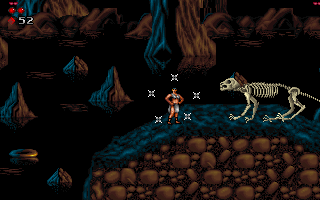


Schuler demonstrates a strong and varied grasp of level design. Some levels are mostly horizontal, some emphasize verticality. There are various types of traps and gadgets such as elevators and swamp rafts. Some levels are mazelike. There's a forced-scrolling type that forces the player to move quickly. Another requires that you ride a snake-like platform upward. The need to switch between characters is well-distributed; you never go too long before switching or get the sense that one character is better than the other.

Although the game uses a lot of the sampled sound effects common to shareware games of the era, the animation is particularly good, with touches such as a Endrick sheathing his sword when it's not in use. It can be completed well within a day, although it's not lacking in challenge. The difficulty increases at a smooth rate through the first, free episode, but the second episode has a significant difficulty spike and it's not impossible to get stuck in a position where it's exceptionally hard to defeat the final boss monster, a questionably designed stone giant that involves random elements in addition to the creature's regular attack pattern. Episode 3 is more in line with the first but there are sections that will almost certainly require that the player save and restore a lot because certain fatal traps can only be found through trial-and-error.

A modest game but good for a dull afternoon.


Monday, February 21, 2022

Tarzan (1984)


Last post I made an aside about the lack of games based on Edgar Rice Burroughs's stories, so I figured it would be good to have a look at one of the very few, Tarzan, produced for the Colecovision. (I'm not counting the several games based on the animated Disney movie, as that version is more Disney than Burroughs.)

Tarzan isn't what most people would describe as sword and sorcery, but as one of Robert E. Howard's favorite authors, ERB's action-packed stories provided a major foundation for the genre. I've noticed over the years that while Howard fans generally enjoy ERB's work, the feeling isn't always mutual as ERB purists sometimes scoff at the lack of romance in the work of Howard and writers that followed him. Anyway, on to the game!

As the manual states, "Cruel hunters and the Beastmen of Opar have abducted Tarzan's tribe of Great Apes and imprisoned them in cages throughout the jungle. It's up to you to save the apes from being shipped out of their jungle home to zoos." I've noticed a lot of modern takes on Tarzan tend to fixate on conservation/ecological themes, as if Tarzan was like a politically incorrect forerunner of Captain Planet. But to the game's credit, at least we do get something involving the city of Opar, and the manual identifies many of the supporting characters in the game by the names Burroughs gave them: Nkima the chimp, Bolgani the gorilla, Histah the snake, and Gimla the crocodile.

The game plays like a Pitfall-inspired platformer. Tarzan must run from one end of the jungle to Opar, freeing apes from cages along the way. You also rescue Nkima, who's supposed to follow you and alert you to dangers such as pit traps, but Nkima will leave you if you pass too close to bananas and his warnings are often useless anyway. Bolganis will rush you and hunters will try to shoot you, but you can either punch them out or avoid them by taking to the trees and swinging through the canopy. Histah will hide in the bushes and leap out at you if you come too close, and Gimla will attack you if you take to the water. Despite the technological limitations, the game does an effective job at presenting Tarzan's toughness, speed, and mobility. 

Approaching Opar, Tarzan will start encountering the beastmen (no La in the game, unfortunately), and when you arrive the temple, you have to scale the levels of the temple and free the last of the apes while beastmen harass you on the levels and the temple idol at the top shoots flames down at you. After managing the climb to the top, you have to push one of the Colecovision's keypad buttons to have Tarzan make the victory cry of the bull-ape, which causes the idol to fall, and then the game restarts at a higher difficulty.

It's a standout game for the system, but unfortunately it didn't release until 1984, i.e., post-video game crash when game distribution was collapsing, so it's fallen into obscurity. As of the present, it doesn't even appear to have an entry on Mobygames.com. The controls can be a little bit fiddly but nothing that can't be gotten used to, and it plays fast and has nice graphics and music. 


Supplemental reading: The Return of Tarzan, by Edgar Rice Burroughs (1913)

Thursday, February 17, 2022

Rastan (1987)

Rastan (aka Rastan Saga) was released by Taito, design credited to Toshiyuki Nishimura under the direction of Yoshinori Kobayashi. Nishimura also is credited as designing The Astyanax, a game that will likely get some coverage here down the line. 

Along with Golden Axe, Rastan is probably the purest example of sword and sorcery in an arcade game and yet another game very clearly influenced by the Conan the Barbarian movie. The international version of the game doesn't have much to show for a story aside from the image of an aged Rastan on a throne, similar to the movie's final image of Conan as a king. The Japanese version, however, includes a screen explaining that Rastan has made a business arrangement with the princess of a kingdom: Rastan will slay a dragon and upon dropping its head before the princess, she will give him all of the money.

Rastan is one of the standout games of its time in terms of presentation. The character designs are instantly memorable, with Rastan being an agreeably drawn loin-clothed barbarian taking on various enemies that tend to have a mythological slant. Centaurs, amazons, chimeras, and harpies, among others. There isn't a lot of parallax scrolling, but the lush, richly colored environments are imbued with memorable effects such as changes in time of day or weather, and interesting features such as colossal statues far in the distance that any Tolkien fan would recognize as the Argonath. Best of all, Rastan has an absolutely great Basil Pouledoris-influenced soundtrack by Naoto Yagishita and Masahiko Tagaki that would probably make a fine transition to a full orchestral performance.


Whereas Golden Axe was modeled on brawlers like Double Dragon, Rastan is purely horizontal and enemies generally are vanquished with a single stroke. Levels are divided between an outdoor section, such as mountains or murky forests, and fortresses that Rastan must navigate until meeting an end-boss in a throne room. Rastan's basic weapon is a sword, but he can find axes, morning stars, or (best of all) a magical sword that shoots fireballs, along with items that carry effects such as replenishing his health or making him more resistant to damage. Rastan has a health bar that runs down to a heart that beats harder as his life runs down, another classy visual touch. An important distinguishing feature of the game's design is that Rastan need not stop before attacking or leaping. A big part of developing a successful strategy for the game is balancing the urge to rush ahead while cleaving through enemies with the need to occasionally slow down or even stop and wait for an opening.

An amusing touch is that Rastan will sometimes have to jump out and grab a swinging vine, calling back to Taito's Tarzan game, Jungle King, which was reworked as Jungle Hunt after the Burroughs estate rattled its saber at the company (not a lot of Tarzan or ERB-based games out there...).

Rastan is unusually difficult even by the standards of coin-munching arcade games. Enemies are numerous and never stop charging at you from both sides. Moreover, the stages are full of hazards such as pits and lakes that will kill you instantly if you fail to make a leap. On top of that, the game pulls a bit of a tough trick on players when it reveals that there are no continues for the final level. To actually overcome the game, one has to learn it very well instead of just purchasing credits all the way through. I confess I've never beaten the game. I'm not good enough.

If one is good enough to win, the game reveals Rastan moving on before concluding with the shot of his older self on the throne, stating that this was only one of his adventures on the way to earning his kingship, and that he might have other stories to tell. Taito did create more games featuring the character, but those are stories for another time...


Friday, February 11, 2022

COVER ART: Deadly Towers (1986)


Deadly Towers, published by Broderbund for the NES. Artist is unidentified? Classic example of the cover promising something the game wouldn't deliver.


Thursday, February 3, 2022

Conan: Hall of Volta (1984)


Obviously for a blog of this nature, the various officially licensed Conan games are going to be of particular interest. As near as I can tell, this release from Datasoft was the first Conan game to be released, although it really isn't much of a Conan game after all. It was originally designed by Eric Robinson and Eric Parker for the Apple II and then ported to other 8-bit systems such as the Atari 400/800 and the Commodore 64.

One of Datasoft's early distinguishing features was that they were enthusiastic about licensed games. Starting in 1984, the company released games based on Bruce Lee, The Goonies, Zorro, the Dallas TV series, and The Neverending Story, and with the exceptions of Dallas Quest and Neverending Story these games were all platforming action games with a certain amount of puzzle-solving. 

In Conan, you control the alleged barbarian as he must traverse a castle divided into seven levels to defeat an evil wizard. Killing a wizard is a classic go-to move for sword-and-sorcery stories, so in that sense the game is more or less on-brand. Where it starts getting hazy is that Conan is occasionally aided by a friendly bird, which was never a feature in any of Robert E. Howard's stories, and instead of using a standard weapon, Conan throws swords that loop back to him like boomerangs.

Conan runs at a pretty fast clip, he can safely fall any distance, and he takes long somersaulting leaps, and passing levels generally requires that the player master Conan's jumping ability to avoid falling into lethal hazards like lava pits or beds of spikes. Swords can be thrown to fend off enemies such as bats or giant bugs, and keys and gems need to be collected to unlock doors or operate certain mechanisms. 

The game is actually not bad at all. The controls can be unpredictable in that Conan sometimes gets caught on ledges in odd ways or they won't respond as quickly as modern players are accustomed to, but each level has a distinguishing feature. In level 3, for instance, you have to make use of portals that teleport you to a different floor to get a gem, which you place on an altar to create giant air bubbles from a lava pit, which you ride on to rise high enough to jump into a hole that takes you to the next level. It's a challenge to get through all seven levels but not an insurmountable one.

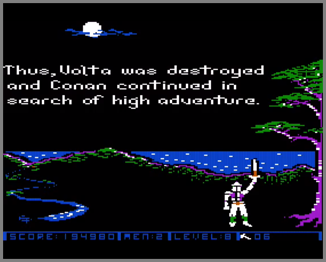
The reward for defeating Volta is a congratulatory screen that says Conan "continued in search of high adventure," but the character depicted on the screen, wearing full armor and helmet, doesn't resemble any popular depiction of Conan, even if Conan did occasionally dress that way in Howard's stories. Later revisions of the game replaced this figure with something closer to the classic Conan image. The reason for this, along with other departures from Conan's, uh, canon is because the game allegedly began as an unrelated game called Visigoth that was retitled and slightly modified to be a Conan game after Datasoft secured the license as a tie-in with Conan the Destroyer. Not uncommon for the gaming industry but this unserious approach has persistently dogged Conan as a property. 

Source: Digital Press


Thursday, January 27, 2022

Tiny Barbarian DX (2012)


Tiny Barbarian opens with a scene of our hero, the Tiny Barbarian, under the player's control as he fights enemies on all sides. You can battle for a while but eventually you'll be overwhelmed and the game transitions to Tiny Barbarian hung on a tree with vultures looming over him. One gets too close and Tiny Barbarian grabs it with his teeth and shakes the creature until it's dead, then he busts loose and charges off to get revenge. The scene directly homages Conan's crucifixion in A Witch Shall Be Born, although the visualization of it and the following level, in which you battle snake cultists and a pair of villains that strongly resemble Thulsa Doom and Dagoth, indicates that the creator of the game was thinking more of the Conan movies than Robert E. Howard's original story. Tiny Barbarian's own design, with his brown hair and comically top-heavy physique, resembles Arnold Schwarzenegger more than the black-haired and pantherish look of Howard's creation.


The second level features Tiny Barbarian hacking his way through a lost city inhabited by giant bees and ape-like people with advanced technology. If this is inspired by a specific story, the source eludes me. The third level pays homage to the original Castlevania as the hero travels through a strange town at night and enters a floating tower.

Level four sees the hero abducted by aliens while battling Lovecraftian cultists, leaving it to his girlfriend to put on a spacesuit and grab a ray gun to rescue him in a goofy tribute to Barbarella. Midway through, she rescues him and they team up for the rest of the level in a nice changeup to the gameplay.

The most interesting level to me and what initially brought the game to my attention is a bonus level directly based on Robert E. Howard's The Frost Giant's Daughter. Tiny Barbarian sees and becomes enamored with an icy woman floating through the air and battles his way across the snows until she lures him into her trap: her two giant brothers.

As a game, it's fun but can also be frustrating. Like many similar retro-styled games, there's a masochistic, trial-and-error aspect to the gameplay that is intended to evoke the "Nintendo hard" difficulty of 1980s games but is probably even more difficult in direct comparison. At the least, there's a trade-off: Tiny Barbarian gives you infinite chances to overcome it while jacking up the challenge compared to older games that provided limited lives and continues and usually had the difficulty somewhat increased to ensure it would be too hard to clear on a daily rental.

The graphics are appealing enough even if they aren't dazzling to look at. Games in the 8- and 16-bit eras were primarily concerned with increasing the size of the characters because it was a real technical limitation to be overcome back then. This minor trend in modern games of miniaturizing the characters reflects a different, more self-imposed limitation, one of trying to see how small one can go while still maintaining a sense of clarity and style.

Friday, January 21, 2022

The Mark of Kri (2002)

I'm not very familiar with Polynesian fantasy, but in 2002 Sony released this game for the Playstation 2. The player controls a swordsman named Rau, marked with a particular birthmark, who after a tutorial mission takes a sketchy job from an old man at a tavern. Before long, you're fighting demons and trying to save the world from a necromancer.

The game's most striking aspect is its graphics. "Get Disney to animate Conan" isn't an idea that I'd ever heard anyone seriously utter, but someone behind this game more or less had that idea and it turned out to be remarkably inspired. The characters and environments are beautifully drawn and animated with clean lines and shapes that help offset the game's age. The game might look like a Disney movie, but it's not rated like one, as the game doesn't skimp on violence and gore. Rau is a suitably brutal fighter who can master combinations that result in enemies skewered on his sword or their skulls and necks crushed against stone walls.

The melee combat system is based on a unique method of using the right stick to lock up to three enemies to a specific attack button, giving the player the ability to smoothly manage crowds of attackers. It takes a short while to get used to it but it's a reasonable enough system for the time. Rau can also use a bow to attack at a distance.

Although Rau is a hulking brute, he's no superman and stealth is often preferable to charging in and alerting entire camps to your presence (unless you're really mastered the melee system and want to show off). Even Conan and Kane liked to sneak and avoid notice most of the time. The stealth system is relatively easy to master and it's forgiving in that if you're detected you'll have a fight on your hands, but you can also win out and then go back to sneaking. It's not a game that demands a perfect lack of detection as some stealth games do. Rau can hide and when an enemy comes within reach, he can yank them out of view and quickly snap their necks.

The game's last major trick is to give Rau a raven companion who can explore areas and give the player a vantage point to scout out which enemies are present and where.

A very good game that really ought to be better known. 

Supplemental viewing: The Beastmaster


SKALD: Against the Black Priory (2024)

  SKALD: Against the Black Priory is a Kickstarted RPG by Anders Laurindsen that hearkens back to classic PC RPGs, particularly those for t...