Monday, September 26, 2022

Arthurian Legends (2021)


Despite its title, Arthurian Legends doesn't really have a huge amount to do with Arthurian legend, but it does include a little bit of backstory that refers to Uther Pendragon, Merlin, and Igraine but backstory is all it is. You start the game and are greeted with men breaking into your house to kill you, so off you go. You don't meet Uther, or Merlin, or anyone else associated with the legends. Just a bunch of armored men, wizards, and hell creatures, all of whom need killing. Essentially, the story is that you're a one-man army fending off an invasion by devil-worshipping Saxons.

The game is an FPS that greatly takes after Witchaven in that it emphasizes melee combat while including the use of magical runes and potions. Despite being created by a one-man studio, Scolaro Games (Keith Scolaro), it's actually a general improvement on Witchaven. The combat is more complex and provides more of a sense of feedback than most melee FPSs. You can actively block with a shield, perform a shield bash to stun enemies, or use an extra weapon in your left hand if you prefer, and there's a better sense of attacks connecting through enemy reactions, sound effects, and blood spraying everywhere. It's an amusingly gross game - even using the crossbow, enemies will literally explode upon death, leaving behind a pool of gore and a a decapitated head that you can kick around a bit.

The setting is dark and grim, but there is a sense of humor running through the game that takes after classic FPSs, particularly the Build engine classics, and Monty Python and the Holy Grail. Visually, it resembles Build engine games in its sense of verticality but it lacks that engine's capability for reshaping the environment mid-level. Scolaro made the game using a program called 001 Game Creator, one of those "game design for rookies" programs, which makes the completed game even more impressive because it certainly appears that Scolaro pushed the engine as far as it could possibly go. The graphics are clear, easy to parse at a glance, and about on par with mid-90s 2D FPSs. The soundscape is somewhat inconsistent, which is common with indie games. Some enemies will speak up but it's not unusual for them to sneak up on you completely silent. Unfortunately, the low-budget indie nature of the game becomes apparent with the kinds of bugs that occur, particularly in corrupted saved games that get more common in the game's later stages.
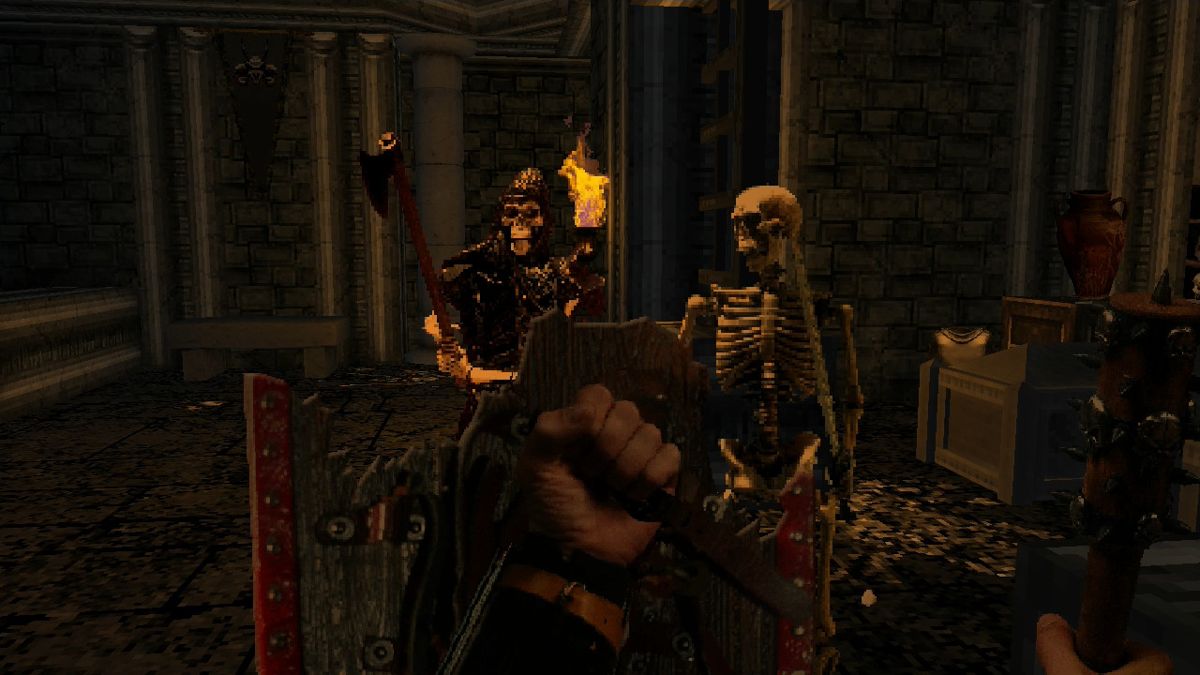


Basic enemies include various types of enemy soldiers who gradually give way to giant spiders, undead skeletons (these guys again...), two-headed wolves, and flying imps. At the end of each episode, you have to face a boss enemy that is an evil witch or wizard, and there are occasional mid-episode bosses who are mostly optional, such as the Green Knight, the Questing Beast, and...the Killer Rabbit (make sure you save one of your holy hand grenades for that one).

Much like Witchaven, weapons and armor degrade through use, and the game encourages you to switch among them often because of "ammo" shortages; e.g., the spiked club is great for stunning magic users and the grenades are great for when you're being mobbed, but you really should save them for such occasions.

Supplemental reading: The Dragon Lord, by David Drake


Sunday, September 18, 2022

COVER ART: Warrior of Ras: Dunzhin (1982)


The Warrior of Ras series is an early Rogue-like RPG series (four in all) created by Randall Don Masteller. Well-executed "go in the dungeon, get magical object, escape" stuff. It seems to have fallen into obscurity, possibly because of its age and the fact that only the first game was ported to IBM PCs? The games and their advertising all feature art by Michael Haire depicting this distinctive blonde warrior. Turn his hair white and he could almost pass for Elric. Haire has contributed to many other games through his career, including various other Med Systems titles and Microprose's games such as Darklands and Sid Meier's works.


Monday, September 12, 2022

Trojan (1986)


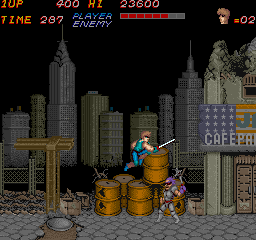
When sword and sorcery started fading from prominence in the 80s, one of the genres that arguably picked up the standard and gave audiences some of the same feeling was post-apocalyptic sci-fi/action. Generally (though not always...) lacking in sorcery or fantasy elements, but stories about hardened warriors wandering a bleak landscape, often having to revert to melee weapons because of scarcity of firearms, coming into conflict with local warlords, and then moving on the next adventure. Trojan (Tatakai no Banka - Battle Song?) takes place in one of these scenarios. 

The player controls a man armed with a sword and shield as he hacks his way through the demon army of a tyrant named Achilles. The game begins in a ruined city, then proceeds through wilderness, dilapidated factories, and ends up at Achilles's classically styled palace. Many of your foes are just armored men with maces and crossbows, but some appear to be flame-spitting mutants and others have bionic attachments like a metal arm with an extendable claw. Some especially annoying guys will use gyro-packs to attack you from the skies. Some enemies can knock your weapons away from you, forcing you to fight with your hands and feet until you can retrieve a fresh set, which makes the hero look like a total badass in his ability to adapt. 


It's the fourth game designed by Takashi Nishiyama, who broke in at Irem and created Moon Patrol, and then went on to design Kung Fu Master/Spartan-X (inspired by Jackie Chan's Wheels on Meals) before leaving for Capcom. Trojan feels like a spiritual successor to Kung Fu Master in that both games are strictly horizontally-scrolling brawlers in which you often have to determine if it's better to move forward or to turn around and take care of the goons breathing down your back while also minding the knife-throwers and other threats still coming from the front. Trojan is a lot more hectic than Kung Fu Master, and Capcom's influence shows in how the game, much like Ghosts 'n Goblins, requires you to beat it twice before it's considered properly completed. The "true ending" for Trojan, though, only amounts to some insignificant changes in the ending text and most players should feel satisfied if they only complete the first loop - that's an accomplishment in itself.

Visually the game is exceptionally dark, mostly taking place at night, with lots of muted gray and brown backgrounds, while the somewhat more colorful characters look very manga-influenced. Although the game has a lot of the popular hallmarks of the genre, with the crumbling buildings and goons in big shoulder pads, it's hard to imagine that the game wasn't heavily inspired by Fist of the North Star, particularly considering its Japanese origins. Fist of the North Star was a very hot series at the time and had a bigger impact on video games than many westerners realize. For instance, it was also a primary influence on Double Dragon, despite popular assumptions that Double Dragon was some kind of campy take off of The Warriors or martial arts B-movies. 


Tuesday, September 6, 2022

Blade of Darkness (2001)


In recent years, it's become popular for Dark Souls fans to dig through older game catalogs and try to retroactively label certain titles as "the Dark Souls of its time!" In most cases, they're just fixating on classic "Nintendo hard" games because games tended to be more difficult in the past compared to how designers now want to make sure everyone can see all the expensive work they put into their games, but with Blade of Darkness (aka Severance: Blade of Darkness, aka Blade: The Edge of Darkness) there's actually something to it.

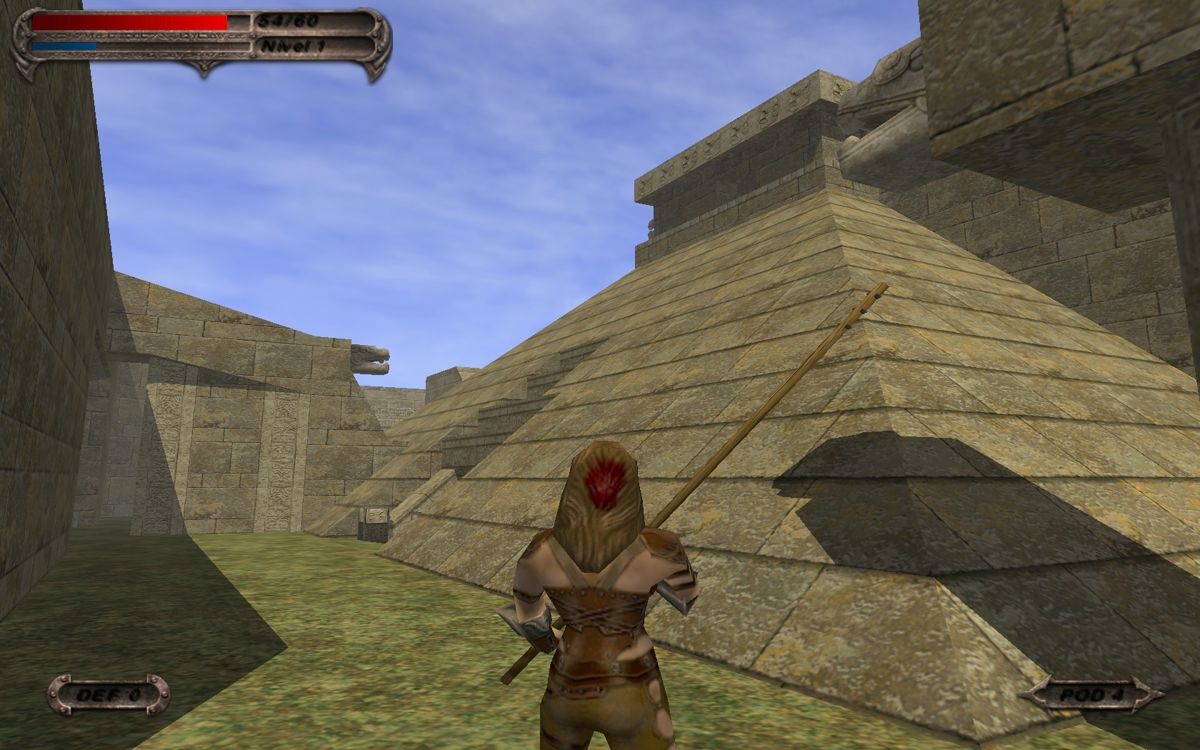
Created by Rebel Act Studios of Spain, Blade of Darkness gives players a choice of controlling a knight, a dwarf, an amazon, or a barbarian, each with their own particular style, advantages, and disadvantages; e.g., the knight is the classic well-balanced type, while the amazon is relatively weak but nimble and has exceptional reach because she specializes in polearm weapons. Fans eager to get their Conan on with the barbarian should take caution that he's arguably the hardest character in the game to master because of his almost nonexistent defense (what you get for never wearing shirts), large stature, and ponderous movement. The amazon is arguably the most traditional sword and sorcery protagonist in the sense that she's the one whose quest begins with her raiding tombs for treasure instead of following duty.


Having chosen a hero, the player starts with a unique opening level designed to introduce that particular character before the game dovetails into a broader story that attempts to mix a classic sword and sorcery mood with an epic quest that includes elements of Tolkienesque fantasy (elves, dwarves, orcs, etc.) and Zoroastrian concepts like Ahura Mazda's creation of the universe. Basically, the story involves having to find special objects (mystical runes and gems) that will allow the hero to obtain the only weapon (the Sword of Ianna) that can vanquish the root of all evil, but the way this plays out is the player's lone hero trudging through foreboding, highly deadly ruins of temples and castles, battling one to four foes at a time in very intense, gory combat.

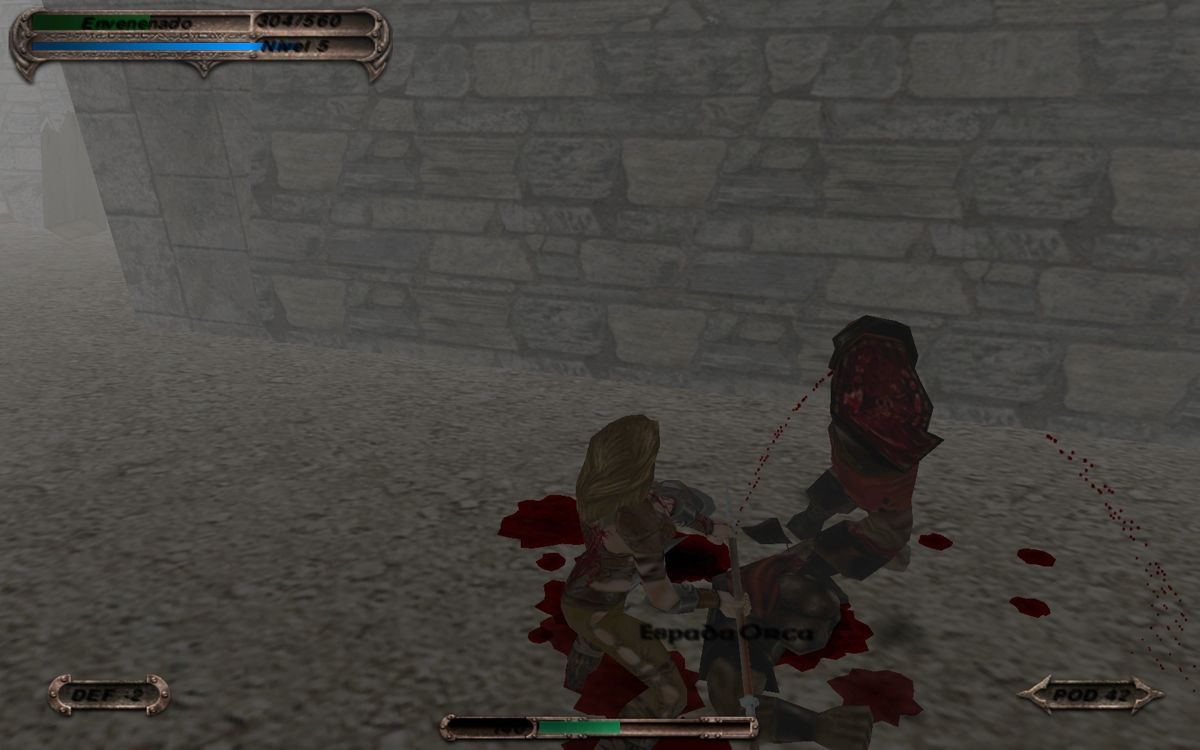
The combat system is unusual even today in how it creates a sense of weight in the characters. Positioning and timing are critical in determining your ability to get through an enemy's defense (e.g., if you don't want to bounce off their shield, best to try attacking their right side most often), and when contact is made the results can often be devastating. Even the lowest level enemies in the game can annihilate the hero in a few hits if the player isn't fully concentrating. Characters can dodge, but for the most part the dodge won't save you if you're caught in the wrong spot at the wrong time and it usually won't take you all the way out of danger. Best to learn the bad guys' patterns and move out of the way before they're well into their attack combos. The player can't just mash buttons because there's a stamina meter (a real Dark Souls connection there) to watch and if you try to do too much too fast, the character will be left heaving for breath while opponents hack away at them.

The reason the game is sometimes called Severance is because the bodies of the characters react according to where weapons hit them. Cut through an enemy's arm and the arm will fall to the ground and can even be picked up and used as a weapon if you're feeling like a sicko. There's a great rush when you hit a perfect combination and don't just kill an enemy but literally make hash of them like they're King Harold, watching their heads fly off, torsos bifurcated, legs lopped at the knees, etc. And it's pretty humbling when the enemies do that to you.


The intensity of the combat greatly advances the game's atmosphere. When even one enemy can kill or at least cripple you based on a wrong move, creeping through shadowy temples, not knowing what's around the next corner while ominous music plays and your healing supplies dwindle can make the game feel more like a survival horror experience than a rollicking swashbuckling adventure. Many areas are so dark that it's not a bad idea to bring a lit torch with you.

The are some areas in which the game oversteps itself a bit. The camera can get pretty jittery and even out of control, especially in tight spaces, and the physics, although quite advanced for their time, can sometimes act goofy. It's funny when you try to run down stairs so fast that the character takes to the air and starts falling/floating forward in space. Controls can take some work to learn, especially the more complex combos, and it's very frustrating when button presses are either not registered or the game interprets one button press as a double-tap, especially in a tense fight where mistakes need to be minimized. 

A quality game but a bit more demanding than most.


Monday, August 29, 2022

Torvak the Warrior (1990)


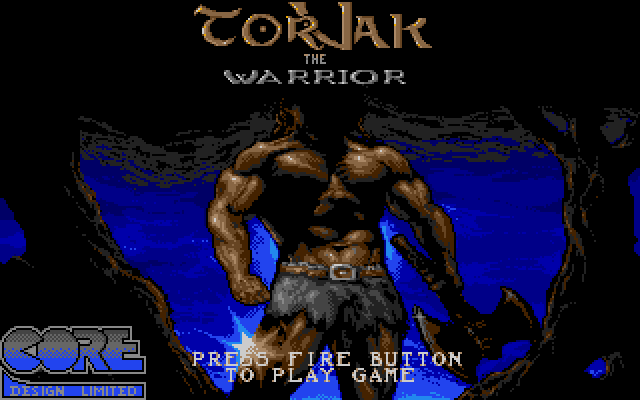
Torvak the Warrior is a relatively early game from Core Design, which of course would go on to fame for creating the Tomb Raider series. Torvak is yet another poor barbarian warrior who comes home from the war to find the whole place burned down and all villagers slain by the forces of a necromancer. With no rest for the weary, Torvak picks up his axe and heads off to make the sumbitches pay.


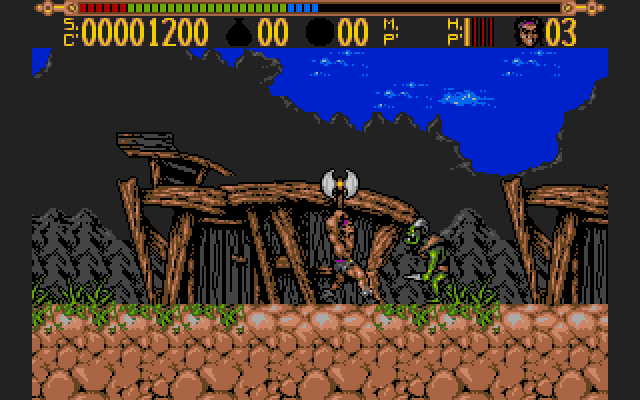
This takes the form of a side-scrolling hack-and-slash game in which Torvak has to generally go from left to right over five levels, but those levels can get a bit mazelike and feature long vertical shafts and hidden secrets that offer extra points and power-up items. Torvak will face human berserkers, green-skinned orcs, rat-men, oozing swamp creatures, and rock-men, among several others.

Torvak begins with his axe but he can pick up a broadsword, a warhammer (leave this one alone, it's terrible), or a ball-and-chain. He can find shields for protection, and he can find potions that allow him to unleash a limited number of magical attacks, handy for facing level bosses.

The game superficially resembles stuff like Rastan, but it's a slow, plodding experience. Torvak, with his top-heavy upper body and relatively stumpy legs, moseys along his way, stops moving while attacking, and since bigger enemies often take multiple hits to kill, he frequently has to take a shot, then leap backwards to create enough space for a second attack. Although he has an explosive jumping ability, he's definitely more akin to Arnold's lumbering portrayal of Conan than Robert E. Howard's quick, pantherish original.


Torvak the Warrior seems to have been initially designed for the Atari ST, then ported to the Amiga, a phrase that probably triggers old Amiga fans' PTSD. The Amiga version got a modest upgrade to Matt Furniss's soundtrack, but nothing else. The relatively limited colors and lack of parallax scrolling betray the game's ST origins, and even the improved soundtrack comes at the cost of forcing the player to choose between music or sound effects, but not both simultaneously, a common issue with Commodore machines because of their limited audio channels.

To its credit, though, the game plays fairly, controls well, and it looks okay even if it's not a technical marvel. Core had some good artists (Lee Pullen and Terry Lloyd in this case), so their games often had a clean, attractive look and distinctive characters. The levels have the standard swamp/mountains/jungle themes, but there are evocative background details like giant skulls and rotting carcasses of huge creatures littering the ground.

Torvak the Barbarian is better than many games, but there are also many games better than it.

Supplemental reading: Legend, by David Gemmell


Monday, August 22, 2022

Heretic (1994)


Art by Brom
 

Heretic is the fourth game released by Raven Software, a studio founded by Brian and Steve Raffel. With their debut game, an Amiga Dungeon Master clone called Black Crypt, John Romero of id took notice of them and the studios formed a partnership in which Raven would develop games based on game engines id created - ShadowCaster was built on the Wolfenstein 3D engine; Heretic and its sequel, Hexen, were made on the Doom engine; Hexen II on the Quake engine; and onward. Eventually Raven was bought out by Activision and sent to the slave mines to spend eternity working on Call of Duty sequels, but that's not important here.

Heretic's story is mostly conveyed in the manual, which tells us of the Sidhe, "an ancient elf race adept at arcane sorcery and keepers of the Tomes of Power." The Sidhe are attacked by three Serpent Riders from Hell, who begin forcibly converting everyone to a cult called the Order of the Sign, but the Sidhe are immune to the Serpent Riders' mind control, leading the Serpent Riders to brand them...HERETICS! The two more powerful Serpent Riders depart, leaving one behind the manage the situation on Earth and slaughter the Sidhe, but one Sidhe remains to continue the fight and that's you.

Upon starting the game, it immediately becomes clear that Heretic is effectively Doom with the knob cranked all the way to the Fantasy side of the meter. You run and fight monsters, find color-coded keys, and find the exit. Brian Raffel said the studio planned on Heretic being more of an RPG, as they were all D&D fans, but John Carmack advised them to just "do it like Doom, and add the fantasy flavor and other stuff." (This process of starting with something relatively complex and then stripping it down to make a simpler, action-heavy experience sounds a bit like how Wolfenstein 3D and Quake were made. Perhaps it was one of id's advantages in that their games didn't suffer from feature creep like many others but instead emphasized accessible, impactful gameplay.) 


So Heretic became a Doom-like game, but with some expansions on the game engine. You could look and up and down (although the game still auto-aims for you if enemies are above or below), you got a modest item inventory, you could cast a flight spell, and by using a Tome of Power item you could gain powered up alternative-fire versions of the weapons. Most amusing is the morph ovum, a magic egg that turns monsters into chickens.

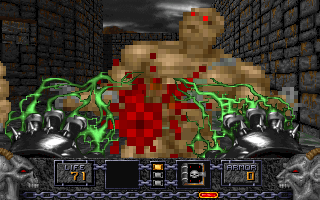
The weapons are all fantasy-based variations on Doom's arsenal. You start with a simple staff for melee attacks (instead of your fists) and a weak magic wand for a pistol. The crossbow is the shotgun equivalent, the Dragon Claw is the chain gun equivalent, etc. One of the more memorable weapons is the game's version of the chainsaw, a pair of magical gauntlets that send lightning into enemies at a touch.

The monsters, however, aren't precisely 1:1 Doom variations. There are flying gargoyles, golems, undead warriors, snakemen, flying wizards, etc. Some come in intangible "ghost" variations that can only be killed with particular weapons. 

The game is often called a Doom clone in a somewhat pejorative way, like people recognize that it's fun but lament that it wasn't more unique, but the thing is that "D&D Doom" or "medieval Doom" or "fantasy Doom" is still Doom and therefore is still pretty good. Raven developed a reputation for making excellent action games, especially FPSs, and Heretic shows they had those talents from early on. Heretic has creative level design and the gameplay additions are interesting without overcomplicating the experience. The art design and audio are very good. It's maybe not quite as "heavy" as Doom in the sense of having a thrash metal edginess about it, but it set the stage for fantasy FPSs carrying more of the sword-and-sorcery feel going forward in its sequels and other games like Witchaven. When a fantasy FPS is made even today, people often compare it to Heretic and Hexen before anything else.


Friday, August 19, 2022

COVER ART: Dragon Wars (1988)


 Boris Vallejo's cover to Dragon Wars, which was a sort of unofficial Bard's Tale IV...before they actually made Bard's Tale IV a short while ago.

Are they fighting the monster or saluting it?


SKALD: Against the Black Priory (2024)

  SKALD: Against the Black Priory is a Kickstarted RPG by Anders Laurindsen that hearkens back to classic PC RPGs, particularly those for t...