Black Tiger (aka Black Dragon) was created by Capcom under the supervision of Yoshiki Okamoto. Okamoto got his start at Konami, where he created Time Pilot and Gyruss, and at Capcom he had his hands in a whole bunch more classic games, such as Gun.Smoke, 1943, Willow, Magic Sword, and Armored Warriors, not to mention mainstay franchises like Street Fighter, Final Fight, and Resident Evil.
In Black Tiger you control a classic Frazetta-esque warrior as he fights to free the land from the clutches of three dragons that have descended on it. This takes the form of you running and jumping among platforms while blitzing your way through any creatures that oppose you. You wield a long flail while simultaneously hurling a spread of three daggers, which sounds impressive except that many enemies can take a good amount of punishment before going down. The levels scroll in all directions and have maze-like qualities, making it easy to take wrong turns and run down your time limit while your health gets chipped away. It's a pretty tough game and success is best achieved by memorizing the most efficient routes and enemy placements while keeping on your toes for any random attacks that spring up in your path. The likelihood of managing this is low, however, and the game is very much eager to eat your quarters for continues. It's also a long game that could take up to an hour to complete.
There's a modest RPG influence on the game in that you collect money (zenny) from fallen enemies, chests, and vases and you can find shops to spend that money on power-ups. Be careful of trapped chests, though. You have to find keys to unlock chests, and can gather hints by restoring to life wise men that have been turned to stone.
Black Tiger has a striking graphical look. Not overly lush or fancy, but cleanly designed and the hero and the monsters have solid, relatively realistic proportions that would be more eye-catching to a traditional western fantasy audience, rather than super-deformed styles that are common in Japanese games. The hero himself, clad in his horned helmet and scant armor, looks like he leapt right off of a classic paperback cover. It's rarely hard to track what's happening on-screen. However, there is a sameness to the levels that grows wearisome in their length. There's some recycling going on with the boss enemies - even the dragons are basically just the same enemy repeated three times. Combined with the relatively long clearance time required, Black Tiger comes across similar to games like Gauntlet or Rampage, where a little bit of the game goes a long way and it's often easier to just play a credit or two before moving on. If you do persevere, you get a congratulatory message on your strength and prowess and the credits roll over an image of the hero resting on a throne (got to get that classic throne pose in there), but at least this hero gets to have an attractive lady on his knee instead of just glowering in his loneliness like Rastan or Grandoval.
Tomarc the Barbarian was released by Xonox for the Atari 2600, Colecovision, and Commodore computers in 1983. Xonox wasn't an acclaimed studio and is arguably the kind of lame outfit that contributed to the 1983 console gaming crash in the U.S. with its awkward, buggy releases.
Tomarc was actually supposed to be a Thundarr the Barbarian game, but Xonox was unable to secure the license before release, possibly because the Thundarr people didn't like what they were seeing from the game...
As the cover helpfully explains, Tomarc is a barbarian hero who needs to rescue his girlfriend, Senta. Tomarc is stuck in a cavern and has to find his sword while avoiding killer rats, before ascending to the dungeon, while Senta is trapped in a cage and has to cast energy bolts (see, this all makes sense if the characters were to be Thundarr and his sorceress companion, Princess Ariel) to ward off vampire bats. The most interesting thing about the game is that you have to handle these goals simultaneously. By pulling down on the joystick, you switch characters when you hear a danger signal go off.
Unfortunately, that's just about all the game has going for it. Senta's side isn't much of an issue since you're just aiming and shooting at enemies from a stationary position, but Tomarc's section is a platforming game and the platforming simply isn't fun. You have to master the angle at which he leaps because if he bangs his head on a surface, he falls and is stunned for a few seconds. It results in a game in which you feel less like a dynamic fantasy hero and more like a clumsy dork.
On the whole, the Colecovision version is probably the one to play. The Atari 2600 version to its credit plays faster, and Tomarc better resembles a barbarian hero than the stocky green/blue/red-clad guy in the CV version, but the CV version has an exclusive second level in which Senta is imprisoned by a giant spider and Tomarc has to scale the spider's web while avoiding the spider's smaller offspring. Senta's role is much the same as the first level except she's now blasting spiders instead of bats. The CV version also has superior graphics, although the tradeoff is its slightly slower pace and the spider level seems to be buggy in that Tomarc can get stuck on certain strands of the web, unable to grab another or sometimes even forced to remain on invisible strands. Regardless, though, it's a very missable game and flunked its part in advancing the sword-and-sorcery concept in video gaming. Probably for the best that Thundarr never got a video game adaptation back then. A Thundarr game now, with graphics that could faithfully adapt Alex Toth and Jack Kirby's designs for the show, could be fun...
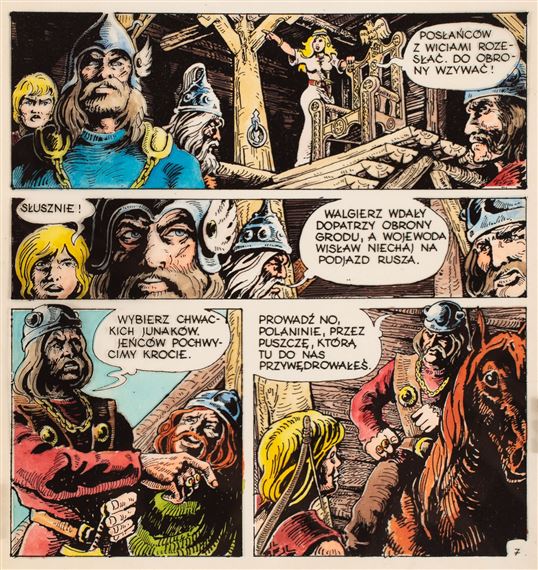
Doman: Grzechy Ardana (Doman: Sins of Ardan) is something of a Golden Axe clone based on a Polish sword-and-sorcery comic drawn by Andrzej Nowakowski.
The player controls one of two characters, Doman himself or his sidekick Baurus, that I assume are the heroes of the comic (it's hard to find information about Doman in English...) and you simply walk down a path slaying everyone dumb enough to get in your way.
The moves are heavily inspired, if not outright swiped from the classic Barbarian, and the controls are similar in how you hold the fire button and then push a direction to perform a specific move. Holding the button and pulling away from an enemy will execute the famous twirling decapitation attack from Barbarian, for instance, and it will decapitate the enemy if their health bar is low enough.
The game was created by World Software, which caused a brief mid-90s stir in Eastern Europe through games that were crudely made but hilariously over the top in their gore and general subject matter. The year before releasing Doman, they made a beat-'em-up called Franko: The Crazy Revenge!, which involved a couple of heroes cleaning up the streets by splattering the blood of street punks all over the place. Not a particularly well-made game, but memorable and funny in a time when simply being edgy and gross was enough to ensure a certain amount of attention. Doman is a bit more advanced than Franko, but only just so. The graphics are little more refined and the controls are a bit easier to use, although it's still very difficult and, like Franko, the levels do go on for a bit. There are some between-level cutscenes and you get the occasional image of Doman reclining on a throne just like Conan did in the movie. The game could have used something like at least one layer of parallax scrolling, but you get the sense that these guys were just having fun cranking out games they wanted to see and were lucky enough to get paid for doing so.
Similar to the Conan game released by Datasoft, Mindscape's Conan for the NES was actually a different game to which they made some modest changes before they slapped the Conan branding on it. At least Datasoft's game was just a game they picked up before completion and publication, whereas Mindscape's was published under a different title on other platforms: Myth: History in the Making.
Myth is another minor classic of old school PC gaming, mainly for the C64 and ZX Spectrum, although the Amiga version has a solid following as well. The 8-bit versions of Myth have some modest differences, but the gist is that a bored high school kid is suddenly called by the gods to battle evil in several time periods, facing enemies drawn from various mythologies such as the Greek, Egyptian, and Norse. The Amiga version altered the concept slightly so the hero is instead a more traditionally muscular, long-haired warrior. The NES version...uses Conan as the protagonist.
The gameplay is a mixture of action and puzzle-solving. You run and jump like in a regular platforming game, fending off attacks from randomly spawning monsters (like many old European games, the emphasis is more on managing your health as you absorb numerous unavoidable attacks from all sides, rather than avoiding hits entirely as tends to be the case in American and Japanese games). In the opening level, for instance, you have use magical attacks to slay monsters (those sword-wielding skeletons again) in the underworld until one drops a sword you can pick up, then you carry the sword to a particular place where a body is suspended from the ceiling by chains. You breaks the chains with the sword, causing the body to fall next to a sea of fire. After slaying this new enemy and causing its head to fall into the fire, a trident-wielding demon rises from the fire. After dispatching this demon, you pick up its trident, carry it until you meet a fire-breathing griffon, which you kill with a throw of the trident. This opens the way to the exit, and you're whisked off toe ancient Greece. It's a bit obtuse, but since your gameplay options are fairly limited you can persevere by simply blundering around until you accidentally hit on the right sequence of actions to take.
Conan of course makes no sense at all as a hero in these kinds of situations. Yeah, he's a man of action, but he doesn't throw magic missiles around, he doesn't time travel, he isn't a pawn of gods. Even so, games can still be fun even if there's something weird about the concept, but the NES version isn't at all fun. The original computer versions have quirky gameplay (e.g., floaty jumping) but it's something that can be quickly acclimated to, but the NES version has horrific controls that make simply picking up the items you need more of a chore than it needs to be. You'd think pressing down on the controller would work well enough, but pushing down actually causes you to jump (pushing up also causes you to jump), so you have to hold down one of the attack buttons and then push down. The collision detection is lousy, so it's hard to get a sense of how close you need to be to enemies to fight them and the sword somehow seems to do even less damage to enemies than punching or kicking them. The imps that release health pick-ups, so crucial since you're under constant assault, are frustratingly elusive. That's just the first level, too. The graphics are poor, too, with the NES version looking even rougher than the Spectrum's despite the Spectrum's limited color palette. About the only positive is that there's music that could be worse. It's a port that shows many signs of laziness and sloppiness. Kind of like how Conan was treated in general in the media around that time.
That's Les Edwards's art for Poul Anderson's Conan the Rebel (British Sphere edition). The original version of Myth featured a hero who was supposed to be a modern high school kid, but for the Amiga version they went with a jacked up warrior type.
There are so many classic sword and sorcery stories centered on thieves - e.g., The Tower of the Elephant, The Tale of Satampra Zeiros, Ill Met in Lankhmar, Liane the Wayfarer, etc. - and Thief: The Dark Project seems to take after them so well, but the funny thing is that in looking over its development history, Thief's final form seems to have been largely an accident.
The germination of it began with plans at Looking Glass Studios for some kind of sword-fighting/melee combat game, including one that would have involved hacking up communist zombies. Before long, the developers shifted focus to an Arthurian-themed game called Dark Camelot, which would have inverted the lore, making King Arthur the villain and Mordred the hero (very edgy 90s). Dark Camelot had a troubled development period until the developers noticed that missions involving sneaking around were more involving than the rest, so they shifted focus again, ditching the King Arthur stuff in favor of full-time thieving, and renaming the game The Dark Project. The setting mutated further, putting players in a steampunk city only known as The City, which is under the control of a religious order called the Hammerites, who seem like what might have happened if medieval Freemasons had taken over the Catholic Church.
The player controls a man named Garrett. The game explains in one of its stylish, Nine Inch Nails-esque cutscenes that Garrett was a street urchin who tried to pick the pocket of a man who happened to be part of a secret sect called the Keepers. The man adopted Garrett and had him trained in the ways of the Keepers (the opening tutorial covers this period), but Garrett turned out to be a rebellious and amoral type who struck out for himself, using his skills to become an independent master thief.
The game begins with Garrett pursuing his regular work (i.e., robbing a rich noble's mansion), but as it progresses, Garrett finds himself caught up in a hard-boiled story in which he's hired by shady benefactors to steal accursed prizes and finds himself exploring increasingly weird, sinister environments.
Unlike most games, Thief's story is clearly told and doesn't fall prey to sprawling or becoming overambitious. Garrett does a job, that leads to another job, this job attracts the attention of a femme fatale who offers Garrett a job he might not normally do but he takes it anyway, this leads to yet another job that pulls him even more out of his comfort zone but the pay is too good to turn down (plus, beautiful woman). Double-crosses happen and by the end Garrett is in way over his head against a Pan-like figure called the Trickster God. Everything flows logically until it reaches a logical end. In the right hands, it could reasonably be adapted as a traditional story and not lose much.
One of the lessons Looking Glass learned after creating Ultima Underworld is that, contrary to prevailing wisdom, games become less immersive the more players have to interact with NPCs (humans simply have far more responses to situations than what any game could account for), so when they designed System Shock they made it so that players would never do more than listen to what NPCs were saying and they furthered this in Thief. There are no dialogue trees and no choices to be made. Although Garrett is a relatively distinct character in the sense that he has a certain job and a personality suited to that job, his reactions to story developments are almost entirely kept to the brief cutscenes that set the context for his next mission. He'll make very occasional wry comments on things he sees that don't rock the boat too much ("Looks like these stairs have seen better days"). Otherwise, players are free to find what they encounter as funny or disturbing as they'd like and they're free to react how they'd like within the game's constraints.
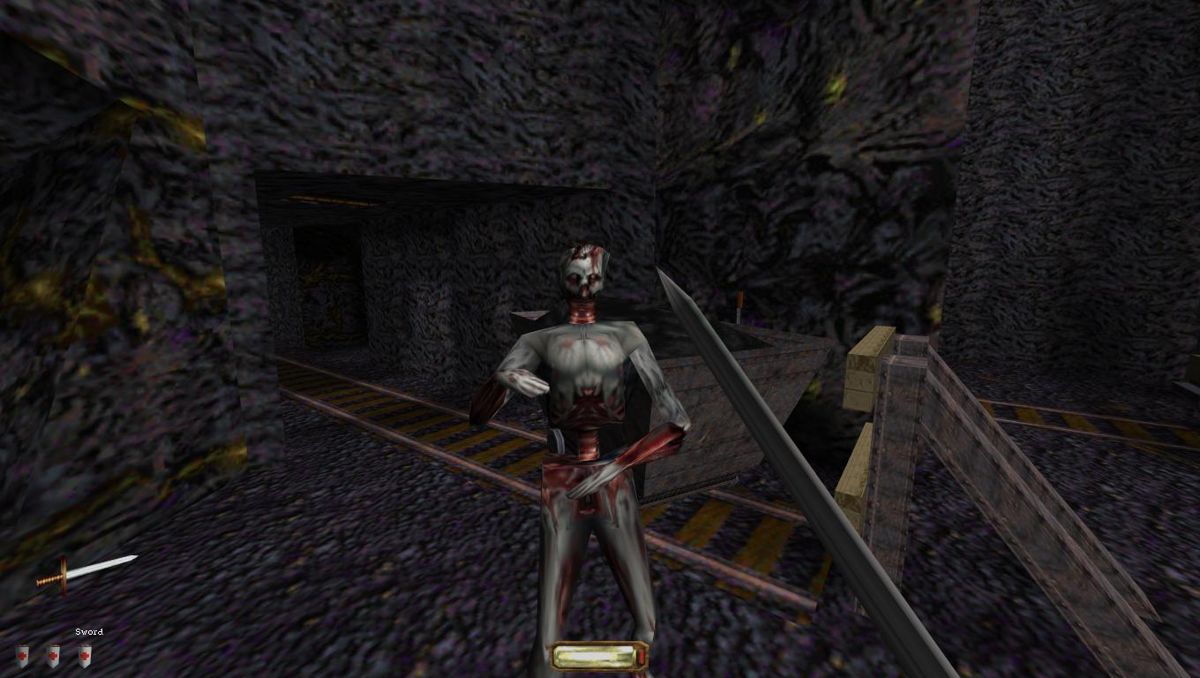
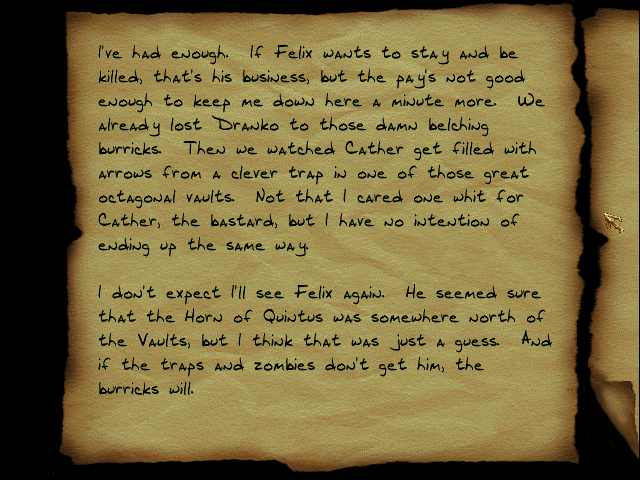
What the players will encounter starts out relatively normal, with Garrett being up against armored guards protecting a rich man's house. In the second mission, Garrett has to infiltrate a prison through some mines beneath, but these mines have undead corpses shambling around them. In the next mission, Garrett robs a massive tomb that is crawling with undead - it's this point that the game's sword and sorcery content, the sense of adventure mingling with supernatural horror with a vulnerable hero exploring forbidden territory, is arguably at its strongest. A later mission, in which Garrett is hired to burglarize another mansion, starts out normal enough but as Garrett ascends the floors he's confronted by bizarre sights like twisting hallways, rooms that are upside down, hallways that play tricks on perspective, rooms that open into infinite voids, and tunnels that seem to shrink passersby down to rodent size. It's Lewis Carroll given a very Lovecraftian twist.
There are no expository dumps in the game. After all, why would Garrett, someone who lives there, need someone to explain How It All Works to him? Between bits of conversation, papers and books the player can read, and simply observing how the world works, it's possible to glean that the setting's history involves some kind of calamity that unleashed an undead plague on the world, and that the Hammerites' ascension involved their ability to fight back against these forces and wall off the most afflicted parts of the city. The fact that they're such humorless fanatics possibly is because of the pressures they face in managing this existential threat. But it's mostly down to interpretation.
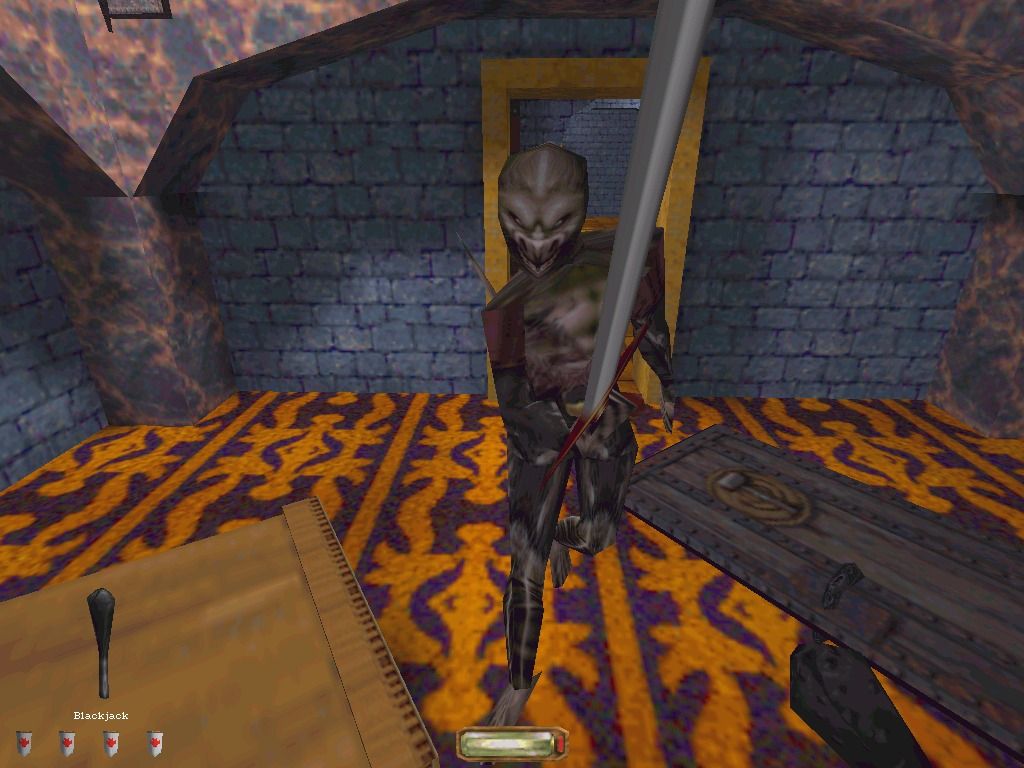
Oh, right, how does it play? As a thief, it's all about staying out of sight and making as little noise as possible. Like the Shadow himself, Garrett practically vanishes in deep shadows. On soft surfaces, he makes very little noise, but metallic or hard-tiled floors are terrifyingly hard to keep quiet on. To help him along, he's got a Green Arrow-like array of trick arrows he can use, such as arrows with vials of water that somehow can silently douse a blazing torch or arrows that sprout moss to give Garrett an instant carpet to run on silently. Garrett's shadow coverage and detectability are indicated through a very simple icon on the screen. Garrett can kill or club enemies from behind, but if he leaves their bodies lying in the open, guards will become suspicious if they discover them. Garrett does have a sword, but he's no Conan or Gray Mouser in swordsmanship and face-to-face encounters are to avoided if at all possible. Although Thief does show its age in its graphics and some AI limitations of the enemies, it's actually still superior to many modern stealth games, especially in how it uses sound to differentiate surfaces. Another nice feature is in how it handles difficulty - instead of the classic move of giving enemies more health or putting more enemies in a level, kicking up Thief's difficulty simply adds more objectives to your mission list, so you're actually encouraged to explore more thoroughly and see more of what the game has to offer.
The game can be a bit rough in controls. Garrett's mantling ability doesn't always work predictably, and his aim with his blackjack or sword can sometimes be infuriatingly picky (fortunately, enemies don't always notice the weapon fanning through space behind their heads). The physics sometimes mean Garrett hilariously struggles to get up a simple step while crouching. And although most of Thief's game time is absorbing to play, in its later stages it sometimes waffles on its own stealth concept and seems to encourage Garrett to fight and generally do things to which the game engine isn't ideally suited, a problem similar to the Tomb Raider games from the same era. Some missions are just not as good as others. Return to the Cathedral in particular is notorious for going from a white knuckle horror experience to exasperation as players have to constantly double-back over the area to fill a lengthy "Oh, just one more thing..." shopping list for an addle-brained Hammerite ghost.
Thief was very well-received by PC players of the time and despite its age is still today rightfully regarded as a first-rank classic. It spawned a sequel that gained even more acclaim; a second sequel that had a more mixed reception but is still considered to have some very good qualities, especially if its modded; and then a modern reboot by a different studio that most people feel just missed the point.
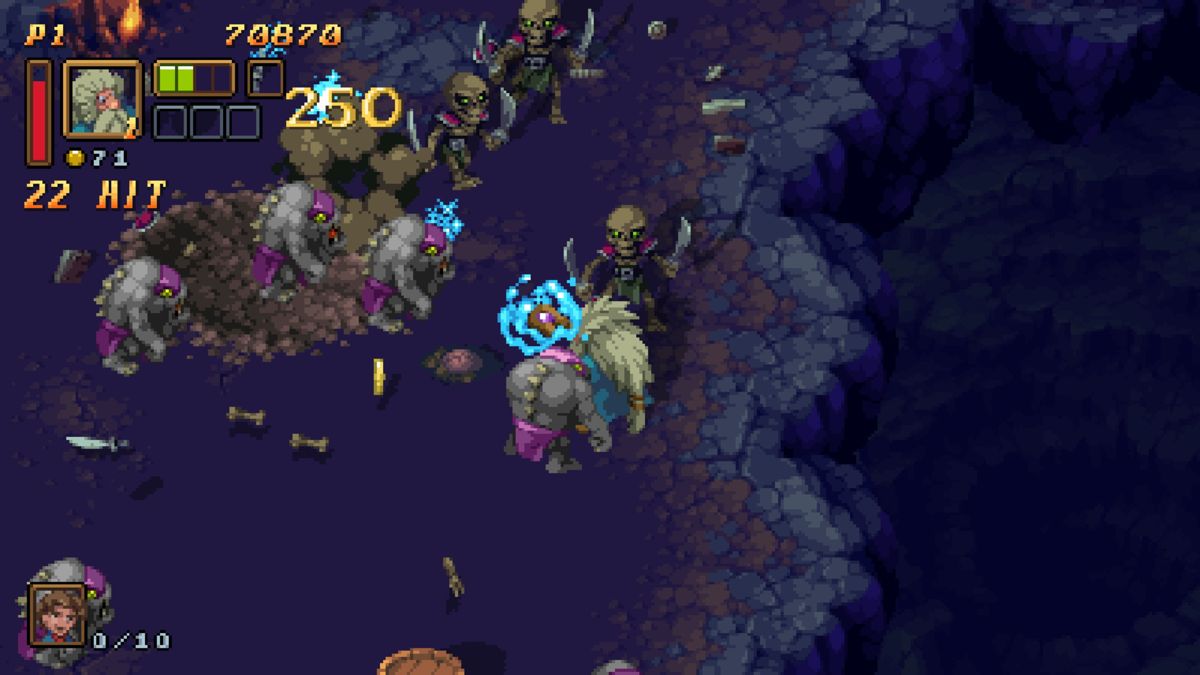
Battle Axe is the Kickstarted brainchild of Henk Nieborg, who wanted to create a game inspired by Gauntlet, Golden Axe, Knights of the Round, and Capcom's Dungeons & Dragons games. The game itself doesn't explain much of a story (not a big deal), but the Kickstarter campaign outlines a Seven Samurai-like scenario in which an evil sorceress sends her orks out from their northern wastelands every seven years to round up new slaves. The player chooses from a selection of three heroes who have answered the pleas for help from the populace: a red-haired pirate who lugs a cannon on his shoulder, a dark elf woman who wields twin blades, and an old wizard.
Nieborg got his start in the early 90s, coming out of the German demoscene and doing graphics for Thalion, working on Ghost Battle, Lionheart, and Ambermoon. After Thalion dissolved, Nieborg's art showed up most prominently in The Misadventures of Flink and the Lemmings spin-off, The Adventures of Lomax. His pixel art stands out especially for its verdant colors and details. He's hung around the industry and has worked in 3D, but with the resurrection of pixel art in indie games, there's now an opening for him to be appreciated for his art in ways that weren't there before. Lots of games feature pixel art, much of it well-done, but there's a repetitiveness to a lot of it, as if the creators were all imitating or taking their lessons from the same sources. Nieborg is an original with his own style. He's one of those sources that the newer developers are aping, much like how many fantasy artists take cues from Frazetta but rarely get the sense of color and mood that Frazetta was so great at.
So Battle Axe is a very nice-looking game. It's on the cartoony side but only just so. It's not meant to be really heavy in terms of mood. A recurring aspect of the four levels is that the action mostly happens on a floating plane, so a bit of parallax scrolling can happen in the background despite the overhead view. Nieborg chose to base the game's resolution on the Sega Megadrive, but it looks more advanced than what a real 16-bit console could do, more like something that would have been released for the Neo Geo. It really does feel like a long-lost Neo Geo game, albeit one with music by Manami Matsumae, who worked on Capcom games like Magic Sword.
In terms of how it plays, Battle Axe does play a bit like Gauntlet in the way it involves monster generators that have to be wrecked, but what it most reminds me of is a fantasy take on Shocktroopers (see? Just like a Neo Geo game). It's fast-moving and quite challenging even on the easy setting. It's easy to get tripped up on traps, especially since the view is a bit more zoomed in than in Gauntlet. The screen can get a little busy at times, somewhat obscuring the gameplay, but it's doesn't cross the line into feeling unfair (contrast with Xeno Crisis, a game Nieborg didn't design but contributed graphics to. A decent but often frustrating experience). Each character has melee or ranged attacks and a rechargeable special move. The game has attracted some criticism for its short length (only about 30 minutes to complete), but that ignores that the game's difficulty will require most players to spend some hours learning the stage design and monster placement and figuring out which characters are most agreeable to their style. There are no continues - you have to finish it in one shot, die and you have to restart. The game is relatively expensive for an indie production, though, and it's advisable to wait for a sale on it.