Valfaris is a semi-sequel to Slain, overseen by Slain's team of Andrew Gilmour and Thomas Jenns. While Slain was a straight fantasy that emphasized swordplay, Valfaris shifts to a sci-fi theme in which the hero wields guns as much as melee weapons. It might be coincidental, but the death metal/gothic/space opera mixture of Valfaris makes the game come across like what you might get if someone decided to combine Contra with Warhammer 40K, especially the old school extra++ grimdark 40K of the 1980s.
Thursday, January 5, 2023
Valfaris (2019)
Valfaris is a semi-sequel to Slain, overseen by Slain's team of Andrew Gilmour and Thomas Jenns. While Slain was a straight fantasy that emphasized swordplay, Valfaris shifts to a sci-fi theme in which the hero wields guns as much as melee weapons. It might be coincidental, but the death metal/gothic/space opera mixture of Valfaris makes the game come across like what you might get if someone decided to combine Contra with Warhammer 40K, especially the old school extra++ grimdark 40K of the 1980s.
Sunday, December 25, 2022
Batbarian: Testament of the Primordials (2020)
The reason it's called Batbarian is because you control a barbarian and his sidekick, a magical bat. The game opens with them being chased off a cliff by a horde of ogres. The barbarian falls so long that the game introduces you to its sense of humor by doing a gag based on the guy falling so long that he starts getting bored. Eventually he hits the ground, deep inside a cavern. He picks himself up, reunites with his bat friend, and they head off to figure out how to escape this strange place.
The game is a Metroidvania with the gimmick that the bat is luminous and can be manipulated by tossing different kinds of fruit for it to eat, and you can get power-ups that allow you to switch among different elemental affinities. Up against an ice-based enemy? Switch the bat to fire mode to make the enemy thaw enough for you to damage it with your sword. Some switches are operated by light, so you'll need to toss a fruit over to the switch so the bat's light will turn on the switch and open the door or create the platform you need to advance. It's an interesting concept in a genre that has rapidly become crowded over the last decade.
It's a light-hearted, humorous game, with the humor slanted more toward farce. It's not funny in the same way as Age of Barbarian, where the humor is based on a specific familiarity with the genre, but more like something you'd find in the old Dragon magazine comic strips, broadly poking at fantasy cliches. Sometimes it's genuinely funny, but most of the time it's merely smile-inducing.
It's a pretty nice-looking game. The graphics are a bit on the miniaturized side, but they still convey a lot of personality and atmosphere. On the downside, between the player character, the bat, and the extra sidekicks you can acquire through the course of the game, things can get very chaotic when combat picks up a lot. Are you tracking your guy or your partners along with the bad guys?
It's also probably one of the more challenging examples of its genre. Metroidvanias tend to emphasize exploration more than anything else and often make the player feel very powerful by the end thanks to all the powers you gain, but Batbarian likes to make the player work for everything by throwing out increasingly tricky combinations of enemies and requiring deft handling of the hero, the bat, and your partner. Although there's an RPG-like leveling system, upon a level-up the game presents the player with a slot machine that, based on when you click, will determine if your offense, defense, or "awareness" increase (awareness seems to increase the radius of the bat's illumination?). The slot machine isn't too hard to use, but it's also a needless bother and if you're not paying attention to it, you might get stuck picking up more awareness increases than is advisable and then handicapping yourself in terms of attack/defense power by the later stages of the game.
The biggest issue the game has is that it's yet another pretty good Metroidvania in a genre that's stuffed with similarly pretty good examples. You could pick it up and have a decent time playing it, but you could say that about many other games as well and when really top level games like Hollow Knight are out there, you need to be better than just decent to stand out. The barbarian theme is amusing but not explored very deeply beyond gags about how he expresses himself in dialogue scenes (do you pick the brutish option or the eloquent one?).
Thursday, December 15, 2022
Forbidden Forest (1983)
Monday, December 5, 2022
Tuesday, November 29, 2022
Black Tiger (1987)
Black Tiger (aka Black Dragon) was created by Capcom under the supervision of Yoshiki Okamoto. Okamoto got his start at Konami, where he created Time Pilot and Gyruss, and at Capcom he had his hands in a whole bunch more classic games, such as Gun.Smoke, 1943, Willow, Magic Sword, and Armored Warriors, not to mention mainstay franchises like Street Fighter, Final Fight, and Resident Evil.
In Black Tiger you control a classic Frazetta-esque warrior as he fights to free the land from the clutches of three dragons that have descended on it. This takes the form of you running and jumping among platforms while blitzing your way through any creatures that oppose you. You wield a long flail while simultaneously hurling a spread of three daggers, which sounds impressive except that many enemies can take a good amount of punishment before going down. The levels scroll in all directions and have maze-like qualities, making it easy to take wrong turns and run down your time limit while your health gets chipped away. It's a pretty tough game and success is best achieved by memorizing the most efficient routes and enemy placements while keeping on your toes for any random attacks that spring up in your path. The likelihood of managing this is low, however, and the game is very much eager to eat your quarters for continues. It's also a long game that could take up to an hour to complete.
There's a modest RPG influence on the game in that you collect money (zenny) from fallen enemies, chests, and vases and you can find shops to spend that money on power-ups. Be careful of trapped chests, though. You have to find keys to unlock chests, and can gather hints by restoring to life wise men that have been turned to stone.
Black Tiger has a striking graphical look. Not overly lush or fancy, but cleanly designed and the hero and the monsters have solid, relatively realistic proportions that would be more eye-catching to a traditional western fantasy audience, rather than super-deformed styles that are common in Japanese games. The hero himself, clad in his horned helmet and scant armor, looks like he leapt right off of a classic paperback cover. It's rarely hard to track what's happening on-screen. However, there is a sameness to the levels that grows wearisome in their length. There's some recycling going on with the boss enemies - even the dragons are basically just the same enemy repeated three times. Combined with the relatively long clearance time required, Black Tiger comes across similar to games like Gauntlet or Rampage, where a little bit of the game goes a long way and it's often easier to just play a credit or two before moving on. If you do persevere, you get a congratulatory message on your strength and prowess and the credits roll over an image of the hero resting on a throne (got to get that classic throne pose in there), but at least this hero gets to have an attractive lady on his knee instead of just glowering in his loneliness like Rastan or Grandoval.
Monday, November 21, 2022
Tomarc the Barbarian (1983)
Tomarc the Barbarian was released by Xonox for the Atari 2600, Colecovision, and Commodore computers in 1983. Xonox wasn't an acclaimed studio and is arguably the kind of lame outfit that contributed to the 1983 console gaming crash in the U.S. with its awkward, buggy releases.
Tomarc was actually supposed to be a Thundarr the Barbarian game, but Xonox was unable to secure the license before release, possibly because the Thundarr people didn't like what they were seeing from the game...
As the cover helpfully explains, Tomarc is a barbarian hero who needs to rescue his girlfriend, Senta. Tomarc is stuck in a cavern and has to find his sword while avoiding killer rats, before ascending to the dungeon, while Senta is trapped in a cage and has to cast energy bolts (see, this all makes sense if the characters were to be Thundarr and his sorceress companion, Princess Ariel) to ward off vampire bats. The most interesting thing about the game is that you have to handle these goals simultaneously. By pulling down on the joystick, you switch characters when you hear a danger signal go off.
Unfortunately, that's just about all the game has going for it. Senta's side isn't much of an issue since you're just aiming and shooting at enemies from a stationary position, but Tomarc's section is a platforming game and the platforming simply isn't fun. You have to master the angle at which he leaps because if he bangs his head on a surface, he falls and is stunned for a few seconds. It results in a game in which you feel less like a dynamic fantasy hero and more like a clumsy dork.
On the whole, the Colecovision version is probably the one to play. The Atari 2600 version to its credit plays faster, and Tomarc better resembles a barbarian hero than the stocky green/blue/red-clad guy in the CV version, but the CV version has an exclusive second level in which Senta is imprisoned by a giant spider and Tomarc has to scale the spider's web while avoiding the spider's smaller offspring. Senta's role is much the same as the first level except she's now blasting spiders instead of bats. The CV version also has superior graphics, although the tradeoff is its slightly slower pace and the spider level seems to be buggy in that Tomarc can get stuck on certain strands of the web, unable to grab another or sometimes even forced to remain on invisible strands. Regardless, though, it's a very missable game and flunked its part in advancing the sword-and-sorcery concept in video gaming. Probably for the best that Thundarr never got a video game adaptation back then. A Thundarr game now, with graphics that could faithfully adapt Alex Toth and Jack Kirby's designs for the show, could be fun...
Friday, November 11, 2022
Doman: Grzechy Ardana (1995)
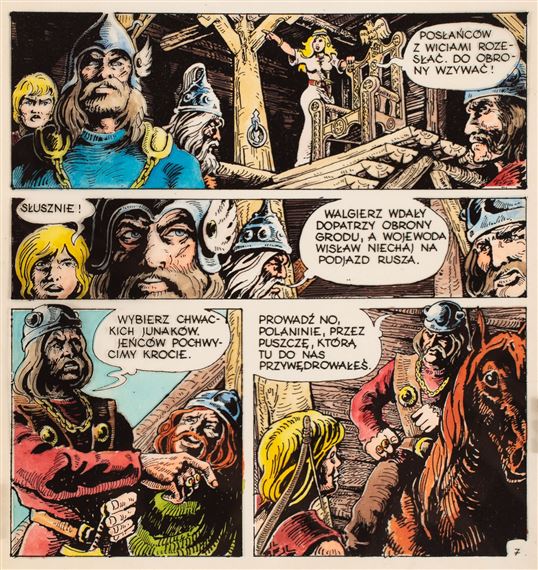
Doman: Grzechy Ardana (Doman: Sins of Ardan) is something of a Golden Axe clone based on a Polish sword-and-sorcery comic drawn by Andrzej Nowakowski.
The player controls one of two characters, Doman himself or his sidekick Baurus, that I assume are the heroes of the comic (it's hard to find information about Doman in English...) and you simply walk down a path slaying everyone dumb enough to get in your way.
The moves are heavily inspired, if not outright swiped from the classic Barbarian, and the controls are similar in how you hold the fire button and then push a direction to perform a specific move. Holding the button and pulling away from an enemy will execute the famous twirling decapitation attack from Barbarian, for instance, and it will decapitate the enemy if their health bar is low enough.
The game was created by World Software, which caused a brief mid-90s stir in Eastern Europe through games that were crudely made but hilariously over the top in their gore and general subject matter. The year before releasing Doman, they made a beat-'em-up called Franko: The Crazy Revenge!, which involved a couple of heroes cleaning up the streets by splattering the blood of street punks all over the place. Not a particularly well-made game, but memorable and funny in a time when simply being edgy and gross was enough to ensure a certain amount of attention. Doman is a bit more advanced than Franko, but only just so. The graphics are little more refined and the controls are a bit easier to use, although it's still very difficult and, like Franko, the levels do go on for a bit. There are some between-level cutscenes and you get the occasional image of Doman reclining on a throne just like Conan did in the movie. The game could have used something like at least one layer of parallax scrolling, but you get the sense that these guys were just having fun cranking out games they wanted to see and were lucky enough to get paid for doing so.
SKALD: Against the Black Priory (2024)
SKALD: Against the Black Priory is a Kickstarted RPG by Anders Laurindsen that hearkens back to classic PC RPGs, particularly those for t...
-
No sorcery in this one, just sword, but a lot of classic S&S does have a strong historical element. And even as history-minded as this g...
-
Lionheart for the Amiga might be described as being like Thundercats except not lame. The story of the game is that Valdyn, a half-man/half-...
-
Art by Brom Heretic is the fourth game released by Raven Software, a studio founded by Brian and Steve Raffel. With their debut game, an A...