Saturday, June 24, 2023

COVER ART: Shard of Spring (1986)


 Art by Joe Chiodo. Despite the rise of epic fantasy through the 80s, the classic Frazetta-esque swordsman still lingered and was often even in the forefront.


Friday, June 16, 2023

Venture (1981)


Venture can probably lay claim to being the very first instance of dungeon-crawling in an arcade game. At a distance, it might appear to be a fantasy-themed variation of Berzerk, with its overhead view of combat and happy-faced character, but it's slightly different.

The player takes control of the crossbow-armed Winky, the aforementioned happy-face character, sort of a heroic version of Berzerk's Evil Otto. You start out in a dungeon, the halls of which are patrolled by fearsome and invincible monsters. Avoiding the monsters, you duck into individual rooms, at which point the game zooms into a more detailed view of the room. Each room includes a certain type of monster - such as our old friends the skeletons, snakes, spiders, etc. - and a treasure to be claimed. Unlike the monsters in the halls, Winky can use his crossbow to vanquish the denizens of the treasure rooms, but he has to be quick because if he takes too long the monsters from outside will invade the room and chase after Winky. If you can claim the treasure and escape the room, the game will fill its outline in the broader view, marking it as complete, and the process repeats until the entire floor has been cleared, all the treasures collected, and then Winky descends to the next, more difficult, level of the dungeon. Not unlike Gauntlet - you're killing monsters, taking their stuff, and exploring deeper and deeper - but without the multiplayer aspect.

The game was designed by Exidy co-founder Howell Ivy, not a household name today but his list of credits is nothing to sneeze at. Among his other games were Death Race, an unofficial Death Race 2000 adaptation that was the first game to ignite a moral panic, Circus, Mouse Trap, and Pepper II. The graphics in Venture are a bit Space Invaders-like in how they balance abstraction, menace, and an odd cuteness, and the game has well-rendered, high-tempo music that wasn't yet a common feature in 1981 games. Winky might be a far cry from Conan and his various clones and offshoots, but he was probably about as good as 1981 gaming could manage.

The game is exceptionally difficult because of the combination of its controls and enemy AI. Instead of being a smoothly maneuvering, agile character, the controls for Winky are unusually sticky in that pushing the joystick in a direction will cause him to first aim his crossbow and then move a moment later, but the enemies aren't bound similarly. They flit about rapidly like water bugs and will deliberately evade shots from the crossbow, and in the event they can be pinned down for a killing shot, their corpses will remain deadly until they decompose and vanish after a couple of valuable seconds. Not only do you have to kill them, you have to make sure they don't die in a spot where they'll block your path and slow you down. Despite its level of challenge, the game is addictive because of its pacing and the dopamine hit that washes over you after you've cleared a room and maybe even an entire floor, and the discovery of new types of treasure.


Wednesday, June 7, 2023

Diablo (1996)


Diablo is something of a video game precursor to the grimdark movement that has been prevalent in modern fantasy. It begins with the player (players if you're playing online with friends, a big deal on its release) choosing a class - warrior, rogue (archer/thief), or sorcerer - and then entering the town of Tristram. You chat up the few inhabitants and are directed to the nearby church to investigate a case of the archbishop leading many of the townspeople to their deaths in the catacombs beneath the church. Soon you're fighting through hordes of creatures, going back to town to rest up and sell valuables, being given more things to investigate, and are gradually lead deeper and deeper under the earth until you're effectively in Hell. It turns out the source of the town's troubles is that a major demon, Diablo, has been confined deep under the surface but is now stirring and drawing evil to it. Success in conquering the Diablo only results in a downbeat ending. Some popular saying about gazing into an abyss might be relevant.

Reading the game's manual reveals an extensive backstory that describes a Manichean and Moorcockian conflict between angels and devils who represent Law and Chaos, with man somehow being the key to swaying the war one way or the other, and then a history of the town and how it got to its present state. It would probably be better to avoid reading the manual's story, though, as the game's atmosphere is much thicker if the player simply explores and discovers things along the way. Despite being a sword-swinging dungeon crawler, the game feels akin to supernatural horror films like Lucio Fulci's Gates of Hell trilogy, where things follow a sort of nightmare logic and there is no happy ending but just an impulse to push ever deeper in a hope to survive or at least find some answer along the way.

As a game, Diablo was intended by David Brevik to take the old concept of Rogue and its imitators, the randomized dungeon delving, and to simply make it digestible to mainstream audiences. Slick graphics  and audio instead of ASCII characters and PC speaker bloops, and easy, streamlined controls based around the mouse instead of numerous keyboard commands. See something you want to attack or someplace you want to go? Just click on it. (There will be so much clicking that you will take a few years off your mouse's life by playing Diablo.) The emphasis is on being able to jump right in and start beating up skeletons instead of wringing hands over rolling up the best character and fussing over their appearance. It was very successful and represented another major step in Blizzard's march to the top of the game industry. To some it also heralded a decline in classic computer role-playing games, another example of video games becoming simpler, dumber, and more action-oriented while claiming to be more highly evolved because of improved graphics and sounds. One way or the other, after Diablo it was common for "action role-playing games" to mimic Diablo's interface, with a red health orb on the left, a blue magic/mana orb on the right, and a hot bar running along the bottom between them.

Diablo does have a certain strategic element, despite its simplified gameplay, which is its emphasis on optimizing a character through picking which stats to upgrade with leveling up while also outfitting the character with the most effective combination of equipment. Another way in which Diablo was highly influential was its stressing of looting the environment even beyond what most traditional RPGs encouraged. Playing Diablo in some respects feels like shopping in how you slaughter a group of enemies and then quickly riffle through whatever they drop to determine what would be good to sell back in town and what would be good to swap for whatever you're currently wearing. By the end of the game you'll be discarding some absurdly effective items because you've already got epic armor and weapons and can't be bothered to even pick the stuff up to sell.

Diablo had one highly regarded sequel, another sequel that was highly controversial, and another sequel that just released that is also highly controversial. The general trend has been toward less grittiness, more epic storytelling, and the kind of broader, more exaggerated art associated with Blizzard's later, post World of Warcraft games, but the original game still has a foreboding and more personal mood and style.


Friday, June 2, 2023

COVER ART: Nightstone (2001)


This cover to a Spanish-made Diablo clone looks familiar...

The English version for a comparison:


Surely many who have viewed Frazetta's paintings thought they could be improved by pasting a couple of CGI women along the edges.


Tuesday, May 23, 2023

Deathflood: Dungeon of Doom (2022)


Deathflood: Dungeon of Doom is a brand new C64 game (freely available from Windigo Productions here) that concerns a lone thief, either the male barbarian or an amazon, who investigates the allegedly abandoned stronghold of a powerful necromancer with the intent on looting its treasures. Locating the stronghold reveals that it's not entirely abandoned because the necromancer's experiments are still shambling about the crumbling halls, and the bulk of it is actually beneath the mountains in which it's situated. Penetrating to the bottom, the thief finds the remains of the necromancer but when attempting to seize the corpse's priceless jeweled crown, the foolish thief sets off a trap: the entire complex is now rapidly filling with water.

The game itself begins with what would be the breakneck finale of most stories, as the player has to escape the dungeon while evading the necromancer's undead minions, grabbing as much treasure as possible, and staying just ahead of the ascending waterline. This is much easier said than done because some of the rooms can get complicated as the player has to climb up and down ladders, searching for keys to unlock doors to reach the room's exit, and the player character doesn't move particularly fast in any direction, leaving very little room for error or wrong turns before the water catches up. Falling beneath the surface isn't an instant death because the player has a limited amount of air to keep them from drowning, but of course you're now slogging through water, and the water rises relentlessly, so you need to go farther up every second to regain your breath. 

Graphically, it resembles the classic Bruce Lee a little bit, with relatively small characters and giving a good overview of the surroundings. The sound is pretty basic, with expected swishes for the sword strikes and the little dings that signify a treasure has been grabbed, but the music provides some frantic melodies. Falling under the water's surface causes all the audio to become muffled in a nice touch.

The controls take a little bit of getting used to in that the character needs a good few paces to pick up speed for long jumps and dismounting from ladders or going up stairs can be weirdly cumbersome. So while it maybe looks like Bruce Lee, it's not as fast or nimble as that game. But that's how the game is made and it doesn't take long to get acclimated. There are multiple endings to the game depending on factors such as how much treasure you snatched on the way out. Pick up enough and you might be able to buy your own kingdom. It's well worth playing and replaying to better your performance.


Tuesday, May 16, 2023

Elderborn (2020)


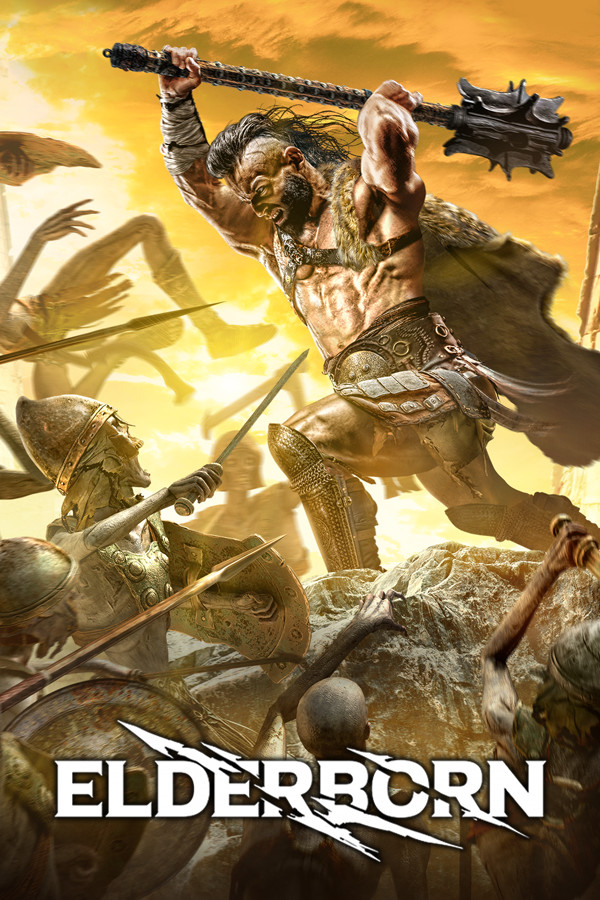
Elderborn is described by its Polish creators, Hyperstrange (Jupiter Hell, Crossbow: Bloodnight, Blood West), as "a Metal AF* Slasher with brutal FPP melee combat and souls-like/RPG character progression. In the times of legend, barbarian tribes need a new dark messiah. Be that merciless slayer. Uncover ancient secrets in the city of doom. Forge your own destiny! *Action Fantasy." The terms "souls-like" and "dark messiah" are particularly notable because the game takes heavily after Dark Messiah of Might and Magic and Dark Souls.

As with Dark Messiah, the game is a first-person melee combat game in which you break through enemy shields by kicking them, although Elderborn lacks Dark Messiah's complicated physics and magic systems. You can at least kick weaker enemies off high ledges to kill them. And like Dark Souls, enemies leave behind experience that can be picked up and cashed in for skill increases at special  respawning locations (mostly fountains instead of bonfires). If you're killed, you'll have to trudge back to where you were snuffed to gather up all the experience your previous life had accumulated, but you lose it entirely if you're killed again.

The premise of the game is suitably Howardian. As a member of a barbaric tribe, you're tasked with making a pilgrimage to the golden city of Jurmum, which has fallen into decadence under the "guidance" of its corrupt priesthood and the exploitation of strange technology that powers the city, and by pilgrimage it means you're supposed to kill everything you see there, but few have ever returned from the city. You're given a choice between a male or female warrior (no real difference between them) and in the game's opening you have to slay the other option in an arena before setting out on your quest. You begin in the catacombs beneath the city, then move into the city itself. Along the way you'll battle various types of undead warriors, homicidal lepers, giant scorpions, and Lovecraftian fishmen. Note that many of these enemies aren't friendly with each other and it's often easy to get them to fight each other. There's some unintentional comedy in sometimes walking close enough to trigger an enemy into moving only to see him turn around, run the opposite direction, and start attacking another group of enemies.

Getting good at the combat mostly involves unceasing movement (often utilizing the game's quick-dash ability) and mastering the game's parrying system. A successfully timed parry will stun the enemy and leave them vulnerable to an extra-high damage counterattack. You can also fully heal yourself with a special injection up to three times before needing to kill more enemies to refill the injections. Unlike Dark Souls, there is no stamina meter that forces you to be conservative in dodging, blocking, or attacking, so the game is quite a bit faster than current-day "souls-like" games. Instead, you'll be contending with potentially large mobs of enemies at particular points in the game, racing from one opponent to the next, whittling down their numbers as you go. There are also some minor puzzle-solving aspects, mostly to do with operating some of the peculiar machines in the city.

For a "Metal AF" game, the soundtrack is adequate. It's suitably hard-driving and enhances the mood in parts but it's also not especially memorable, especially with several games today being accompanied by heavy soundtracks, such as Mick Gordon's work on the new Doom games. The graphics are quite good, but there's a certain lack of color to them. The catacombs are heavy on the blue while the city is a lot of brown (see the game's title card/poster above). It's tough to equal masters like Frazetta in nailing a sense of foreboding and violence while still being very colorful.

The weapon selection is varied enough to cover just about any playstyle (I settled on the spears), and there aren't too many games that allow you to unlock the ability to rip a corpse's head off and use it as a projectile.

The most unfortunate thing about the game is simply how short it is. There are essentially two levels, albeit long ones, and then a relatively brief epilogue. The game seems to end right as it's getting going, leaving a sense that you just completed the opening episode of a shareware game only to realize there's no more of it left. Hopefully a more substantial sequel will come some soon.


SKALD: Against the Black Priory (2024)

  SKALD: Against the Black Priory is a Kickstarted RPG by Anders Laurindsen that hearkens back to classic PC RPGs, particularly those for t...