Tuesday, May 23, 2023

Deathflood: Dungeon of Doom (2022)


Deathflood: Dungeon of Doom is a brand new C64 game (freely available from Windigo Productions here) that concerns a lone thief, either the male barbarian or an amazon, who investigates the allegedly abandoned stronghold of a powerful necromancer with the intent on looting its treasures. Locating the stronghold reveals that it's not entirely abandoned because the necromancer's experiments are still shambling about the crumbling halls, and the bulk of it is actually beneath the mountains in which it's situated. Penetrating to the bottom, the thief finds the remains of the necromancer but when attempting to seize the corpse's priceless jeweled crown, the foolish thief sets off a trap: the entire complex is now rapidly filling with water.

The game itself begins with what would be the breakneck finale of most stories, as the player has to escape the dungeon while evading the necromancer's undead minions, grabbing as much treasure as possible, and staying just ahead of the ascending waterline. This is much easier said than done because some of the rooms can get complicated as the player has to climb up and down ladders, searching for keys to unlock doors to reach the room's exit, and the player character doesn't move particularly fast in any direction, leaving very little room for error or wrong turns before the water catches up. Falling beneath the surface isn't an instant death because the player has a limited amount of air to keep them from drowning, but of course you're now slogging through water, and the water rises relentlessly, so you need to go farther up every second to regain your breath. 

Graphically, it resembles the classic Bruce Lee a little bit, with relatively small characters and giving a good overview of the surroundings. The sound is pretty basic, with expected swishes for the sword strikes and the little dings that signify a treasure has been grabbed, but the music provides some frantic melodies. Falling under the water's surface causes all the audio to become muffled in a nice touch.

The controls take a little bit of getting used to in that the character needs a good few paces to pick up speed for long jumps and dismounting from ladders or going up stairs can be weirdly cumbersome. So while it maybe looks like Bruce Lee, it's not as fast or nimble as that game. But that's how the game is made and it doesn't take long to get acclimated. There are multiple endings to the game depending on factors such as how much treasure you snatched on the way out. Pick up enough and you might be able to buy your own kingdom. It's well worth playing and replaying to better your performance.


Tuesday, May 16, 2023

Elderborn (2020)


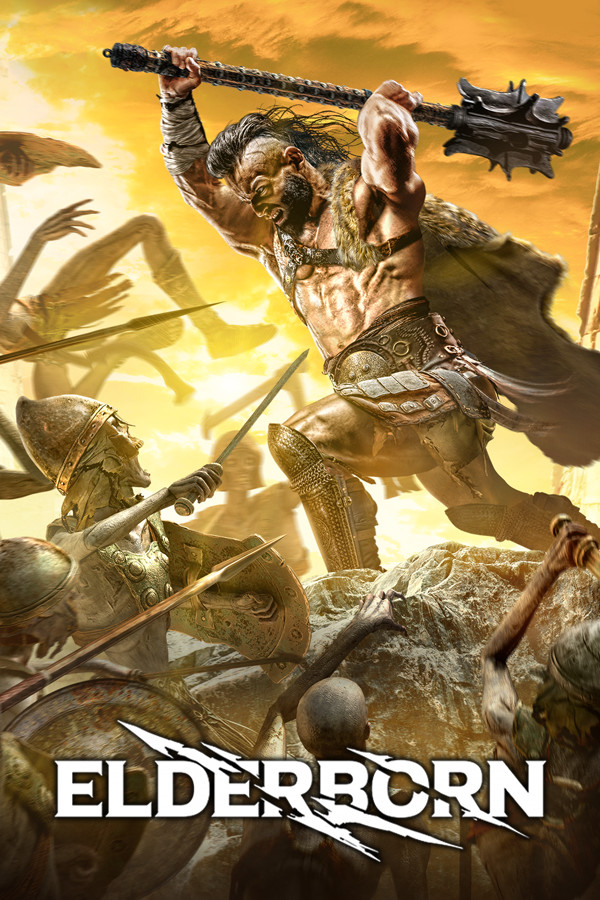
Elderborn is described by its Polish creators, Hyperstrange (Jupiter Hell, Crossbow: Bloodnight, Blood West), as "a Metal AF* Slasher with brutal FPP melee combat and souls-like/RPG character progression. In the times of legend, barbarian tribes need a new dark messiah. Be that merciless slayer. Uncover ancient secrets in the city of doom. Forge your own destiny! *Action Fantasy." The terms "souls-like" and "dark messiah" are particularly notable because the game takes heavily after Dark Messiah of Might and Magic and Dark Souls.

As with Dark Messiah, the game is a first-person melee combat game in which you break through enemy shields by kicking them, although Elderborn lacks Dark Messiah's complicated physics and magic systems. You can at least kick weaker enemies off high ledges to kill them. And like Dark Souls, enemies leave behind experience that can be picked up and cashed in for skill increases at special  respawning locations (mostly fountains instead of bonfires). If you're killed, you'll have to trudge back to where you were snuffed to gather up all the experience your previous life had accumulated, but you lose it entirely if you're killed again.

The premise of the game is suitably Howardian. As a member of a barbaric tribe, you're tasked with making a pilgrimage to the golden city of Jurmum, which has fallen into decadence under the "guidance" of its corrupt priesthood and the exploitation of strange technology that powers the city, and by pilgrimage it means you're supposed to kill everything you see there, but few have ever returned from the city. You're given a choice between a male or female warrior (no real difference between them) and in the game's opening you have to slay the other option in an arena before setting out on your quest. You begin in the catacombs beneath the city, then move into the city itself. Along the way you'll battle various types of undead warriors, homicidal lepers, giant scorpions, and Lovecraftian fishmen. Note that many of these enemies aren't friendly with each other and it's often easy to get them to fight each other. There's some unintentional comedy in sometimes walking close enough to trigger an enemy into moving only to see him turn around, run the opposite direction, and start attacking another group of enemies.

Getting good at the combat mostly involves unceasing movement (often utilizing the game's quick-dash ability) and mastering the game's parrying system. A successfully timed parry will stun the enemy and leave them vulnerable to an extra-high damage counterattack. You can also fully heal yourself with a special injection up to three times before needing to kill more enemies to refill the injections. Unlike Dark Souls, there is no stamina meter that forces you to be conservative in dodging, blocking, or attacking, so the game is quite a bit faster than current-day "souls-like" games. Instead, you'll be contending with potentially large mobs of enemies at particular points in the game, racing from one opponent to the next, whittling down their numbers as you go. There are also some minor puzzle-solving aspects, mostly to do with operating some of the peculiar machines in the city.

For a "Metal AF" game, the soundtrack is adequate. It's suitably hard-driving and enhances the mood in parts but it's also not especially memorable, especially with several games today being accompanied by heavy soundtracks, such as Mick Gordon's work on the new Doom games. The graphics are quite good, but there's a certain lack of color to them. The catacombs are heavy on the blue while the city is a lot of brown (see the game's title card/poster above). It's tough to equal masters like Frazetta in nailing a sense of foreboding and violence while still being very colorful.

The weapon selection is varied enough to cover just about any playstyle (I settled on the spears), and there aren't too many games that allow you to unlock the ability to rip a corpse's head off and use it as a projectile.

The most unfortunate thing about the game is simply how short it is. There are essentially two levels, albeit long ones, and then a relatively brief epilogue. The game seems to end right as it's getting going, leaving a sense that you just completed the opening episode of a shareware game only to realize there's no more of it left. Hopefully a more substantial sequel will come some soon.


Thursday, April 27, 2023

Magic Sword (1990)


A little while after doing Black Tiger, Capcom took another crack at "Heroic Fantasy" with Magic Sword. Up to two players can take control of a hero who must ascend 51 floors of the Dragon's Tower, defeat the wizard, Drokmar, and destroy the Black Orb that gives him his power. Wizards and their towers...

Unlike Black Tiger's leaping and climbing gameplay, Magic Sword places more emphasis on plain hacking and slashing through mobs of enemies, although some areas do require the player to leap across deadly pits. Magic Sword's primary gimmick is that the player can collect keys that unlock prison cells throughout the tower, freeing their inhabitants (who call out to you with poorly translated lines like "Get rid of me!") so they can fight alongside you. The other party members - Amazon, Big Man, Ninja, Thief, Wizard, Priest, Knight - have particular strengths and weaknesses. Collecting a magic ring will allow you to recruit a Lizardman, arguably the best companion, to your side. The player can also collect various power-up items that have effects such as raising attack or defense or revealing locations of hidden chests. Altogether, the game has a lot of options to test out so the player can settle on what they like best.

At first the number of floors to go through will seem daunting, but as it turns out most of the floors can be cleared very quickly, especially if you just want to move along instead of trying to clear out every single chest on every floor. Every few levels a boss enemy will be revealed, usually a variation of a dragon or chimera. The pacing and user-friendly controls and gameplay help offset the game's running time, making it easy to jump in and start cutting through the enemies, who respawn quickly, freeing prisoners, breaking open treasure chests, and charging for the doors to the next floor.

The graphics are of Capcom's usual high quality, colorful and with well-defined characters. The main hero, shirtless with his long braided blonde hair, is reminiscent of John Jakes's Brak the Barbarian. Manami Matsumae contributes a dramatic musical score. A relatively uncommon feature for arcade games but something that had been appearing in some PC and console games at the time was giving the player a choice between a good or bad ending after defeating the wizard. You could either destroy the Black Orb as directed, or allow yourself to be corrupted by taking it for yourself.


Tuesday, April 18, 2023

Masters of the Universe: The Power of He-Man (1983)


Mattel debuted their Masters of the Universe toyline in 1981 and it might be the closest thing to a sword-and-sorcery or sword-and-planet toy franchise to date. As it's known now, thanks mostly to the 1983 Filmation cartoon, the main hero, He-Man, has a secret identity as mild-mannered Prince Adam, son of the king and queen of Eternia. Adam transforms into the super-powerful He-Man by raising his magical sword and yelling "By the power of Grayskull!" 

When the toys first debuted, things were a little different. The mythology of the characters was mostly conveyed through mini-comics included with each action figure, with Don Glut writing and Alfredo Alcala drawing. According to these comics, He-Man was the strongest member of a primitive spear-wielding tribe and after setting out on a mission to share his talents with the world in battling evil he came across a goddess being attacked by a huge, shaggy creature. His reward for helping the goddess was to be given various weapons and magical harnesses that endowed him with superhuman strength or the ability to project force fields. Shortly afterward, He-Man would battle Skeletor and develop friendships with characters like Man at Arms and the "warrior-goddess" Teela. Later comics by Gary Cohn and Mark Texeira modified things slightly, such as splitting Teela into two separate characters, a Sorceress and a warrior woman, and having He-Man hang around a castle in the court of the king and queen who would evolve into his parents on the cartoon.

It's often been reported that the toyline had some degree of influence from Conan and Frazetta's book covers. Aside from He-Man himself, Skeletor's skull-faced visage is similar to Robert E. Howard villains like Thulsa Doom, and there's a certain Stygian vibe to Teela/the Sorceress and her snake-themed garb and cobra-headed staff. This era of He-Man would seem to be the main basis for the first He-Man videogame on Mattel's own Intellivision, although the game is understandably simple and doesn't incorporate much lore one way or another.

There are two stages. In the first He-Man must pilot the Wind Raider airship 30 miles to Castle Grayskull, dodging or shooting meteorites and bombing Skeletor on the ground before running out of fuel. The second stage features He-Man charging Skeletor across fields while Skeletor tries to hurl him backward with balls of lightning. He-Man has only a limited time to make it across three screens of this, including the inside of Castle Grayskull, but he can extend time by grabbing power swords that occasionally float across the screen, and he can use the force fields his harness allows to block Skeletor's spells. At the end of each screen, He-Man and Skeletor will engage in a swordfight that  of course He-Man wins, and after defeating Skeletor in the castle the game begins again with the difficulty ratched up.

The graphics are reasonably good for the time, with a particularly nice view of Castle Grayskull, although the characters are tiny and wouldn't be recognizable as the characters from the toys to one not already familiar. It also has a decent rendition of theme music from the cartoon that was soon to debut at the time.

It doesn't really capture much of the concept of He-Man/MOTU aside from the general He-Man vs. Skeletor aspect and the fact that the characters engage in swordfights the player can't control is disappointing. Perhaps the programmers ran out of memory for an extra stage, but then again, the creators of the Atari 2600's Superman game did a pretty remarkable job of including all of the essential parts of Superman's lore in an even smaller, more primitive game (Clark Kent working at the Daily Planet/Lex Luthor rampaging around/changing into costume in a phone booth/kissing Lois Lane/avoiding kryptonite/saving the day and dropping the crooks in jail/changing back to Kent and finishing the day at the Planet). It could have been worse but it also could have been better.


Saturday, April 8, 2023

PORTS: Golden Axe - Genesis/Mega Drive (1989)


 Sega didn't waste much time porting Golden Axe to its new Mega Drive/Genesis console, getting it out just in time for Christmas the same year it debuted in the arcades.

They did a pretty good job on it. It's a slight downgrade in audio and video, lacking the great First Blood voice samples and the parallax scrolling of the arcade, but for audiences accustomed to NES games, it would have looked spectacular having something so close to the arcade version at home. More importantly, it plays just about right, too. Techniques that work well in the arcade version still work well in the home version as it moves at a very similar speed and the collision detection seems pretty close as well.

The best home ports usually do something extra with the game and in this case Sega added an extra, final level to the game. It plays out just like the arcade version, with the heroes travelling to Death Adder's castle on the backs of the giant turtle and eagle, but after facing the villain in the throne room and saving the king and princess, instead of the farcical, Blazing Saddles-like ending of the cast breaking out of the arcade, the king informs you that you only faced an underling and the master is somewhere behind the door from which Death Adder appeared. So you head through the door and tackle the final stage.

The last stage is slightly disappointing in its look. Instead of something wild and creative, like maybe dragging the heroes into another dimension or something, it's just a dungeon with some tougher enemies within, many of whom can be cheaply defeated by knocking them into bottomless pits. Before long, you face the true villain, Death Bringer, who's just like Death Adder except getting hit by him is extremely costly because in addition to taking damage from his giant axe, a hit also triggers a magical explosion similar to what the players can do with their fully charged magic attacks. It's a good challenge. Overcoming him leads to the heroes emerging back into the throne room and receiving some thanks from the king and a congratulatory message from the game before some credits roll.


Wednesday, April 5, 2023

Storm (1987)


Mastertronic's Storm is essentially a Gauntlet clone. Storm is an axe-wielding warrior whose wife, Corrine, has been kidnapped by the wizard Una Cum, presumably for some nefarious experiment. Storm and his own wizard buddy, Agravain Undead (?) invade Una Cum's castle to battle through the creatures and traps to rescue Corrine before Una Cum returns from his excursion to seek a magical box known as "The Fear."

So two players can simultaneously play as Storm or Agravain. Much like Gauntlet, the action takes place from an overhead perspective and each room of the castle features a number of generators that spawn monsters that attack the heroes. Food, armor, and keys can be found, in addition to magical items that can be used to annihilate every enemy surrounding you at critical times. To actually win the game, the player must find three snake brooches that will unlock the door to Una Cum's laboratory. Walking over runes on the floor will trigger changes in the rooms, such as traps or creating openings to deeper parts of the castle. It's a game that encourages mapping things out to figure the best path through the castle.

The game lacks the voice sampling in Gauntlet, so it compensates by having a scroll of text running at the top of the screen, which in some cases replicates the voices in Gauntlet ("Save keys to open doors"), but mostly provides atmospheric descriptions of each room ("A beautifully ornamented atrium lies in slight disrepair..."), which is helpful because the graphics are ugly and don't convey much. Most of the game seems drenched in various shades of brown and orange.

The game would basically be fine if it played like Gauntlet, but for some strange reason the programmers chose to use tank controls for the movement, so you have to push forward on the joystick to go forward, while pushing left or right will turn the character. It makes it needlessly confusing just to navigate the rooms. Perhaps this was a tactic to increase the difficulty.

It must be said that the game has some very nice introductory music by David Whittaker, especially the Atari version. The C64's SID chip is renowned as possibly the greatest sound chip ever made, but skilled composers like Whittaker could get some very nice results from the Atari computer's POKEY chip as well.


SKALD: Against the Black Priory (2024)

  SKALD: Against the Black Priory is a Kickstarted RPG by Anders Laurindsen that hearkens back to classic PC RPGs, particularly those for t...